



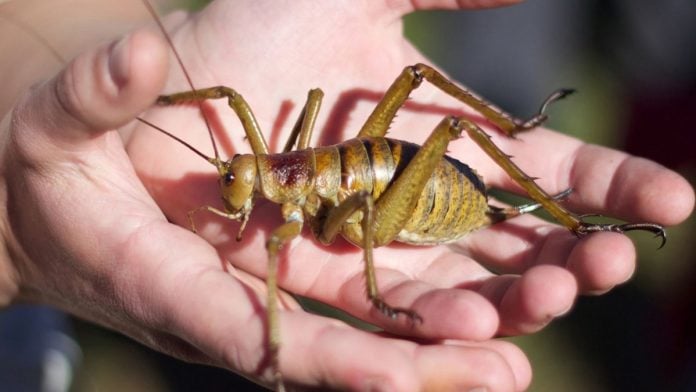
New Delhi: A large-scale breeding programme has spurred the recovery of a large insect native to New Zealand. The wētāpunga, said to be the world’s heaviest insect, has now been categorised as “nationally recovering”, after being declared “nationally endangered” in 2004.
“The future of wētāpunga is looking bright,” said Dr Chris Green, lead author of a study published in the New Zealand Journal of Zoology, which details the project.
As part of the programme, about 11,000 wētāpungas were released into the wild.
The insect is the largest and heaviest species of giant weta in New Zealand. A female wētāpunga can weigh up to 70 gram — typically the weight of a mouse. Their bodies can grow up to 10 cm long, and can easily cover a human’s entire hand.
The species, once widespread in New Zealand’s Northland and Auckland regions, registered a steady decline in the mid 20th century. In the 1990s, only one remnant population remained in the country’s Little Barrier Island. Habitat loss, along with predatory threats from introduced species, contributed to their decline.
Surveys carried out between 2005 and 2009 revealed the species to be in a bad shape; it was decided that there were too few of them left to directly start another wild colony.
Also read: Ancient Egyptian skulls show signs of human sacrifice, new US study says
Intensive breeding
Around 15 years ago, conservationists decided to collect a small number of the insects from Little Barrier Island, to carry out an intensive breeding programme. Tens of thousands of the species were bred at New Zealand’s Butterfly Creek, a wildlife facility, and at Auckland Zoo.
The two sites established husbandry techniques that were scaled up over time to rear a large number of the insects in communal creches. All wētāpungas were maintained on a three-part diet of fresh green foliage, dry fish flake protein, and leaf litter. The protein is “critical” to the survival of the youngest nymphs, Green told The Guardian.
The insects were then transferred to their new habitats, which were predator-free islands and some mainland reserves north of Auckland. These efforts have resulted in 45 different translocations, which Green called “a very high number in any recovery of a species”.
“This species was endangered at the start of the programme, it is now not endangered – it is recovering. So that is a significant benefit to the species and New Zealand’s biodiversity,” Green added. “We need to do that with a lot more species.”
Green hopes that a documentation of this work will inspire other institutions to develop their own conservation programmes for the threatened species of New Zealand.
(Edited by Aamaan Alam Khan)