


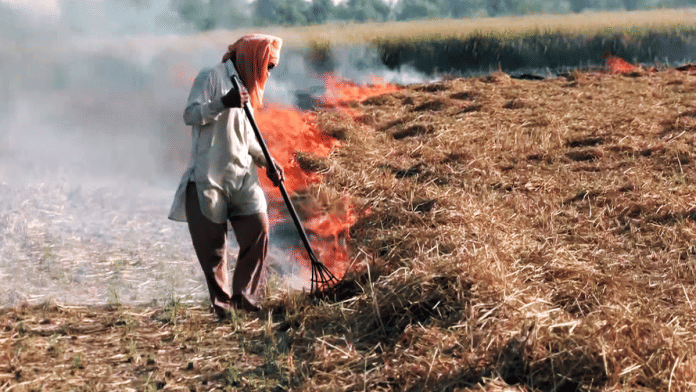
New Delhi: Between 15 September and 1 November, Punjab and Haryana reported declines of about 38 per cent and 64 per cent, respectively, in the number of stubble fires compared with the same period last year, data released by the Union Ministry of Environment, Forests and Climate Change (MoEFCC) showed.
The data showed that between 15 September — when paddy harvesting started in the agrarian states of Punjab and Haryana — to 1 November, 1,514 stubble fires were reported from Punjab, as against the 2,084 fires reported in the same period last year. Haryana, on the other hand, reported 42 fires as against 118 reported last year.
Union Minister for Environment, Forest and Climate Change (MoEFCC) Bhupender Yadav said that a slew of pollution control measures have already been put into place to ensure that the air quality in Delhi-NCR does not slip into toxic levels this season.
“Stubble burning is a significant contributor to seasonal air pollution in Delhi-NCR,” said Yadav, adding that this paddy harvesting season, Punjab is estimated to generate 18.80 million tonnes, Haryana 7.97 million tonnes, and UP-NCR 0.85 million tonnes of paddy straw.
Also read: India will be part of the solution and never the problem, says Bhupender Yadav ahead of COP31
Pollution control measures
After a relatively cleaner October, Delhi’s air quality slipped into the ‘very poor’ quality category for two consecutive days, Monday and Tuesday. On Tuesday, the air quality index (AQI) climbed to 350, higher than Monday’s 324.
Yadav said that states have been asked to ramp up pollution control measures.
The Commission for Air Quality Management (CAQM) has issued a framework for road redevelopment and technical norms for mechanical road sweeping machines.
A Memorandum of Agreement (MoA) was signed in June 2026 between the states, CSIR-Central Road Research Institute and the School of Planning and Architecture (SPA) for implementation of a road asset management system — an integrated set of digital tools, databases, and engineering methods used to collect, store, and analyse data on road infrastructure, such as pavements, bridges, and traffic signals.
“States have been directed to complete pending road works on priority, develop roads as per the CAQM framework, repair potholes, footpaths and central verges, and undertake AI-based videographic surveys of roads,” the minister said.
Yadav added that measures were also being put in place for managing other sources of pollution.
(Edited by Aamaan Alam Khan)