





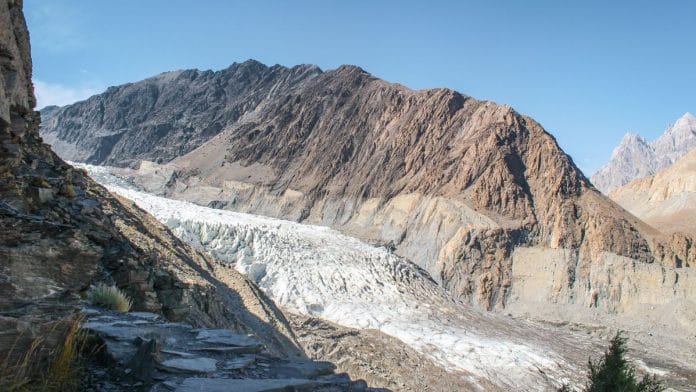

New Delhi: As climate change and global warming melt ice caps across the world, some communities are reviving an old practice where they “marry” two glaciers to birth a new one.
In northern Pakistan’s Gilgit Baltistan region, villagers carry chunks of glaciers in the middle of the night and take them to high-altitude locations, sometimes nearly 4,000m above, in a process known as “glacier grafting”, locally called Gang Khswa.
Porters carry out the grafting in October when temperatures are below zero degrees Celsius but the heavy snow has yet to begin. The ice is then placed into a cave or a pit and covered with sawdust, charcoal, and wheat husk. It can take nearly 10 years for such an ice mass to start producing water.
“It is a marathon activity. The entire process can take up to 48 hours. From the collection of the ice pieces from the source to the destination, the ice has to be kept continuously moving,” Zakir Hussain Zakir, director of planning and development at the University of Baltistan, told Euronews.
Also read: Dwarka was Delhi’s middle class dream. Now it’s fighting traffic, garbage, water woes daily
Marrying Mo-gang and Po-gang
Gilgit-Baltistan contains the Earth’s third-largest ice reserves after the Polar regions. The landscape has over 5,000 glaciers from a few meters to nearly 70-km long.
Among the local community, the Balti word “Mo-gang” describes a female glacier, while the word “Po-gang” describes a male glacier. The female glacier is known to be cleaner, lighter ice while the male glacier is debris-covered. The community says that the female glacier has to be “impregnated” in the making of a new glacier.
A sustainability study in 2021 surveyed 160 households in Gilgit-Baltistan and found that the community associated glacier grafting with increased water, irrigation, fertile land, and even better agricultural yields.
The main reason behind creating such glaciers is water scarcity in the high altitude regions where much of agriculture is glacier-fed. As climate change is disrupting the natural water cycle of glaciers, communities hope that creating such smaller new glaciers can give them more meltwater for irrigation.
“Specifically, the glacial-fed regions, where glacial water is the only source of agricultural activities, face severe impacts of climate change. On the one hand, frequent flash floods destroy the crops, while on the other hand, the extended droughts have severe negative impacts on food security,” read the study.
The science behind such glacier grafting says that the “new glacier” is likely to take shape only in places where snow and ice tend to accumulate. These are high-altitude areas and avalanche prone terrain.
However, according to the Baltistan Culture and Development Foundation the community grafted 10 such glaciers in several villages in 2025.