



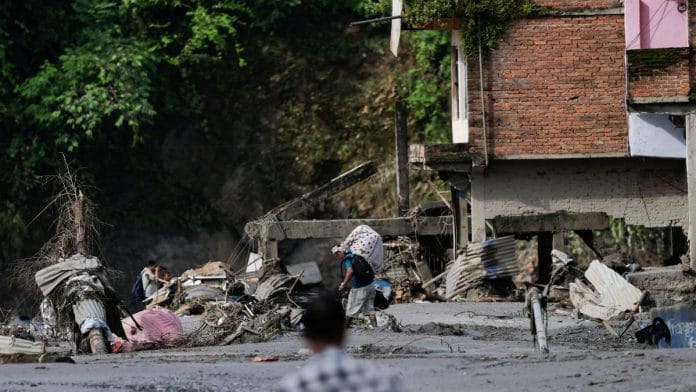
Kathmandu: The Rastriya Swatantra Party president, Rabi Lamichhane, on Thursday morning called for an all-party meeting in Kathmandu to address the devastating flash floods in Nepal that have killed more than 359 people.
In the wake of the floods that occurred in the Bhote Koshi River in Rasuwa district, ministers and opposition leaders in Nepal have taken a unified approach toward tackling the disaster and providing relief and rescue operations.
“We are focused entirely on rescue and relief,” said RSP MP and spokesperson Jagadish Kharel in Kathmandu. “More than a thousand people are missing, and the situation remains tough, but the entire state machinery is giving a 100 per cent input.”
According to the latest numbers provided by the National Disaster Risk Reduction and Management Authority (NDRRMA), more than 13,000 security and police personnel have been deployed for rescue and relief operations, in what is being called one of the deadliest natural disasters since the 2015 Nepal Earthquake.
While Nepal Prime Minister Balen Shah spent Thursday morning visiting flood-affected districts, including Bidur in Nuwakot, other ministers are also working on targeted disaster management work such as restoring communications, energy lines, and mobilising primary healthcare facilities. Kharel also said that a high-level parliamentary committee is being set up to support and monitor the operations.
Also read: Will Nepal be hit by a second flood? China flags high risk of ‘breach’ in a new barrier lake
‘A collective national effort’
Meanwhile, Pradeep Kumar Gyawali, former Nepal foreign minister and current deputy general secretary of the main opposition CPN-UML, termed the event “the deadliest flood and landslide ever experienced”, acknowledging that the magnitude of the disaster was definitely putting a strain on the government’s resources and capabilities.
“Agencies are trying their best, but there could be better coordination between the different levels of government, political institutions, and civil society,” said Gyawali. “This will help better mobilise all of Nepali society into rescue efforts.”
Gyawali did agree that the all-party meeting organised by Lamicchane did allay concerns and rallied troops.
“The meeting was fruitful, and all parties agreed on a single point: to mobilise every resource collectively,” Gyawali said. “No doubts are being raised during this difficult time. This is not just about the government’s efforts; it requires a collective national effort.”
While more than 571 foreign nationals remain missing in the floods, from India, China, Japan, South Korea, and other countries, Gyawali and Kharel said the international community’s support has been great, and they hope it would continue even during re-building.
Gyawali added that the nature of the disaster — an ice-rock avalanche high up in the Himalayan glaciers — does bring into perspective a greater need for cooperation among Himalayan countries.
“Early Warning Systems for such disasters are extremely important. Himalayan countries must urgently develop a unified mechanism to exchange data, analyse high-altitude risks, and share real-time information to mitigate disasters of this magnitude,” he said.
(Edited by Aamaan Alam Khan)