





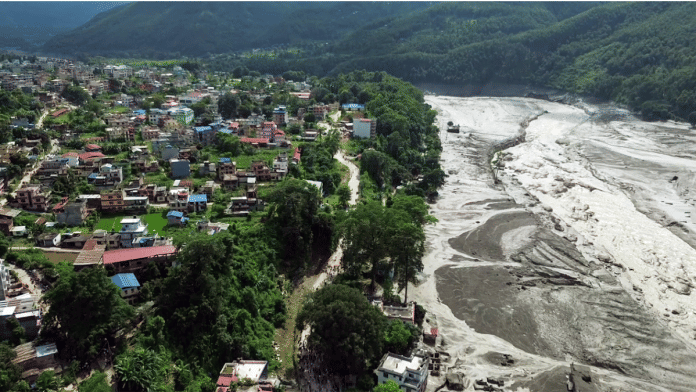

New Delhi: Chinese authorities have warned that a large artificial barrier lake has formed in Nepal. Satellite imagery suggests that this lake, situated in the same area where Nepal’s devastating floods began, is already overflowing and could spill over further in the coming days.
According to the Chinese water resources ministry, the lake’s volume was nearly 2 million cubic metres as of Thursday morning. In the next three days, analysts expect another 3 million cubic metres of water to enter the lake, creating a high risk of a breach, Global Times reported.
The artificial lake in question has formed near the Chhochen Khola and Purepu Tsangpo rivers. These two rivers originate in Tibet and merge before they enter Nepal, where they are called the Bhote Koshi. This, in turn, is one of the main upper tributaries of the Trishuli River.
“Taking this situation into account, residents of downstream areas along the Bhotekoshi river, travelers, rescue personnel deployed in rescue operations, and all relevant stakeholders are requested to exercise special vigilance and move to safe locations away from riverbanks and high-risk zones until the next notice is issued,” read a special notice by the flood forecasting division of Nepal’s Department of Hydrology and Meteorology.
Chinese emergency response
The newly formed barrier lake comes at a time when a sudden and powerful flood caused by an ice-rock avalanche has wreaked havoc in Nepal’s Rasuwa district. The torrent damaged roads, bridges, buildings, and flowed downward into the Trishuli River.
Nepali authorities and rescue teams have been searching for missing people, and bodies are being recovered in several districts.
Chinese authorities have also mobilised rescue forces including emergency responders, the People’s Liberation Army, engineering teams, telecom operators, and other relief organisations.
As of Thursday evening, the death toll of the disaster had already risen to over 300 people, with nearly 300 Indian tourists among thousands reported missing. The Nepal Tourism Board added that among the 384 reported missing were 291 foreign nationals.
(Edited by Prasanna Bachchhav)
Also read: 5 deadly Himalayan floods: A history of frozen terror