



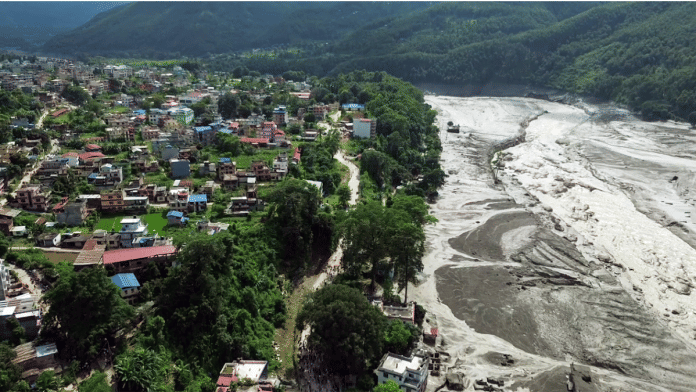
New Delhi: The flash floods devastating Nepal’s Rasuwa district were initially mistaken for being caused by an earthquake. But satellite images soon revealed that the reason was a collapse of ice and rock higher up in the Himalayan mountains.
The disaster is a reminder that floods in the Himalayas are not just monsoon-driven events. When part of an icy mountain collapses, the sediment rushes down, resembling a slurry of concrete.
Here are five other times that a combination of ice and rock spelt disaster in the Himalayas.
2023: South Lhonak Lake, Sikkim
The most recent major example was the Sikkim floods in October 2023.
As a permafrost landslide fell into the South Lhonak Lake, nearly 5,200 metres above sea level, the impact drained the water body into the nearby valleys.
“This triggered a glacial lake outburst flood (GLOF) that travelled 385 km along the Teesta River to Bangladesh. The disaster caused 55 deaths, and 74 persons were reported missing in Sikkim. This event caused extensive damage to infrastructure, making it one of the most disastrous multi-hazard events recorded in the region,” read a study on the disaster.
Also Read: Flood risk in Bihar and Uttar Pradesh after Nepal deluge
2021: Chamoli, Uttarakhand
Similarly, what is happening today in Rasuwa is not different from what Uttarakhand’s Chamoli district witnessed on 7 February 2021.
A large chunk of the mountain plunged down the valley, generating a massive ice-rock avalanche that led to destruction flowing through the Rishi Ganga, Dhaulingaga, and Alalnanda valleys. Satellite imagery and subsequent studies later estimated the size of the mass to be nearly 27 million cubic metres.
At the time, over 70 people were confirmed dead, and 134 were reported missing. The flood even destroyed infrastructure built for the Rishi Ganga project and the Tapovan-Vishnugad project.
2012: Seti River, Nepal
On 5 May 2012, a massive flash flood swept through Nepal’s Seti River valley. NASA’s investigation traced the flood’s origins to an unusual ice avalanche near the Annapurna IV region. The rock and ice fell thousands of meters into the Seti and soon turned into a sediment-rich slurry which was nearly 30 metres high in places. As a result, at least 72 people were either dead or missing.
In December, when astronauts on the International Space Station snapped photos of the region, they could still spot the vertical cliff where the avalanche began, and the debris-covered surface that appeared darker than the bright white snow around them.
1998: Tam Pokhari, Nepal
Thirteen years after the Dig Tsho disaster, a similar disaster hit eastern Nepal. On 3 September 1998, an ice avalanche hit the Tam Pokhari Lake and its waters rose over the natural dam built around it. A World Bank report said that this was among Nepal’s worst Glacial Lake Outburst Floods (GLOFs).
According to reports, nearly 18 million cubic metres of water flowed out of the dam, reaching a peak discharge rate of nearly 10,000 cubic metres per second. Some studies of the disaster estimated that the flood was nearly 25 metres deep in some parts of the river.
Also Read: Nepal’s Rasuwa floods were triggered by a glacial collapse, not an earthquake
1985: Dig Tsho, Nepal
Among Himalayan floods triggered by ice, not all transform directly into a slurry of debris.
On 4 August 1985, an approximately 150,000-cubic-metre ice avalanche crashed into the Dig Tsho, a glacial lake in the Khumbu region. The Dig Tsho was a water body held in place by a moraine, an accumulation of dirt, boulders, and rock debris.
As the avalanche landed in the moraine-dammed lake, the impact led to a wave that broke the dam. Nearly 5 million cubic meters of water poured into the Bhote Kosi and the Dudh Kosi valleys. The floods destroyed a hydropower plant, 14 bridges, and several houses and had a large death toll.
(Edited by Insha Jalil Waziri)