





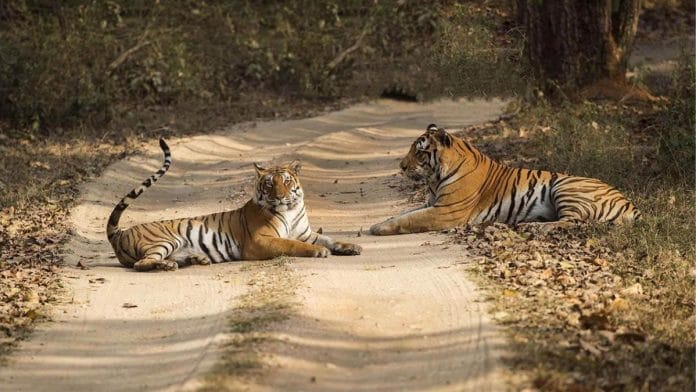


New Delhi: A female tiger cub found dead in Madhya Pradesh’s Kanha Tiger Reserve on Saturday died due to acute respiratory failure, and not starvation, confirmed MP’s forest officials to ThePrint. This was the third cub death in one week in the reserve, all from the same tigress, T-141. The other two corpses have been sent for post-mortem, while the tigress and her last remaining cub are being monitored by forest officials.
“There were lesions found in the cub’s lungs, which indicate ongoing respiratory issues,” L Krishnamoorthy, Additional Principal Chief Conservator of Forests (Wildlife), Madhya Pradesh, told ThePrint. “This is the preliminary report, and we will find more as the other cubs undergo post-mortem.”
While the female cub’s corpse was found on Saturday evening, two other male cubs had been found dead on 23 and 21 April, respectively, in Kanha Tiger Reserve (KTR). Officials confirmed on Sunday that they all belonged to the same tigress and that the cubs were between 12 and 18 months old.
According to Krishnamoorthy and other forest officials at KTR, the mother’s health is being monitored by veterinarians to assess signs of weakness or illness, and her health report is awaited. After the first two cubs died with no external injuries, some reports indicated that they could have died due to starvation.
However, the possibility of starvation as a cause of death for the cubs has been ruled out.
“Starvation is defined as a situation where a healthy animal is hungry, but there is no food available, so it starves to death. That is not the case here,” explained Krishnamoorthy. “Here, the cub was not healthy, and quite possibly the tigress was weak or ill too, which is why she could not provide for her cubs,” he added.
According to wildlife activists in the area, starvation is an unlikely cause because of the density of prey in the region.
“I have visited Kanha Tiger Reserve, and I know it has a high density of herbivores for tigers to feed on. So, starvation is not a real possibility because there’s plenty of food,” said Ajay Dubey, wildlife and RTI activist.
The slew of three cub deaths in the reserve added to the total tiger deaths in Madhya Pradesh since January, 24 in total. Ten of these deaths have occurred just in April, out of which four deaths, including the three cubs, were in the Kanha Tiger Reserve. While the state’s forest department is preparing preliminary inquiry reports about the deaths, Krishnamoorthy assured that the three cub deaths at Kanha are not related to wrongdoing or territorial fights.
“Any poison or targeted killing death happens immediately, but these cubs were being monitored, and yet they passed away, which means there was some internal health issue,” he said. “We will have to wait for the other cubs’ reports, but it could be a bacterial infection, a parasite, or a lung issue.”
Also read: Indian Forest Service has to change. Begin by calling it Indian Environment Service
MP tiger deaths controversy
Madhya Pradesh has 785 tigers based on the last census, which is the highest in any Indian state. However, since January this year, the state has been embroiled in controversy as recurring tiger deaths have put a spotlight on tiger safety and monitoring and patrolling issues.
About half of the 54 total tiger deaths in the country in 2026 have been in Madhya Pradesh, with a few confirmed cases of targeted killing using poison. In March, a radio-collared tiger in Satpura Tiger Reserve was found to have been poisoned and killed by five people in an incident of retaliation. In another incident in February, two tigers were allegedly electrocuted in Shahdol district, near the Bandhavgarh Tiger Reserve.
According to MP-based wildlife activist Ajay Dubey, the deaths reveal a concerning pattern in India’s largest tiger state. In January this year, he filed a petition in the MP High Court asking for an inquiry into 55 tiger deaths recorded in the state in 2025.
“Madhya Pradesh takes pride in being known as the tiger state, but what is the point if you’re not able to safeguard the animals?” he said.
(Edited by Aamaan Alam Khan)