



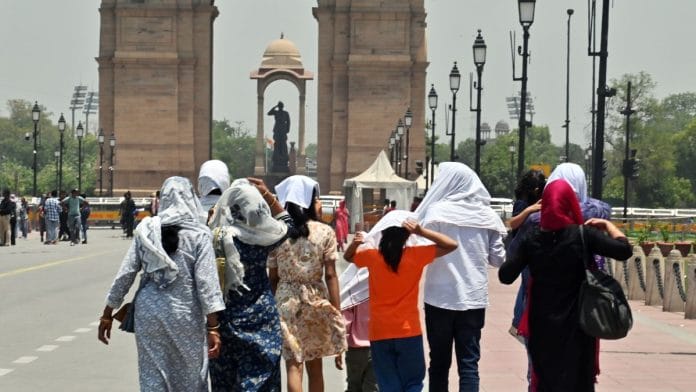
New Delhi: A new study confirms that the land area affected by temperature extremes in India expanded by 20 per cent to 40 per cent per decade across central and northwest India between 1971 and 2022. It highlights that areas appearing as scattered heat hotspots in the 1980s turned into broad, continuous zones of heat stress by the 2010s.
The study, ‘Evolution of Climate Extremes Over the Indian Subcontinent Using a Revised CEI’, was published in the peer-reviewed International Journal of Climatology by scientists from the India Meteorological Department (IMD) and the National Centre for Medium Range Weather Forecasting (NCMRWF). It combined seven separate hazards, including daytime heat, humid heat, heatwave severity and drought, into a single India Climate Extremes Index.
This index was built on 52 years of IMD observations, with trends tested using the Mann-Kendall method—a statistical test used to determine whether data, such as changes in rainfall or temperature, show a significant increasing or decreasing trend over time.
“What stands out over five decades is not just that India is warming, but that heat and drought extremes are covering more and more of the country. They have moved from a few pockets to large, connected regions, and that is a different order of risk to plan for,” said M Rajeevan, former secretary, Ministry of Earth Sciences, who is also a co-author of the study.
Different spells across India
The study highlights that northwest India was emerging as the “heat epicentre” of the country. This region shows the steepest spikes in daytime temperatures, humid heat and heatwave severity. Researchers said that this was because of the region’s arid conditions, drying soils and intense land heating.
South India, on the other hand, was drying up the fastest, with states such as Odisha, Andhra Pradesh and Tamil Nadu consistently recording drought conditions. In several years, more than 40 per cent of the region along the eastern coast experienced droughts.
Northeast India showed a slightly different pattern. There, states were facing heavier single-day downpours, along with more frequent dry spells. This, researchers said, showed growing monsoon instability.
“The same warming shows up very differently across the country. The northwest is heating and drying, while the northeast swings between heavy downpours and dry spells. Building the index for Indian conditions lets us see those contrasts clearly rather than average them away,” said Thota Mohan, from the NCMRWF, who is also the lead author of the study.
Also read: ‘Something big coming’—why 188 Indian ecologists warn of a ‘super’ El Niño
‘Single heat message won’t fit every region’
Researchers said that the varying weather trends showed that India needs a region-specific response plan.
“Since the dominant hazard changes from region to region, the authors argue the response has to as well, with heat action for the northwest, water and drought resilience for the south, and flood and rainfall management for the northeast,” a joint statement issued by the authors on the findings of the research read.
The statement added, “The adaptation must be cross-sectoral, spanning agriculture, water management, health, and infrastructure, given how widely the socio-economic impacts are felt.”
Researchers also called for finer-scale, high-resolution monitoring to support district-level planning, and proposed the IMD climate extreme index itself as an operational tool that government agencies can run every year to track where climate stress is building and target adaptation accordingly.
“A single national heat message will not fit every region. The value of an index like this is that it can be run every year to show where stress is building, so that adaptation, whether for heat, drought or floods, can be targeted where it is needed most,” Rajeevan said.
(Edited by Saptak Datta)