







New Delhi: Three-fourths of Delhi’s land is constantly heat-stressed, and 50 per cent of the city’s population is vulnerable to the rising temperatures, says a new report by the Centre for Science and Environment, released on 2 June.
The CSE report, titled ‘Making Delhi Heat-Resilient: A Roadmap with the Focus on Vulnerable Groups’, studied the impact of heat stress on the city’s residents, existing action plans, and possible strategies to cope. It also said India needs to, first and foremost, recognise heat as a disaster under the Disaster Management Act, 2005, to respond to it like one.
“Addressing heat vulnerability now requires an active heat management approach. Most important is not looking at it as an occasional occurrence but a harsh reality that is going to stay or perhaps even worsen,” said Anumita Roychaudhary, Executive Director, CSE, in a press release.
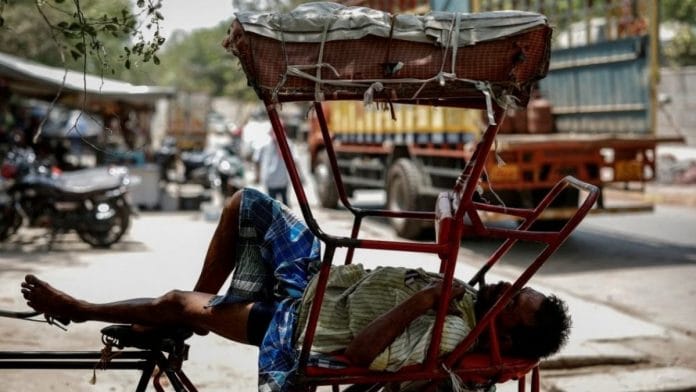
At a launch event at Delhi’s India Habitat Centre, Rajneesh Sareen, Programme Director, Sustainable Habitat, CSE, and one of the authors of the study, said most of Delhi’s vulnerable populations — construction workers, street vendors, and informal settlement dwellers — do not have the means to protect themselves from rising temperatures.
“They toil through the day to earn their daily bread – this becomes brutal when the nights do not provide any respite either. To add to this, if there is a heat-related disruption in work – if they fall sick – it means wage losses,” said Sareen at the event.
On 25 May this year, Delhi saw one of its warmest nights since 2012, with a temperature of 32.4 degrees Celsius. CSE’s report said this is part of a larger trend of warmer days and warmer nights in Delhi. In the last ten years, the report found, Delhi’s temperature departed from its average maximum summer temperature on 42 out of 50 occasions.
This increased warming has come with reduced cooling. The city’s ability to cool itself at night and release the heat trapped during the day has reduced by 9 per cent since 2015.
“Warmer nights push people to seek relief through air conditioners, which then aggravate the ambient temperatures,” read the report. “While mechanical cooling benefits a few, the burden of added heat is shared by all.”
Also Read: In a city told to work from home, Delhi’s traffic police remain in brutal heat
Strategies to help the vulnerable
Older heat action plans have fallen short. The report said that though Delhi’s existing Heat Action Plan, compiled in 2024, initiated steps such as early-warning systems and awareness campaigns, it does not lay out ways to build ‘resilience’ among vulnerable groups.
The report suggested measures such as declaring heat a disaster in order to use resources from the State Disaster Response Fund, developing dynamic heat dashboards, expanding heat reportage by measuring wet bulb temperatures, and building thermal roofs and cooling centres.
For vulnerable groups, recommended measures include developing standard operating procedures for construction work during high-heat conditions, mandating cooling breaks, enforcing staggered work hours for heat-exposed sectors, and improving access to housing, clothing, and food that support thermal comfort.
Also Read: India’s heatwaves have entered a dangerous new phase. The warning sign comes after sunset
Delhi’s hot spots
Using Landsat imagery and data on Delhi’s land area, the study analysed how some regions bear a bigger brunt of heat stress than others. Built-up areas, industrial regions, and dense neighbourhoods such as Uttam Nagar, Najafgarh, Bawana, Connaught Place, Karol Bagh, and Kashmere Gate ISBT are among the city’s ‘hot’ spots.
“As Delhi continues to redevelop, it will need to actively find ways to ensure that the new built-up fabric does not add to the entrapment of heat and instead, mitigates it,” said the report.
Only around 24 per cent of Delhi’s total area has remained below the heat-stress threshold, defined as land surface temperature (LST) of less than 45 degrees Celsius. This is due either to green-blue infrastructure — such as parks, trees, and water bodies — or built-up areas with enough green cover, such as Lutyens’ Delhi, Civil Lines, and the Delhi Cantonment.
“There are some pockets in Delhi that are able to remain cool for most of the summer… including green neighborhoods like Lutyens, Civil Lines,” said the report. “The biggest takeaway here is the enormous role that shading over paved surfaces can play.”