



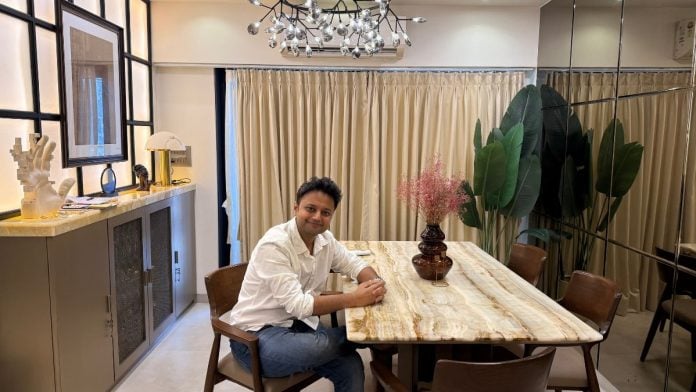
Mumbai: For 15 years, Aakash Kaushik wrote the jokes, twists and scenes for Bollywood films like Bhool Bhulaiyya 2 and 3 while other people got to decide how they looked on screen. With Udta Teer releasing Friday, he finally gets to call the shots. His first film as director is an unlikely spy comedy about an undercover Pakistani soldier who loses his memory and starts rooting for India. But when he finally got the chance to make his first film, he got cold feet.
Kaushik was at a friend’s birthday party when producers Guneet Monga, Karan Johar and actor Ayushmann Khurrana met to discuss the movie without him. Afterwards, Monga texted him ‘Yes’, with a smiley.
“I was happy, but I immediately developed cold feet,” he told ThePrint. “Finally, it’s happening. Oh God, how will I do it? What will I do?”
He told his wife first. On 14 May 2024, his first day as director, Kaushik filmed Khurrana stepping out of a lift. Everyone had expected him to be nervous, but he was surprisingly relaxed.
The feeling of what he was doing didn’t sink in all at once. As filming continued, there were moments when it would suddenly hit him: “Oh, this is happening.”
Udta Teer, starring Ayushmann Khurrana and Sara Ali Khan, is a film Kaushik says he first conceived around 2018-19, before the recent rush of Indian spy comedies. Co-produced by Monga, Johar and Sikhya Entertainment, the film is his chance to turn a script he has carried for years into the kind of movie he has spent his career writing for others.
For a man who spent years writing films, he is very happy with the freedom directing brought.
“The greatest joy I get now is that I get to tell the stories I want to, and the way I want to,” he said.
The first pitch
Kaushik had pitched Udta Teer to his “rakhi sister” Monga, whom he met 19 years ago at a Delhi play in which he was performing.
“After the performance, she came and said, ‘I’m your fan.’ That was the first line she said to me,” he recounted.
They remained close after moving to Mumbai. She went on to produce award-winning independent films while he wrote for commercial Hindi cinema.
Kaushik spends Raksha Bandhan with Monga every year. He also worked on the ‘making-of’ footage for Anurag Kashyap’s That Girl in Yellow Boots, on which she was a producer.
“She would say, ‘I get so many awards, but I’m not making money.’ And I’d say, ‘I’m making so much money, but my films don’t win awards.’ We used to joke that one day we’d make a film together that would win awards and make money.”
So, when Kaushik decided to direct Udta Teer, Monga was the first person he approached.
“I narrated it to Guneet and she absolutely loved it,” he recalled. She asked him to write the script. Just two and a half months later, he called her to say it was ready.
Finding the stars
The next step was getting an actor on board.
Kaushik had narrated about six scripts to Khurrana over the years. The actor liked them, but none had led to a film together.
“Every time, he’d say, ‘Very good, very good,’ but then he wouldn’t do the film. I’d joke with him, ‘You always like my scripts, you leave the narration so happy, but then nothing happens.’ Maybe it was written that he’d say yes to my directorial debut.”
Next, for the female lead, Johar suggested Sara Ali Khan. He narrated it to her, and she said yes immediately. While shooting, he was impressed with Khan’s preparation for the role.
“She’d ask, ‘Should I do it like this? What about doing it this way?’ Even after we’d finished, she’d ask how she could make it better,” he recounted.
On the criticism Khan has faced over the years, he says that she has been judged harshly.
“She brings calm to the storm. And the way she has done that role, with a lot of grace,” he said. “I think this is her most graceful role.”
‘Reverse’ Dhurandhar
A spate of spy comedies have come out recently like Vir Das’ Happy Patel Khatarnaak Jasoos and Kunal Kemmu’s Vibes, taking a shot at the spate of nationalistic films over the recent years. Udta Teer has been dubbed by many online as ‘reverse Dhurandhar’ after the trailer came out.
But Kaushik rejects that his film is a spoof and instead calls it a “patriotic comedy”. And Dhurandhar director Aditya Dhar and he knew about each other’s scripts right from the beginning.
“Aditya Dhar is a very close friend, he’s like a brother to me. I’ve even written a film for him,” he said. “He was writing Dhurandhar while I was writing this film. He knew about it from the nascent stages, as I knew about Dhurandhar. And we were equally excited for each other.”
Kaushik’s interest in geopolitics finds its way into the film. In the trailer, an incompetent terrorist can’t break open a window in one scene. When his family’s history comes up, Khurrana’s character calls it nepotism. The man looks proud.
Kaushik says he has tried to put a funny spin on real observations.
“If you look at terrorist organisations, you’ll find that someone’s father started one, or someone is the son of a man who was number two in Al-Qaeda. Osama’s son was involved too,” he said. “For me, comedy isn’t about people trying to be funny. It’s taking a real situation, revealing its layers, and then having people react to that bizarre situation.”
When things went wrong
Shooting had its own difficulties. All three shooting schedules were during monsoon. The crew had just two days to film a chase through Delhi’s bustling Chandni Chowk.
“We had to shoot so much in those two days, it was almost impossible. It’s a chase, so we couldn’t stay in one location. We had to move from one place to another, then another. And there were so many people,” Kaushik recalled.
In Paharganj, nearly a thousand onlookers gathered for a night shoot that required a traffic jam. Kaushik recounted the stressful schedule, saying they were really short on time.
“We blocked the entire street and brought in our own cars. After every shot, the cars would go back to their positions because we needed continuity. There were a thousand people standing there, and we had just one night to shoot,” he said. “We couldn’t afford to get it wrong because there was no time.”
Kaushik gave his actors room to improvise, but kept returning to what he’d written.
“The script will always be your Bible. It’s your guiding light. You need to follow that. But of course you can have wiggle room to have fun.”
Also Read: ‘Kasab called me badshah’—Ujjwal Nikam on Prahaar, the 26/11 trial & being a ‘gunehgaar’
A loss during the film
Actor Mukul Dev’s death in May last year also delayed the film. Kaushik remembers the actor calling him at night to talk about his scenes.
“He would call me at 12.30 at night. I’d ask, ‘Sir, what happened?’ He’d say, ‘I was remembering that scene you wrote. I could not stop myself from calling you.’”
Kaushik still has recordings of their conversations.
“He would say, ‘When the world sees this, I can’t wait for people to see this side of mine.’ And I made a promise to him. I said, ‘You’ll see, the whole country will give you so much love when this movie comes out.’ I think I’ll keep that promise to him.”
(Edited by Stela Dey)