





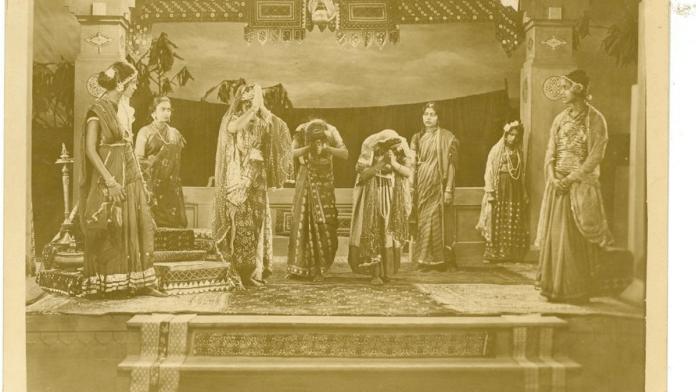

New Delhi: Rabindranath Tagore is often remembered for composing India’s national anthem and introducing the world to the beauty of Bengali literature through Geetanjali and other works. But, not many know that beyond the poet and Nobel laureate, another Tagore existed: a filmmaker.
In 1932, Tagore directed his only film, Natir Puja, based on his dance drama of the same name.
At the time, Indian cinema was fascinated with mythological and historical themes in films such as Shiraz (1928) and Kaliya Mardan (1919), but Tagore chose silence and spiritual conflict.
Tagore’s film followed the story of Srimati, a royal court dancer who becomes deeply devoted to Buddhism. The king, influenced by power and authority, attempts to suppress Buddhist worship and demands unquestioned obedience from those within the royal court. Srimati, however, refuses to abandon her spiritual beliefs, even when faced with humiliation, punishment, and death.
What made Natir Puja unusual was Tagore’s refusal to fully “cinematise” it. Instead of embracing the fast moving visual language cinema was beginning to develop, he retained the stillness and rhythm of theatre. Long pauses and poetic staging dominated the film, making it one of the first works of experimental cinema.
The production of the film brought together the some of the most influential minds of Indian at the time. The film was produced by BN Sircar’s New Theatres, with one of the pioneering technicians of Indian cinema, Nitin Bose doing the cinematography. Music was composed by his nephew, Dinendranath Tagore, and students of Santiniketan formed the cast.
The tragedy of Natir Puja lies not only in its commercial failure but also in its disappearance from public memory. The film was reportedly destroyed in a fire at the New Theatres studio, leaving behind only fragments.
“Tagore was more like an architect of the visual grammar of cinema, probably not the maker of it,” Binayak Bhattacharya, Head of Department Media science from Maulana Abul Kalam Azad University of Technology, West Bengal told ThePrint.
“I won’t say Tagore’s literary legacy overshadowed his talent for cinema. Rather, they shared a complementary relationship,” he said while reflecting on the great Indian poet’s cinematic legacy.
The film carried the educational values of Santiniketan, where art was seen as a path toward self-reflection and spiritual awakening. In many ways, Natir Puja was a visual extension of Tagore’s worldview, where dance became dialogue, silence carried emotion and devotion itself became political. That is perhaps why the film still feels alive despite being lost to history.
(Edited by Insha Jalil Waziri)