



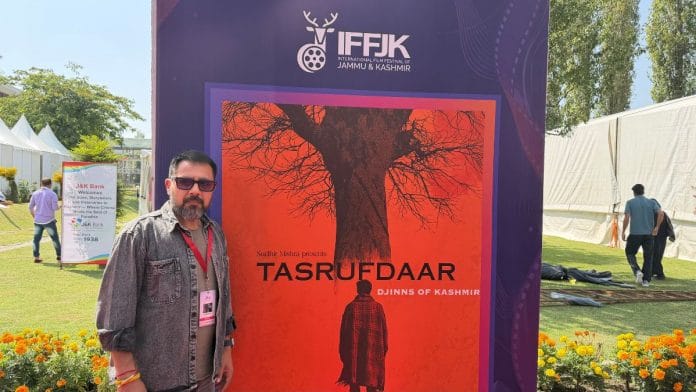

Srinagar: Filmmaker Kapil Mattoo urged the Jammu & Kashmir government to draw inspiration from the Uttar Pradesh government to build a filmmaker-friendly environment in the state.
“The way UP gives you subsidies, they really allow a filmmaker or a producer to take the money. If a local filmmaker is shooting his complete film in Jammu & Kashmir, what is he getting?” Mattoo told ThePrint on the sidelines of the first International Film Festival of Jammu & Kashmir (IFFJK) in Srinagar. “But I know DIPR (Directorate of Information and Public Relations, J&K Government) is working towards it.”
Chief Minister Omar Abdullah spoke about the single window policy during the inauguration of the film festival on Monday and how it will help filmmakers. But Mattoo says it needs further streamlining.
“We need to really make our single window, single window. They need to streamline. Many productions from Bombay are hesitant because the single window has become more complicated,” he said.
‘High time to tell stories from Kashmir’
Mattoo’s short film Tasrufdar is one of the five J&K films screened at the four-day festival, Rang-e-Cinema, which is scheduled from 7 to 10 September across venues in Srinagar, Gulmarg and Jammu. Mattoo’s film chronicles the life of a middle-aged Kashmiri Muslim who encounters a paranormal figure, the spirit of his late father’s childhood friend, Shamboo Nath, a Kashmiri Pandit.
“We can also make a Kantara in Kashmir,” he said. “I think it’s high time to tell stories from Kashmir. Not the one which has been made or the one which is being made; they are also part of the process; they are all pending emotions. But I have taken the route of folklore because it excites me. I want to use all the folklore, the traditions to tell my stories. After all, we are traditionally a very old civilisation.”
According to Mattoo, a film festival of such a grand scale will inspire the youth, who are “very talented” but require the correct “direction.”
“The government needs to help and handhold local filmmakers and enable them to tell their stories. They need to create enablers who can mentor the upcoming talent. You need three to four years of mentoring here. There is a lot of talent here, but they are directionless,” he said.
Many films like Leo, Haider, and Bajrangi Bhaijaan have been shot in Kashmir. But Mattoo says only a native can view Kashmir beyond shooting locations. CM Abdullah also highlighted this point, urging filmmakers to “seek deeper.”
“The locals need to come together and scale up their storytelling. And they have to work on their craft. Craft should speak for itself. It is one area where people in J&K can improve,” Mattoo added.
Also read: How do love stories happen in Kashmir? Filmmaker Sriram Raghavan wants to know
Old wounds, new dreams
Much like filmmaker Sriram Raghavan, Mattoo too brushed away the security threat question. He said that while the Pahalgam incident was “deeply unfortunate and tragic”, Kashmir has no security issues.
“Before and after the attack, the security apparatus was very good. I have shot many projects here. I shot two short films, one before the Pahalgam attack and one after that. It was a one-off incident which sort of scared me as well, but overall the government is doing very well,” Mattoo said.
Whenever he visits Kashmir for shooting his films and shows, he “feels humiliated”, “angry” and “weak” because he has to pay for the stay.
“It’s not about money. I get angry, but I feel weak also. I feel like I have been cheated because this is where I think my house is,” Mattoo said.
Growing up in Srinagar, he has seen multiple Bollywood films starring Rajesh Khanna, Shammi Kapoor and Vinod Khanna being shot in his area. Mattoo calls Shammi Kapoor films, in terms of entertainment, his favourite depiction of Kashmir.
“It puts you right back in a Kashmir which is very dreamy, imaginative and happy. I always go back to his song Tareef Karu Kya Uski, which was shot on a Shikara,” he said, adding that it was the ‘best era of shooting films’ in Kashmir.
“It was carefree Kashmir. People would watch film shootings from a distance. Policemen would stand with ‘lathis’. I have never seen them with a gun. Those were the days,” Mattoo added.
(Edited by Saptak Datta)