





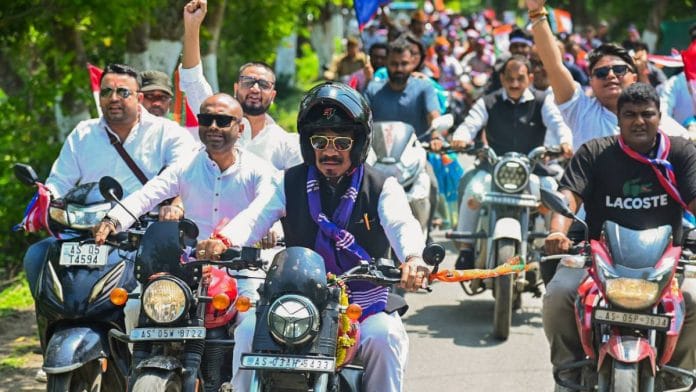


New Delhi: The Asom Gana Parishad (AGP), born out of the anti-foreigners’ movement in Assam and an old ally of the BJP-led NDA, was leading in 8 seats by 1.30 pm Monday as the ruling alliance looked set to retain power in the state. The AGP had contested 26 of the 126 assembly constituencies.
In the 2021 assembly polls, the AGP, then too part of the NDA, had contested 29 seats and won 9.
This year, the party has fielded 13 candidates from the Muslim community, contesting in alliance with the BJP and Bodoland People’s Front (BPF).
As the Election Commission counted results, by 1.30 pm, AGP president and state minister Atul Bora was leading from Bokakhat by over 28,000 votes, while AGP working president Keshab Mahanta, part of the Assam cabinet and who was re-nominated from Kaliabor, was leading by over 16,000 votes.
Diptimayee Choudhury and Prithiviraj Rava were re-nominated from Bongaigaon and Tezpur and were leading by 21,000 votes and 1,000 votes, respectively.
Prodip Hazarika, whose seat was shifted to Sibsagar from Amguri due to realignment during the delimitation process, was trailing at third place. Akhil Gogoi of Raijor Dal secured first spot, followed closely by the BJP candidate.
Karim Uddin Barbhuiya, who switched from the AIUDF and joined the AGP before the elections, was trailing from Sonai by over 16,000 votes against the Congress candidate.
Also Read: Eight journalists, four states and 1 UT—how ThePrint covered 2026 Assembly elections
History of AGP
The AGP has long emphasised on protecting Assamese identity while also focusing on regionalism, safeguarding indigenous rights and securing land rights for natives.
Leaders of All Assam Students’ Union (AASU), who led the Assam Movement against illegal immigration to the state, had formed the AGP in 1985 following the historic Assam Accord, which ended the agitation led by AASU and supported by civic organisations under the All Assam Gana Sangram Parishad (AAGSP). Rajiv Gandhi as PM in 1985 had invited the leaders of the movement and initiated a dialogue which ended in the accord.
Sarbananda Sonowal, currently a Union Minister, had begun his political journey as a student leader with the AASU. In February 2011, he resigned from the AGP, joined the BJP and became CM of the state five years later.
Many AGP leaders have joined the BJP over time, which is seen to have weakened the party. As the BJP gained prominence and greater acceptability in the region, AGP’s influence has gradually waned. It’s now the BJP that is at the forefront of the campaign against illegal immigration.
The AGP has given two chief ministers to the state: Prafulla Kumar Mahanta who first served in the role aged just 33 in 1985 and was given the charge again in 1996. However, the party’s graph has been falling since then.
The AGP-led government in the 1980s faced several allegations related to corruption and giving a free rein to United Liberation Front of Asom (ULFA), a banned militant group. Later, in 1990, the Centre imposed President’s Rule in the state citing a breakdown of law and order and the state government’s inability to effectively respond to escalating violence by ULFA.
In 2001, the AGP aligned with the BJP for the assembly polls but managed to win only 20 seats. The BJP was a junior ally that time. In 2006, the AGP’s number of seats increased slightly to 24 but dipped again to just 10 in 2011.
In 2016, the AGP won 14 seats but in 2019, it split with the BJP over the proposed Citizenship Amendment Bill (now an Act). The split was, however, short-lived as the two parties reunited three months later and contested the 2021 assembly elections together.
(Edited by Nida Fatima Siddiqui)
Also Read: Exit polls bet on LDF upset in Kerala, BJP & DMK return in Assam, Tamil Nadu; edge for BJP in Bengal