







The distance between Jorhat in Assam and Nemon in Kerala is approximately 3,700 km.
This is the journey ThePrint’s reporters have taken readers on over the past one and a half months, since the Election Commission of India announced the schedule for Assembly elections in Assam, Kerala, Puducherry, Tamil Nadu, and West Bengal on 15 March.
Eight correspondents travelling across these states showed us the elections through their reports, video stories and photographs.
DK Singh, Editor, Politics, said when he sat down with his team to plan the reporting on these elections, they were clear that the focus would be on the “larger picture”.
Deputy Editor Manasi Phadke, who is stationed in Mumbai and oversaw election coverage in Kerala and Tamil Nadu, assisted in creating the reporting plan.
“At ThePrint, we have to think about a national audience. Readers across the country won’t be interested in hyperlocal stories,” Singh said.
He added that when planning stories, he puts himself in the readers’ shoes and asks, “What would I be interested in?”
Phadke said she plays the role of an “outsider” with an understanding of the local politics. She guides the reporters.
“How to make the stories connect with our readers, that’s the aim. If the story appeals to us, then it will work with our readers too,” she said.
Sharan Poovanna, ThePrint’s Bengaluru correspondent, spent 11 days in Kerala ahead of voting on 9 April. Along with Aneesa PA, Senior Correspondent, he travelled across the length and breadth of the state.
“When we started, we had specific big-picture story ideas—no micro-reporting,” said Poovanna, “We went beyond just telling readers about the election—we looked at trends, how Kerala has become a modern state. It is a striking story.”
Poovanna’s long report from Kochi and Thrissur shows how Kerala Chief Minister Pinarayi Vijayan has ‘embraced’ private enterprise and transformed the state.
Kerala rose from “28th position in the Ease of Doing Business rankings around 2019… to be among the top states under the ‘fast mover’ category last year, reflecting the result of these reforms,” Poovanna wrote.
Read it alongside Aneesa’s profile of the Kerala CM, and you’ll understand why Vijayan is a serious contender for a third consecutive term.
Also read: Chaos, multiple angles, and a terror module—ThePrint took a deep dive into Red Fort blast case
Show and tell
All ThePrint’s correspondents follow this pattern of show and tell. Their reports are packed with data, reflect the conditions on the ground, and bring views from stakeholders and commentators—especially from the public.
They provide context, historical evidence, and comparisons with five years ago, when the last Assembly elections were held. They spell out what has changed on the ground and in politics.
Deputy Editor Moushumi Das Gupta spent more than three weeks in Bengal. Her reports on the shift in the Muslim vote and the impact of SIR deletions in Muslim-majority areas tell you everything about the state of the minority vote.
Down south, Aneesa and Poovanna looked at the Christian minority vote in Kerala: The BJP’s assiduous courting of the community and its watchful response.
In Assam, this report from Sourav Roy Barman draws a contrast between Gaurav Gogoi, president of the Assam Congress, and Himanta Biswa Sarma, the Chief Minister and BJP leader.
It suggests that Gogoi represents a more civil alternative, which appeals to voters in a city like Jorhat, the “cultural capital” of Assam.
Welfare policies and promises, also called revdis or freebies, have been a constant in this election cycle, too. It is argued that such measures considerably influence voting patterns—especially among women.
Among the states voting this election, Tamil Nadu was the first to take the welfare route. Shweta Tripathi, ThePrint’s Special Correspondent in Chennai, traced the culture of ‘freebies’ back to the 1950s and 1960s when former Congress Chief Minister K Kamaraj offered free “noon-meal schemes in government and panchayat schools.”
Then there’s this joint report by Tripathi and Deepika Amirapu, Senior Associate Editor, on crimes against women in Tamil Nadu. The data-heavy report reveals how the number of cases in the state has risen appreciably, but the percentage of charge sheets has remained the same.
No wonder this has become a poll issue, with all parties promising security for women in their manifestos.
From West Bengal came a story on women voters—the backbone of Chief Minister Mamata Banerjee’s support base—and their ambivalence toward her now.
“Mamuni said she has voted Trinamool for years, but is having second thoughts this time,” wrote Moushumi Das Gupta. “For getting anything done, you have to pay the party men,” Mamuni told her.
Also read: Meet ThePrint’s new reporters — a lawyer, an ex-KPMG manager & an edtech founder
National interest
As I read through more than 60 reports by these journalists—and there were many I hadn’t read—it became clear that ThePrint’s coverage was more about depth than breadth.
Their focus wasn’t on campaign rallies, constituency- and ticket-distribution, the daily bickering between the parties, or following the top leadership of national parties: Prime Minister Narendra Modi, Home Minister Amit Shah, Leader of the Opposition and Congress MP Rahul Gandhi.
It was about the chief ministers in the fray—Mamata Banerjee, MK Stalin, Pinarayi Vijayan, and Himanta Biswa Sarma. It was about the personalities dominating these elections—Vijayan and Tharoor in Kerala, Stalin and Vijay and Ramadoss in Tamil Nadu, Sarma and Gogoi in Assam, for example.
“These are national figures,” said Phadke.
Stories about star power or political clout were more thematic.
“This was my first election. I hadn’t written extensively on politics, but I came to understand that this had to be about larger issues, not district-to-district concerns. I had to find a common connection between different parts of the state,” said Tripathi.
This was Aneesa’s second election, and first in Kerala.
“I would think of ideas from the perspective of national interest,” she said. It’s a guideline that all of ThePrint’s reporters followed.
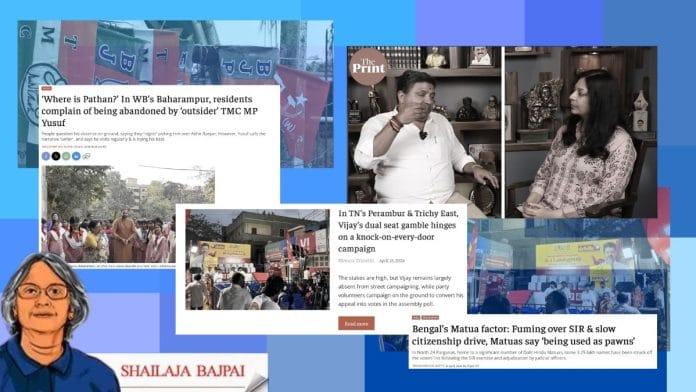
Thus, there are several reports on actor-politician Vijay, whose choice of constituencies revealed something interesting about his campaign. As Tripathi wrote, the two constituencies he is contesting from “have oscillated between the DMK and AIADMK in recent years”, which means Vijay is attempting to “pitch himself and his party as a credible alternative to the two Dravidian majors.”
From Tamil Nadu, there were also stories on the BJP’s Annamalai, and Sasikala—Jayalalithaa’s aide and founder of All India Puratchi Thalaivar Makkal Munnetra Kazhagam. The virtual absence of PMK’s Ramadoss, once a prominent figure in Tamil Nadu politics, is one of the factors that make the 2026 election different, said Amirapu. So she wrote about him.
Amirapu, who is from Tamil Nadu and based in Hyderabad, conducted several video interviews as well, including with AIADMK leader Singai Ramachandran, BJP state secretary Vinoj P Selvam, and DMK leader and IT Minister Palanivel Thiaga Rajan.
“I picked people who had a worldview of Tamil Nadu, and very clear communication. They had a very good idea of what made people vote,” she said.
In West Bengal, a visit to former cricketer and TMC MP Yusuf Pathan’s constituency explored the star value of candidates and why the TMC fields celebrity candidates. “We wanted to see what these celebrities are up to in their constituencies,” said DK Singh.
“The idea was to capture big issues,” explained Das Gupta. She did so with her coverage of the SIR, CAA and the Matuas of North 24 Parganas in this report.
Understanding the voter
While much of the coverage followed a plan, there were stories that reporters only found once they hit the ground running: The new T20 party in Kerala and dynastic politics in the CPI(M), for example.
When Barman wrote about singer Zubeen Garg’s memorial in Guwahati, it was to understand his death’s impact on the voting in Assam. Garg died in Singapore last summer, and the Himanta Biswa government alleged he was killed. Although the Singapore authorities found no evidence to back that claim, Garg’s death became a highly emotive issue in the run-up to the polls.
“I wanted to understand if this was indeed an election issue,” said Barman.
And this is what he found: “…the issue has not quite translated into an electoral fault line that could shape the outcome of the 9 April vote.”
In Bengal, Moushumi Das Gupta visited Murshidabad and found that construction had begun on former TMC leader Humayun Kabir’s proposed mosque, modelled after the Babri Masjid.
Tripathi revisited the site of the Karur stampede, which resulted in 41 deaths and over 60 injuries and saw Vijay being summoned for questioning.
“In the lanes of Karur, the stampede has become less an electoral issue and more a symbol of political opportunism, invoked selectively by parties,” she reported.
From Tamil Nadu came the delightful story about multiple candidates with the same name contesting from the same constituency.
“In Coimbatore North, TVK candidate V. Sampath Kumar will fight against three independent candidates named Kumar: R. Sampath Kumar, S. Sampath Kumar and K. Sampath Kumar,” wrote Shweta Tripathi.
Also, CM Stalin does let his hair down, occasionally: Find out when in this story.
Also read: ThePrint is widening its lens. New shows on AI, economy, bureaucracy—and fresh newsletters
Lessons from the ground
Once DK Singh and Manasi Phadke put their heads together, the reporters on the ground drew up their own schedules. The central idea was to travel as much as possible outside the state capitals and visit places that best told the stories of these elections.
For example, before Das Gupta left for West Bengal, she looked at the poll schedule.
“It was a good idea to begin from the North, which voted in Phase 1. It was also a BJP stronghold,” she explained. The districts included Malda and Murshidabad.
From there, she wove her way down toward Kolkata and on to Nandigram.
“Everyone was very willing to talk, very open. I relied on local contacts—I couldn’t have done it without help,” she said.
Tripathi travelled extensively outside Chennai in Tamil Nadu.
“My first election, and I was also new to ThePrint, so I had to find my way around and do a lot of research.’’
Travelling gave her a new perspective.
“It was a big learning curve on the ground. I discovered that although Gen Z are very aware of politics and history, most young people don’t know why they support Vijay,” she said.
Amirapu saw Vijay’s entry as a major factor in the election: “You can neither ignore nor dismiss him,” she said.
Poovanna knew Kerala well, having visited it often from Bengaluru. He worked in tandem with Aneesa: She moved from south to the centre, and he went from the centre to the north, covering Thrissur, Mallapuram, Kozhikode, Kannur and Kasargod.
“Themes and context were important: For instance, the economic change in Kerala and the CPI(M), under Vijayan, changing their attitude toward private investment was a major theme,” he said.
Aneesa, who had to start from scratch in Kerala, is thankful to the people she met during her reporting and conversations with them left her feeling “humble”.
“I was so heavily dependent on people. I was outside my comfort zone, and they were so generous.”
She did come away with one lesson: “Be on the ground, do field reporting as much as possible—it’s the only way to learn,” she said.
Shailaja Bajpai is ThePrint’s Readers’ Editor. Please write in with your views and complaints to readers.editor@theprint.in
(Edited by Theres Sudeep)
ThePrint’s coverage of West Bengal elections was just pathetic. It was more focused on Raghav Chadha’s exit from AAP and his joining BJP. The quality and quantity of articles on the situation and mood in West Bengal left a lot to be desired.
Maybe that’s what ThePrint is – a Delhi based media organisation whose prime focus is Delhi politics. How else can anyone explain this strange fixation with a political non-entity like Raghav Chadha?