


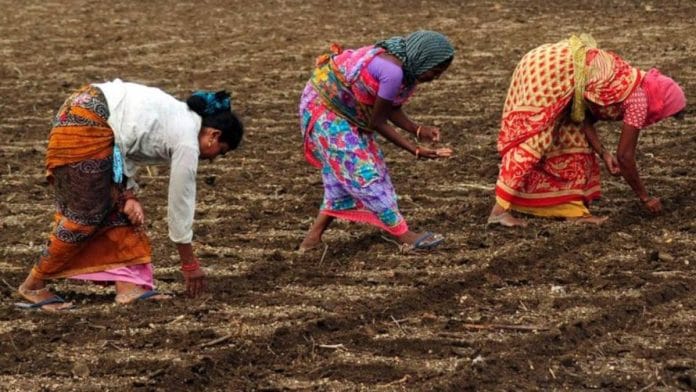
New Delhi: India’s female workforce has nearly doubled to 201 million in 2025 from 104 million in 2017-18, but much of the increase has come among women entering agriculture, self-employment and unpaid family work rather than better-paying, regular jobs, according to a new report by the Indian Council for Research on International Economic Relations (ICRIER), an independent economic policy think tank.
“The additional women drawn into the workforce, therefore, have entered predominantly through self-employment and unpaid family labour, the most insecure and lowest-paid categories, rather than through formal, regular salaried jobs that would signal genuine improvement in the terms of women’s work,” the report said.
Released last week, the report, ‘The Participation Paradox: Women’s Work and Time-Use in India, 2017-18 to 2025’, highlights how the sharp rise in women’s workforce participation has not translated into better earnings, more secure employment or a reduction in their disproportionate burden of unpaid domestic work.
“The quantity of female employment and its quality have moved in opposite directions,” the report said.
Unpaid family workers are defined as those who help in an economic activity run by a household member, such as a farm or family business, without receiving regular wages. This is classified as employment and is distinct from unpaid domestic activities such as cooking, cleaning and looking after children.
The female worker population ratio (WPR), which measures the proportion of the working-age population that is employed, increased from 22 percent in 2017-18 to 38 percent in 2025.
However, these gains have been concentrated in rural India, where women’s participation grew from 23.7 percent to 44.9 percent. In urban areas, it increased more slowly, from 18.2 percent to 25.9 percent.
The report outlines two explanations for the rise in rural women’s workforce participation.
One attributes it to economic distress, with women taking up low-productivity work to supplement household incomes amid flat wages and fewer working hours. The other links it to better opportunities, including growth in allied activities, improved rural infrastructure, digital access and government schemes such as Deendayal Antyodaya Yojana-National Rural Livelihoods Mission and MGNREGA (Mahatma Gandhi National Rural Employment Guarantee Act).
The report found that 73.3 percent rural women employed in 2025 were working in the primary sector (agriculture-related activities), up from 70.7 percent in 2017-18. In absolute numbers, women engaged in crop and animal production more than doubled, from around 54 million to over 100 million during this period (census adjusted figures).
The increase has also been driven by self-employment and unpaid family labour. The number of rural women working as own-account (self-employed) workers increased from 13.9 million in 2017-18 to 56 million in 2025, while those working as unpaid family workers rose from 28.8 million to 49.3 million.
In contrast, the number of rural women in regular salaried employment increased from 7.9 million to 13.9 million. Their share in total female employment, however, declined from 10.5 percent to 9.3 percent.
A similar shift was visible in urban areas. The number of women working on their own account rose from 6.9 million to 13.8 million, while unpaid family workers increased from 3.3 million to 6 million. Meanwhile, the share of regular salaried employment edged down from 52.2 percent to 50.9 percent.
The study uses Periodic Labour Force Survey (PLFS) data from 2017-18 and 2025 to assess employment, wages and working hours, and Time Use Survey data from 2019 and 2024 to examine paid and unpaid work. Population estimates are adjusted using projections from the Technical Group on Population Projections (2020).
Widening wage gap, fewer working hours
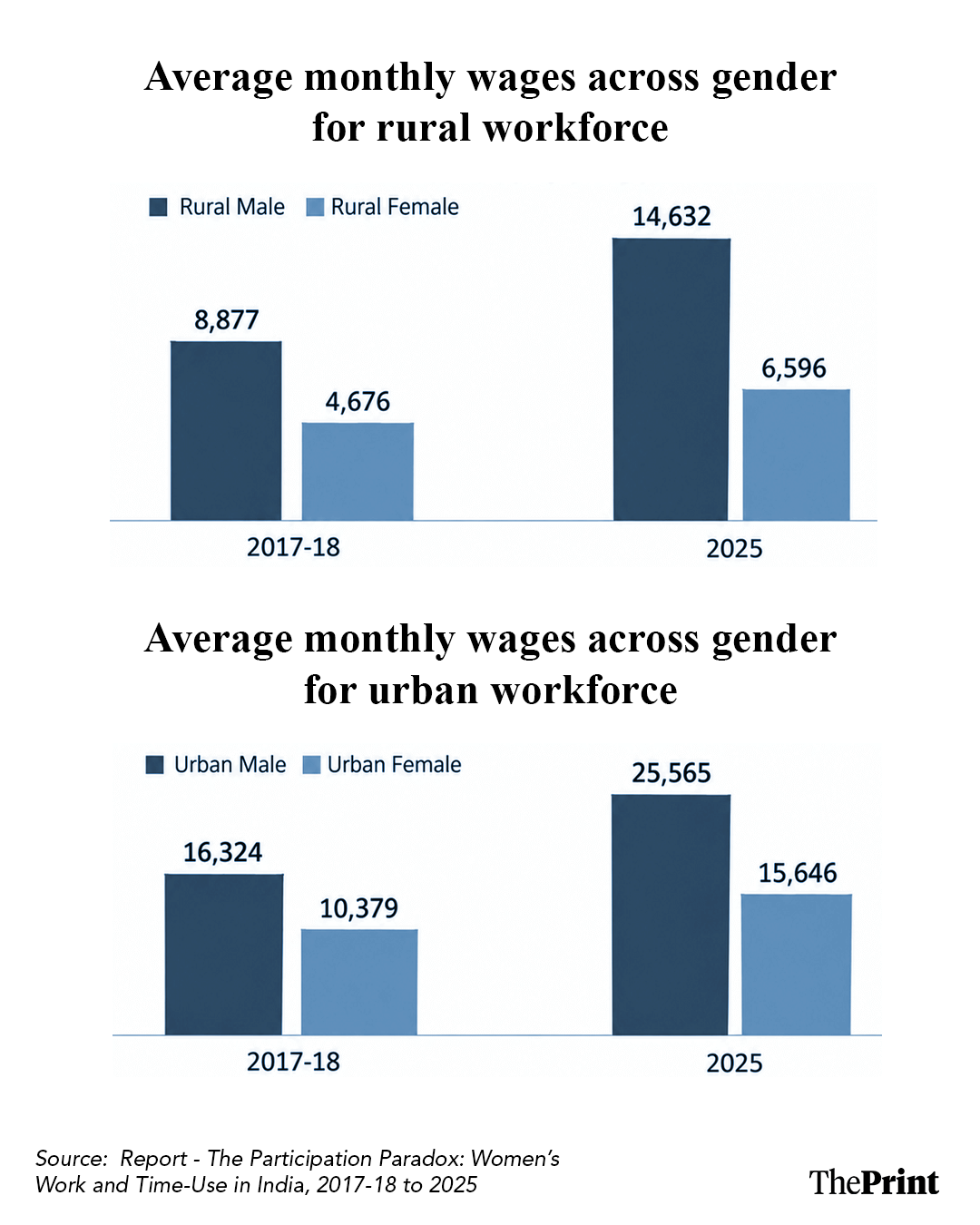
The decline in employment quality is also reflected in women’s earnings. Rural women earned an average monthly wage of Rs 6,596 in 2025, compared with Rs 14,632 for rural men. This means women earned just 45 percent of what men earned, down from around 53 percent in 2017-18.
In absolute terms, the rural gender wage gap nearly doubled, from around Rs 4,200 to more than Rs 8,000 per month during this period.
The wage gap also widened in urban areas—urban women earned Rs 15,646 per month in 2025, against Rs 25,565 for men.
The report also found that average weekly working hours for rural women fell from around 40 hours in 2017-18 to 34 hours in 2025, even as their workforce participation increased substantially. For rural men, average weekly working hours declined from 50 to 47 hours.
The fall in working hours was sharper for rural women than for rural men and urban workers, whose weekly hours declined by around two hours. The report’s findings suggest that rising female employment has not necessarily meant more sustained or better-paid work.
Unpaid household work remains a major constraint
The report identifies domestic responsibilities and caregiving as major barriers preventing women from entering the workforce or taking up better employment.
According to the PLFS data analysed by the authors, 60 percent of women outside the labour force in 2025 cited childcare and personal household commitments as their primary reason for not working. This was marginally higher than the 59 percent recorded in 2021-22. In comparison, only around 1 percent of men cited household commitments as the reason for not participating in the labour force.
The findings are reinforced by the India Time Use Survey, which records how individuals spend their time across different activities during a 24-hour day.
An analysis of the 2019 and 2024 surveys found that women spent around 320 minutes daily on unpaid domestic activities such as cooking, cleaning and household maintenance, compared with 97 minutes for men. Women also spent 144 minutes on unpaid care work involving children, elderly people and other household members, against 81 minutes for men.
The report argues that women’s participation in paid work has increased without a corresponding sharing of domestic and caregiving responsibilities.
The findings point to a wider challenge: Increasing the number of women in the workforce is only one part of the task. Ensuring access to secure, better-paid jobs, while easing the unequal burden of unpaid work at home remains critical to improving the quality of women’s employment.
(Edited by Viny Mishra)
Also read: India’s workforce is stuck in low productivity. Here’s what must change