



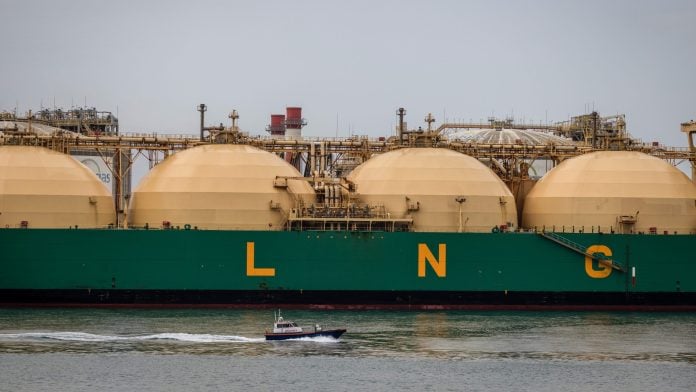
Emerging Asia is the future of the LNG market — one that never seems to show up in present-day reality.
Consider the history. For at least a decade, the big growth story for shipped natural gas has focused on a handful of mostly Asian countries whose domestic fields are declining. In its inaugural outlook for LNG in 2017, Shell Plc called out Thailand, Bangladesh, the Philippines and Vietnam among leading sources of growth.
The same four countries loom large in its latest projections, published after the crisis in the Strait of Hormuz sent shockwaves through the market. South and Southeast Asia will make up about 40% of LNG imports by the middle of this century, Shell says, accounting for more than two-thirds of additional demand beyond current levels.
Stung by high costs and supply uncertainty, Asian governments are busy throwing those forecasts on the bonfire.
Thailand is the most prominent example. On paper, the country is a paragon of the gas market. Its economic boom in the 1980s and 1990s can largely be attributed to the opening up of domestic fields. Methane still provides almost two-thirds of electricity, a larger share than you’ll see in gas-fueled giants like the US and Russia. In Shell’s latest outlook, it’s the most exciting prospect in emerging Asia, with LNG imports five times higher in 2040 than they are now.
Bangkok has other ideas. Under the government’s latest power market plan, released in draft form earlier this month, renewable energy will increase to 50% from 20% of the grid within the next decade, before rising as high as 89% around 2050. A core reason for the shift? In the words of Energy Minister Akanat Promphan, to reduce reliance on “expensive and volatile spot LNG imports.”
It’s far from alone. Look at Bangladesh, Shell’s second-ranked future growth market in the region. Its dependence on LNG has been pushing the economy to the brink in recent weeks, as we’ve written. The main plan for solving that crisis is to increase solar power generation and open up offshore gas exploration blocs to eke out the last dregs from its domestic fields, according to Prime Minister Tarique Rahman. “We will no longer be consumers of imported energy. We will be solar power producers,” he told parliament earlier this month.
Other purported boomtowns aren’t looking much better. The Philippines has been shifting toward using gas to backstop renewables rather than as the core of its power system, as once envisaged. In Vietnam, a huge promised LNG fleet is looking increasingly stranded, with the government resisting developer demands for extraordinary purchase promises guaranteeing as much as 95% of their sales for up to 25 years.
Add all this up and the picture looks pretty demoralizing for gas producers. None of these retreats are being driven by ideological attempts to hit net zero. Indeed, the governments in question all owe much of their growth in recent decades to exploiting domestic fossil-fuel reserves. Instead, they center around LNG’s failure to deliver on a promise of reliability and affordability.
That’s a devastating position to be trapped in. For most of the past decade, the most powerful argument against the march of zero-carbon electricity in favor of using gas as a compromise “bridge fuel” has centered on the energy trilemma — the idea that power sources must be both clean, cheap and secure. For consumers of energy, it’s not enough that a wind farm has low emissions: It also needs to be more affordable and available whenever it’s needed.
Nowadays, LNG is failing on all three. It’s never been clean, but these days it’s not cheap, either: Just buying the gas for an existing plant can cost more than building a brand-new solar-plus-storage system from scratch. As for security, that argument fell apart the moment Iranian drones closed off roughly a fifth of the global market, plunging Asian importers into blackouts and power rationing.
Given the backdrop, it’s not hard to see why Vietnam is balking over the terms sought by its LNG developers. Even setting aside environmental considerations, why would Hanoi pay over the odds for 25 years of guaranteed purchases, if the project in question can’t even promise to deliver power when necessary?
At this point, the best argument for LNG in emerging Asia is that it isn’t an energy source at all. Instead, it’s best seen as a raw material for fertilizer and oil refining, and a source of heat for products like glass and ceramics that are hard to electrify.
What looks increasingly implausible is the vast new market in power generation that producers have spent a decade waiting for. Emerging Asia can remain the future of LNG for only so long. Eventually, a fuel that is dirtier, dearer and less secure than the alternatives runs out of tomorrows.
David Fickling is a Bloomberg Opinion columnist covering climate change and energy. Previously, he worked for Bloomberg News, the Wall Street Journal and the Financial Times.
Disclaimer: This report is auto generated from the Bloomberg news service. ThePrint holds no responsibility for its content.