



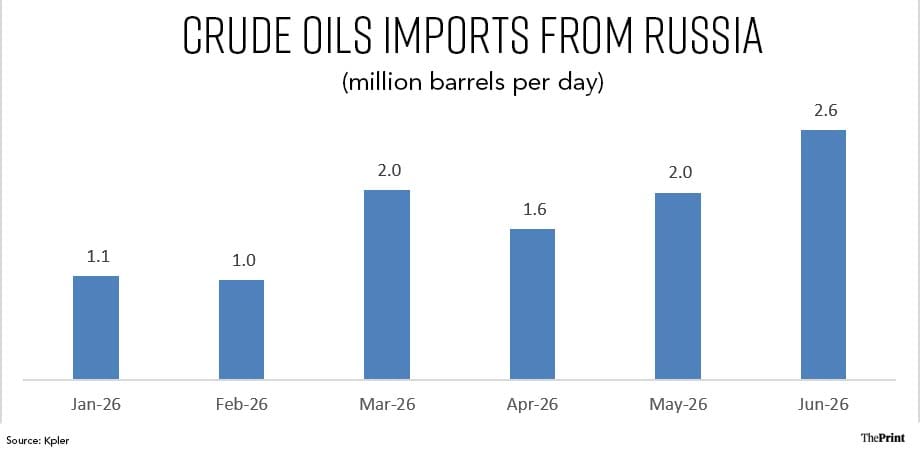
New Delhi: Russia supplied more than half of India’s crude imports for the first time in June, with shipments touching a record 2.6 million barrels per day (mbpd) as Indian refiners ramped up purchases of discounted Urals (Russian oil grade) crude. Overall, India’s crude imports rose to around 5 mbpd, the highest ever for the month despite weeks of geopolitical uncertainty.
Russia’s share in India’s crude basket reached around 52 percent in June, marking the first time a single supplier has accounted for a majority of India’s crude imports. Russian shipments grew from around 2 mbpd in May to 2.6 mbpd in June, comfortably surpassing the previous high of around 2.1 mbpd in July 2024.
“The wide Urals discount relative to Dubai and Oman remains the core pull, while the collapse in Iraqi crude arrivals has left a gap that Russian barrels have filled,” Naveen Das, senior analyst at Kpler, a global data analytics firm, told ThePrint.
He added, “Indian refiners have also fully rebuilt their Russian supply chains after the disruption caused by the US sanctions earlier this year.”
The record level of imports underlines how Indian refiners have reshaped their procurement strategy over the past few months by relying on barrels from Russia while reducing dependence on several Gulf producers that were impacted by the West Asia conflict.
“India’s crude imports have quietly demonstrated remarkable resilience over the past 100 days,” said Sumit Ritolia, manager at Kpler, adding that record imports reflected refiners’ success in diversifying supplies while optimising procurement economics.
The surge in import from Russia suggests Indian refiners have continued to purchase Russian barrels despite the US waiver on sanctions expiring on 17 June without an extension.
According to Abu Dhabi-based commodity analyst Natalia Katona, state-owned Indian Oil Corporation (IOC) was the biggest buyer of Russian crude in June, importing more than 9,00,000 bpd, followed by Reliance Industries’ Jamnagar refinery at over 5,00,000 bpd. Russia’s Rosneft-backed Nayara Energy, whose Vadinar refinery resumed operations after maintenance, imported only Russian crude at around 3,45,000 bpd.
Iraq’s loss, UAE & Venezuela’s gain
The biggest shift in India’s import basket during June came from Iraq, once the country’s largest supplier from the Gulf.
According to Kpler, Iraqi crude imports plunged from around 1 million bpd in January to just 67,000 bpd in June. Das attributed the decline largely to commercial disagreements between Indian refiners and Iraq’s state marketer SOMO (State Organisation for Marketing of Oil) over pricing, with cheaper Russian and Venezuelan crude emerging as more attractive alternatives.
Das expects Iraq to regain market share over the coming months because long-term contracts, refinery compatibility and shorter shipping distances remain intact. “SOMO will eventually blink when the market share losses accumulate,” he said.
The UAE became India’s second-largest supplier in June at around 5,00,000 bpd, while Saudi Arabia’s exports fell from about 1 million bpd in February to 3,30,000 bpd in June. Katona said the decline reflected Saudi pricing rather than logistics, with Yanbu port allowing exports to continue but official selling prices making Saudi barrels among the costliest available to Asian refiners.
Venezuela has also re-emerged as a key supplier, with imports holding between 2,60,000–2,90,000 bpd per month since April, after virtually disappearing for the previous ten months. Das said Venezuelan crude would remain important in the near term because it can be sourced under current US policy.
Iranian crude return not immediate
Despite renewed discussions following the US sanctions waiver, analysts do not expect Iranian crude to return to India immediately.
Das said the earliest Indian refiners could receive Iranian crude would be around three to four weeks after any formal agreement because though the voyage from Iran to India’s west coast takes only six to ten days, currently no Iranian cargoes are loading, in transit or scheduled for India.
Kpler data shows India imported 1,33,000 bpd of Iranian crude in April when cargoes were loaded during a brief waiver issued by US to procure Iranian oil at sea.
Ritolia said Indian refiners have little need for additional supplies as most crude requirements till the first half of August are already secured.
“We may see one or two opportunistic cargoes during July or August, but any sustained or meaningful return of Iranian crude is more likely only after the first half of August, and only if the regulatory and policy environment allows,” he said, noting that the current sanctions waiver expires on 21 August.
Katona agreed, saying sanction waivers alone may not be enough to revive imports from Iran.
“A waiver may make purchases legally possible, but it does not automatically make compliance departments comfortable,” she said. “Indian refiners do not want to be the first mover. When nobody else is buying, no compliance team wants to be the pioneer that tests the sanctions boundary.”
While crude imports remain absent, Iranian LPG continues to reach India. Das said the US supplied 62 percent of India’s 1.44 million tonnes of LPG imports in June, up from 18 percent a year earlier, while Iranian LPG imports stood at 1,16,000 tonnes during the month.
What next
Looking ahead, market analysts expect Gulf producers to gradually regain some market share as tanker traffic through the Strait of Hormuz improves.
Katona said Iraq is offering stranded cargoes at discounts of up to $20 per barrel, while Saudi Arabia has lowered official selling prices for Asian buyers.
However, she cautioned that the rush to move delayed cargoes could keep freight rates elevated, making long-haul imports from Latin America and the US less competitive.
She added that some Gulf producers are also transferring cargoes ship-to-ship outside the Strait, allowing buyers to purchase crude only after it has safely crossed the chokepoint and reducing shipping risks for refiners.
Ritolia said India’s crude import position remains comfortable. “Rising exports from Africa, Russia and Venezuela, together with higher OPEC+ production and continued crude flows through the Strait of Hormuz, should provide ample sourcing options,” he said.
The recent decline in global crude prices suggests the market is becoming increasingly comfortable with supply availability despite lingering geopolitical risks.
(Edited by Viny Mishra)
Also read: Waiver or no waiver, Russian crude remains centrepiece of India’s oil imports strategy