





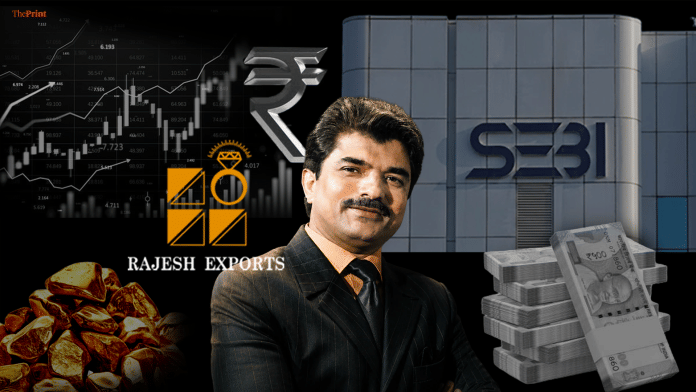


Mumbai: Claims of purchases of a gold mine in Africa that don’t add up, Rs 15.15 lakh crore of allegedly misrepresented revenues over six years, a client that accounts for 99 percent of sales on paper denying any involvement—an interim order by India’s market regulator has made some alarming observations about Bengaluru-based Rajesh Exports Limited.
REL, a gold refiner and exporter, was listed on the exchanges in 1995, and has a market cap of Rs 3,100 crore. State-owned Life Insurance Corporation (LIC) is an institutional investor in the firm, with a 10.79 percent stake, according to its latest shareholding data filed with exchanges in September last year.
The Securities and Exchange Board of India (SEBI) has alleged that REL misrepresented revenues, kept its books opaque, made contradictory submissions, routed funds through promoter-controlled accounts, and did not disclose transactions with related parties.
“…The conduct of REL prima facie reveals a coordinated pattern of financial misrepresentation, concealment and regulatory non-compliance extending across multiple financial years,” Kamlesh Chandra Varshney, whole-time member at SEBI said in the interim order, dated 3 June.
REL denies it all. In a statement to the exchanges Thursday, it said that this was just an interim order and that there had been “no adverse conclusion” on any aspect by SEBI.
“The revenues declared by the company are correct and there is no overstating of revenues. There seems to be some type of communication gap and confusion between SEBI and the company,” the statement read, adding that REL is in the process of clarifying all of SEBI’s queries and providing the necessary documents.
SEBI’s investigation was based on a shareholder’s complaint from 11 March, 2024, which raised concerns about a large sum of trade receivables having been outstanding for two years at the time, suggesting possible irregularities.
The resultant interim order, barring promoter Rajesh Mehta from trading in the company’s shares, presents a highly complex picture. The firm’s mesh of subsidiaries, repeated routing and re-routing of funds, and pattern of misrepresentation of revenues, sales and purchases are all under the regulator’s scanner.
On Thursday, the matter quickly took on a political flavour, too, as the Congress questioned LIC’s stake.
“How could LIC fail to detect such a massive fraud in a company where it held such a substantial stake? This raises the question of whether the purchase of such a large stake by LIC was directed by the ruling ecosystem,” Congress MP Jairam Ramesh wrote on X.
A spokesperson representing LIC (third-party) said that the company did not want to comment.
A web of subsidiaries
The roots of Rajesh Exports go back to 1988, when Rajesh Mehta and his brother Prashant joined their family retail business. In two years, they launched a gold jewellery manufacturing facility in India, and by the early 1990s, the company became a significant gold exporter from India. REL went public in 1995, and established branded retail chain stores under the name “Shubh Jewellers” in Karnataka.
In 2012, the Mehta family made a splash in Bengaluru by buying the land where the landmark Brindavan Hotel had stood for decades. According to media reports, the property was valued at about Rs 130-140 crore. Mehta wanted to build a comfortable house for his family. The hotel has since been razed to ground, but the land remains vacant.
Rajesh’s own net worth skyrocketed during this entire journey. According to Forbes, he and his family had a net worth of $1.57 billion by 2019.
In 2015, REL told the exchanges it had acquired a Switzerland-headquartered gold refinery, Valcambi, for Rs 2,500 crore, in an all cash-deal through its Singapore subsidiary.
It is this Valcambi that has turned into a source of mystery for the SEBI with regards to REL’s consolidated revenue.
SEBI has noticed that an uncharacteristically large amount of the company’s revenues come from its subsidiaries, as can be seen in the difference between standalone and consolidated revenues. A company’s standalone financial statements refer to its own accounts, while the consolidated statements include the finances of all of its subsidiaries as well.
For the last six fiscal years from 2020-21 to 2025-26, the standalone revenue of the company has been anywhere between 0.8 percent to 2.6 percent of its consolidated revenue.
For instance, in FY 2025-26, the company’s standalone revenue stood at Rs 9,189 crore—1.1 percent of its consolidated revenue of Rs 7.78 lakh crore.
In 2024-25, the standalone figure was Rs 7,027 crore—1.6 percent of consolidated revenue of Rs 4.23 lakh crore.
According to the SEBI order, the structure of Rajesh Exports is such that it has two 100 percent subsidiaries—REL Singapore Pte Ltd and ACC Storage Pvt Ltd.
ACC Storage is a start-up researching advanced energy storage devices and is yet to begin operations, REL disclosures to SEBI show. REL Singapore is said to be a holding company and is not engaged in any day-to-day business activities. Under REL SIngapore, there is BAB AL Rayan Jewellery LLC, a 100 percent subsidiary, which procures scrap gold/gold bars, refines, manufactures and exports gold products.
Then, there is Global Gold Refineries (GGR) AG, where REL Singapore has a 95 percent stake and REL owns five percent. GGR is a holding company of Switzerland-based Valcambi SA, and is not engaged in any day-to-day business activities. Valcambi SA has a wholly-owned subsidiary, Valcambi USA Inc, which manages the Valcambi brand in North America, the SEBI order said.
‘Revenue misrepresented’
REL’s disclosures say that REL Singapore, GGR and ACC Energy have no substantive business operations, and that Valcambi SA is the principal operating entity of the group. BAB AL Rayan and Valcambi USA were also said to have ceased operations several years ago.
However, the numbers in the books made available to the auditors were inconsistent with this claim. The standalone revenues of Valcambi SA were less than 0.5 percent of the consolidated revenues of GGR and REL.
For instance, SEBI’s order says, REL’s consolidated revenue in 2024-25 was Rs 4.23 lakh crore, but the standalone revenue of Valcambi SA was just Rs 423.63 crore.
“Viewed cumulatively, the material available on record indicates that the consolidated financial statements of REL appear to have materially overstated and misrepresented the operational scale and financial performance of the group during FY 2020-21 to FY 2024-25,” the order reads.
For all six years under consideration, SEBI says, the misrepresentation of revenues was over 99 percent, prima facie misrepresenting revenues of Rs 15.15 lakh crore over the six-year period.
In its defence, REL has claimed that the core observation in the order is with regard to the misreporting of the revenues, which has occurred due to “confusion” as SEBI has considered “the EBITDA of Valcambi instead of revenue”. EBITDA refers to Earnings Before Interest, Taxes, Depreciation, and Amortisation.
“Hence it has stated that there is difference of about 97 percent of the revenue. Consolidated revenue as stated by the company is correct,” the firm said in its statement. “There is no reason for any listed entity to inflate revenue and maintain the earnings. This will only reduce the margins of the company, which would be adverse to the company.”
Additionally, SEBI said that REL did not cooperate during the investigation, which has impeded the audit process. The company did not provide access to the Enterprise Resource Planning systems and its books of accounts. The vital journal dump of the company was withheld, shielding individual accounting entries. The order said that the company cited the Swiss Federal Act on data protection, refusing to share data on its foreign subsidiaries.
The market regulator added that according to its reading of the Swiss Federal Act on data protection, it only grants protection to “natural persons and does not extend to corporate information or the data of legal entities like Valcambi”.
“A listed entity operating in the Indian securities market cannot rely upon private confidentiality arrangements or foreign data protection provisions to defeat or dilute its statutory disclosure obligations under Indian securities laws,” SEBI said.
Links with EV manufacturing firm
In 2020, back when B.S. Yediyurappa was the chief minister in Karnataka, the state government had announced a major investment of Rs 7,476 crore, meant to generate employment for 1,804 persons, at Kottur in the Belur industrial area of Dharwad district. It was a grand proposal by a company called Elest Private LImited—incorporated by REL founders Rajesh and Prashant Mehta—to establish a lithium ion cell and battery manufacturing unit over 88 acres.
The plant is yet to materialise.
Meanwhile, SEBI says, the company has had close financial transactions with REL and its promoters. Elest was incorporated in October 2020, just two months before the Karnataka government approved the Dharwad investment proposal. According to its 2020-21 annual report, the company is engaged in manufacturing lithium ion cells, lithium ion battery packs and electric vehicles.
Between 2020-21 and 2025-26, REL transferred Rs 565.88 crore to Elest in multiple transactions, and Elest transferred Rs 350.03 crore into REL, says the regulator’s order. But in its annual reports, REL did not mention these transfers as related party transactions. The minutes of board and audit committees only mentioned a Rs 200 crore investment in Elest and a grant of loan of Rs 75.15 crore, and have not mentioned anything on the other transactions, according to SEBI.
In January 2025, Elest purchased shares of ACC, which increased its shareholding in the firm to 48.95 percent, while REL’s stake decreased to 51.05 percent from 100 percent. SEBI said that bank statements show that Elest transferred Rs 147 crore to ACC Energy, of which the latter transferred back Rs 112 crore to the former on the same date.
SEBI said, “The aforesaid transactions involving REL, Elest and ACC Energy disclose serious concerns regarding diversion and routing of funds, non-transparent related party arrangements, absence of adequate approvals and deficiencies in disclosures made to shareholders and investors.”
‘Fictitious sales & purchases’
Over three years, REL recorded sales transactions of Rs 11,487 crore with Ahmedabad-based Affluence Shares & Stocks Private Limited, amounting to 66 percent of the standalone sales during this period.
On the other hand, it recorded purchase orders of Rs 11,488 crore from Affluence, recording 67.11 percent of all purchases, resulting in “near-zero or negative value addition”. SEBI’s interim order alleges these transactions are “fictitious”.
Affluence is a SEBI-registered stock broker, which has, in its filings, described its source of revenue as financial advisory, brokerage and consultancy services. SEBI has said that this is inconsistent with REL’s claims of major financial transactions with Affluence.
When the regulator reached out to Affluence for clarifications, the stock broker said that REL had never been a client and that there was no direct contract or agreement between the two entities, with no sale or purchase transactions executed between them.
SEBI order says, “The near matching of sales and purchases, absence of meaningful commercial value addition, absence of direct banking transactions between REL and Affluence, denial by Affluence regarding existence of transactions with REL, and absence of supporting documentation collectively raise serious concerns regarding the genuineness and economic substance of the transactions recorded by REL with Affluence.”
Affluence, in its response to SEBI, said that it only had trading relations with Rajesh Mehta in his personal capacity, who had made payments of Rs 7.45 crore to it, and had suffered aggregate net losses of Rs 3.5 crore.
SEBI also noted that REL had transferred Rs 7.5 crore to Rajesh, who then used the amount to trade in gold derivatives using his personal account at Affluence. Affluence refunded the net balance of Rs 3.94 crore after adjusting for his trading losses, which he then transferred back to REL.
In an email on 17 March this year, REL justified it saying the company intended to trade in gold derivatives through MCX, but due to litigation with the commodity exchange, the trades were routed through Mehta’s personal account.
The interim order also says that foreign exchange fluctuations were improperly recorded under ‘Revenue from Operations’ and ‘Cost of Material consumed’. Interest income was also improperly included in ‘Revenue from Operations’.
Similarly, REL had recorded purchase transactions dated 31 December, 2022, with Vishakhapatnam-based Harshil Enterprise (Rs 16.46 crore), and Mumbai-based Vienna Multiventures Private Limited (Rs 42.54 crore).
Vienna Multiventures has declared IT and accounting services as its major source of revenue, with no indication of any business connected with gold bars, diamonds or precious metals. The company has been in corporate insolvency proceedings since April 2023, but REL does not feature as a creditor. SEBI has said that these purchase transactions lack adequate supporting evidence.
(Edited by Mannat Chugh)
Also Read: Mumbai’s construction debris now exceeds its solid waste. Here’s how BMC plans to tackle it