





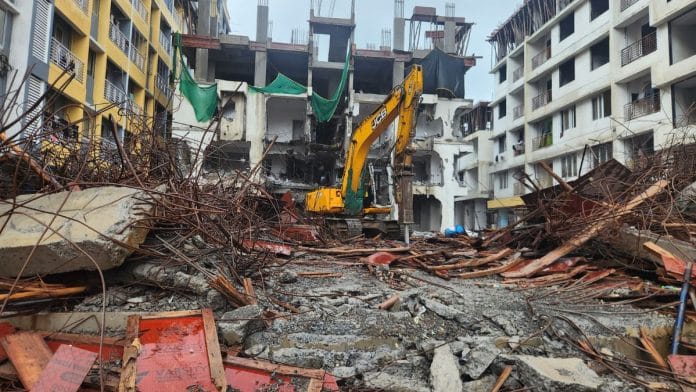


Mumbai: Mumbai now produces more construction waste than garbage every day—nearly 1,000 tonnes more. But, while the city has a proper garbage disposal system, its infrastructure for construction and demolition (C&D) waste disposal is woefully lacking. Now, the Mumbai civic body has formulated a plan to plug this gap.
So far, a large part of the construction debris is most often illegally dumped outside Mumbai city limits, civic officials say.
The Brihanmumbai Municipal Corporation (BMC), under its concept plan, will create a digital dashboard, such as Delhi’s ‘Malba’ portal. On this online portal, every developer and infrastructure agency must clearly state what debris they create, and how and where they will dispose of it. The plan also includes boosting the debris processing capacity of existing waste plants while building a new one.
The BMC presented its concept plan to a high-powered committee last month for its consideration. The committee was constituted by the Bombay High Court after taking suo motu cognisance of Mumbai’s deteriorating air quality.
Speaking to ThePrint, BMC’s Deputy Commissioner for Solid Waste Management, Kiran Dighavkar, said, “As of today, Mumbai generates about 8,000 tonnes of construction and demolition waste per day. This figure, only five years ago, was barely 1,200-1,300 tonnes per day. In comparison, the solid waste the city produces per day is 7,000 tonnes.”
“It’s a very unique urban problem that our construction waste is higher than the waste the city produces, and we don’t have any solution for it as of now.”
Construction activity in Mumbai has become increasingly hectic for the past two or three years. This is not just limited to ongoing road transport infrastructure projects. Private developers are working on more than 2,000 old buildings, which remain in various stages of redevelopment. Meanwhile, government agencies—the Maharashtra Housing and Area Development Authority and the Slum Redevelopment Authority—are completing housing development projects.
Mumbai’s construction waste
According to BMC officials, the Centre has laid down rules for handling C&D waste, ensuring its proper segregation, collection, transportation, processing, and disposal. It often becomes difficult to follow the rules entirely, as the civic body has a limited capacity to track and dispose of debris.
At the building permission stage, developers declare to the BMC the amount of debris a project is expected to generate. The debris is to be transported to authorised recycling plants and processed only there.
However, as of now, BMC has only two plants as authorised recycling facilities for C&D debris—one at Dahisar and another at Kalyan. Each, according to BMC officials, has a capacity to handle only 600 tonnes of waste per day.
“We also have a debris-on-call system, but that’s mostly for small waste generators, home interiors, and so on. But, mostly large generators end up unscientifically disposing of debris, often dumping it outside Mumbai,” an official who did not wish to be named said.
“Debris dumping becomes a root cause for the destruction of mangroves. The ecologically sensitive land is being illegally filled, using this debris, leading to encroachments,” the official added.
In its concept note, the BMC said, “While the current system is legally compliant, it faces challenges such as fragmented digital platforms, limited vehicle tracking, incidents of illegal dumping and insufficient real-time oversight—issues repeatedly highlighted during air quality-related review.”
BMC’s proposed action plan
Under the plan, a copy of which ThePrint has seen, the BMC will make it mandatory for all developers to segregate excavation material, such as soil, and C&D debris.
It has also proposed a unified C&D waste portal, which will be under the solid waste management department. On the portal, all waste generators—whether private developers or government agencies—will write down their waste management plan, which will be verified and linked to construction permissions. The portal will register all waste generators, integrate waste management plan declarations, and monitor consent letters, disposal requests, and the transportation and processing of waste.
All vehicles transporting C&D waste will be equipped with vehicle tracking management systems to trace the transportation of debris. Executive engineers, assistant engineers, and solid waste management officials will have access to this tracking system, ensuring real-time oversight.
The debris is to be transported only to authorised processing facilities, whose capacity the BMC plans to augment to 1,500 tonnes per day. Additionally, the BMC has proposed to build one more processing plant for C&D waste at Deonar.
“Additionally, we will also encourage private players to set up waste processing plants,” Dighavkar said.
The BMC has strictly prohibited the disposal of debris outside its jurisdiction.
Further, the BMC has proposed punitive action and fines for violators.
Any instance of unauthorised dumping, mixing of waste, absence of a vehicle tracking system, or any deviation in route will attract a penalty of Rs 25,000 per vehicle per instance. The BMC may even suspend permissions, issue stop-work notices, or encash bank guarantees, as part of its enforcement system.
(Edited by Madhurita Goswami)
Also Read: Mumbai family deaths: FDA finds no additives in watermelon sample, but bacteria not ruled out yet