


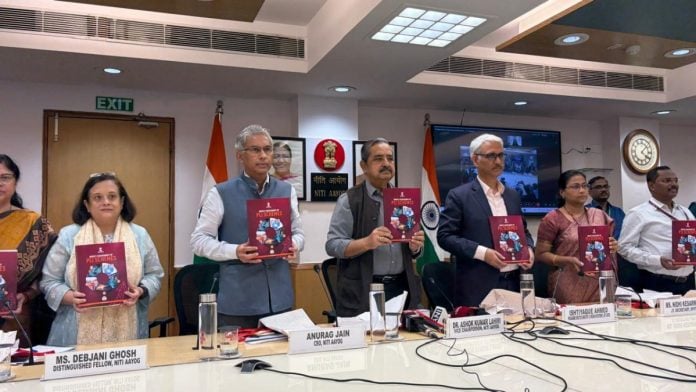
New Delhi: The Centre’s production-linked incentive (PLI) schemes have attracted investments of Rs 2.4 lakh crore, generating production and sales worth Rs 22.66 lakh crore across 14 sectors, according to a NITI Aayog assessment report launched Thursday. The schemes generated employment for 8.49 lakh people as of March 2026, against a full-tenure target of 30.18 lakh jobs.
In percentage terms, employment generation had reached only 28 percent of the target. In comparison, investment reached 76 percent of its target, while production and sales stood at 64 percent, according to the report, ‘Impact Assessment of PLI Schemes’, prepared by NITI Aayog in collaboration with the Indian Institute of Management, Ahmedabad.
The PLI scheme offers financial incentives to companies for increasing production in India. It seeks to attract domestic and foreign investment, expand manufacturing, reduce import dependence and make Indian companies more competitive globally.
The 14 schemes cover sectors including electronics, pharmaceuticals, bulk drugs, medical devices, IT hardware, automobiles, telecom, textiles, food processing, drones, white goods, solar photovoltaic modules, advanced chemistry cell batteries and speciality steel.
The NITI Aayog assessment examines their impact on investment, production, employment and exports, and identifies areas that require further attention.
Investment, production outpace job creation
The report noted that the 14 schemes had completed 58 percent of their combined implementation period as of March 2026, with 42 percent still remaining. It cautioned that investment in manufacturing facilities often takes time to translate into production and employment, particularly in sectors with longer gestation periods.
“Higher investment does not automatically translate into proportionate employment generation, particularly in sectors where automation and capital intensity are high,” the report stated, explaining the relation between employment, investment and the role of automation.
Nearly 70 percent of the targeted segments are broadly on track, with electronics manufacturing, telecom and pharmaceutical drugs showing particularly strong results.
Notably, large-scale electronics manufacturing has recorded cumulative investment of Rs 20,580 crore, production and sales of Rs 11.61 lakh crore, and employment for 1.69 lakh people by March 2026.
The food processing sector recorded investment of more than Rs 9,200 crore and employment for 3.29 lakh people. The report said the gains were driven primarily by large firms in ready-to-eat foods and processed fruits and vegetables.
The pharmaceutical sector recorded positive outcomes in bulk drugs. The report highlights that domestic capacity had been established for several critical active pharmaceutical ingredients, thus reducing dependence on imports.
In the white goods sector, domestic value addition increased from 20 percent to 55 percent, reflecting progress in localising components and technology transfer through global partnerships.
However, outcomes have been uneven across sectors. The PLI scheme for textiles, which focuses on man-made fibre apparel, fabrics and technical textiles, attracted investment of Rs 8,117 crore, generated sales of Rs 11,241 crore and created 33,427 jobs by March 2026. However, the report said investment remained below aggregate targets and employment trends were inconclusive.
It also pointed to the scheme’s initial eligibility conditions, including high investment and turnover thresholds, which were difficult for many micro, small and medium enterprises (MSMEs) in textile-sector to meet. The report said subsequent changes to these conditions could help improve performance in the coming years.
Other sectors are still at an early stage, with investments yet to translate fully into commercial production. The report said sectoral outcomes need to be assessed in the context of differences in technology, maturity and investment cycles.
Ashok Kumar Lahiri, Vice Chairman of NITI Aayog, stated, “While several industries have made progress in attracting investment, there remains scope to further strengthen production capabilities and realise their export potential.”
Areas for improvement
The report called for greater attention to sector-specific bottlenecks, workforce skills, innovation and domestic value addition. It also recommended better alignment between manufacturing capacity and market demand, saying stronger domestic demand could complement the existing incentives.
It noted that the PLI framework is largely focused on increasing production and building manufacturing capacity. Future schemes should also include measures to create demand for Indian-made goods, such as stronger domestic procurement, development of export markets and greater government purchasing of domestically manufactured products.
The report also called for greater industry participation in setting sector-specific targets, particularly in industries with long gestation periods and uncertain demand. Better coordination between the Centre and state governments was also needed to address local regulatory and implementation hurdles.
Lahiri said building manufacturing capabilities was essential for India to become a competitive global manufacturing destination. “It is not an option, it is a compulsion, it is a must,” he said.
The report also flagged gaps in data reporting across sectors, including limited information on exports and employment, which make it difficult to fully assess the schemes’ impact. It recommended standardised reporting by ministries and regular monitoring of firms.
Overall, the assessment said the schemes were beginning to deliver results across several sectors, but their full impact would depend on addressing implementation challenges and translating investment and capacity creation into sustained production, exports and employment.
(Edited by Nivedita Patil)
Also Read: NITI Aayog launches science & tech scoreboard to map research, innovation ecosystem across states