


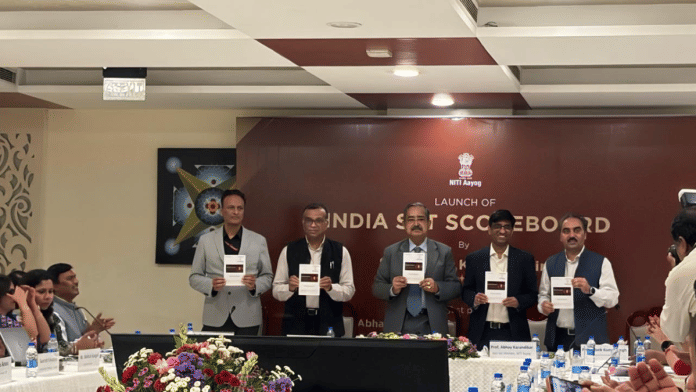
New Delhi: The Indian government’s apex policy think tank NITI Aayog Tuesday launched the ‘India Science and Technology (S&T) Scoreboard’, an interactive data platform aimed at mapping the country’s science and innovation ecosystem across states and Union Territories (UTs), enabling policymakers to assess performance, identify gaps and compare their progress with other states.
Developed by NITI Aayog’s Science and Technology Division, the scoreboard seeks to address the absence of robust and comparable data on science and technology at the state level. It will bring together information on research institutions, publications, patents, start-ups, research funding and state-level policies in one place.
The platform will provide a national overview of India’s science and technology ecosystem, alongside state-wise profiles and benchmarking. Users will be able to compare any two states or UTs, examine their research output and assess their performance across sectors.
It will also cover 11 priority research areas of national importance, including clean energy, artificial intelligence, semiconductors, critical minerals and agriculture, allowing users to assess research output and compare progress across these sectors.
The scoreboard will capture data on central, state and private higher education institutions, R&D laboratories, deep-tech startups, Atal Tinkering Labs, and research funding from central, state and private sources.
For patents, the platform will provide information on applications filed, patent strength, research areas and collaboration between states. It will also document state science and technology, startup and innovation policies, along with notable practices that other states can study and adopt.
The platform comes at a time when India has made progress in several science and technology indicators but continues to face challenges in expanding its research ecosystem beyond a limited number of institutions.
India ranked 38th in the Global Innovation Index this year, compared to the 81st position in 2015. The country ranks third globally in scientific publications and sixth in patent filings. The share of resident applicants in India’s patent filings has increased from 25.5 to 56 percent.
However, research output remains concentrated. Around 67 percent of India’s research publications between 2001 and 2020 came from approximately 450 centrally funded institutions, highlighting the need to strengthen research capabilities across states and other institutions.
While India’s publication volumes and patent filings have increased, its global position in publications has remained unchanged and its share of global patent filings remains relatively small.
‘States must be more proactive in strengthening S&T ecosystem’
NITI Aayog Vice Chairman Ashok Kumar Lahiri said at the launch that the availability of comparable data would help states understand where they stand and learn from better-performing peers. He said states needed to play a more proactive role in strengthening India’s science and technology ecosystem, rather than leaving the responsibility to the Centre. “The Centre alone can’t do it. It calls for a more proactive and committed role from the states. States must step forward, take ownership, and become the engines of this transformation.”
Lahiri also emphasised the need to ensure that research translates into practical applications and reaches industries. “Fundamental research must also translate into innovation. And it must get transmitted to the factory floor.”
Umesh V Waghmare, Secretary, Department of Science and Technology, said the scoreboard would help policymakers identify strengths and weaknesses in different parts of the science and technology ecosystem and prioritise interventions. “This information will help us understand gaps, strengths in various parts of the ecosystem and plan in a prioritised manner.”
Waghmare said the platform could also help improve coordination between different states, ministries and industry, while enabling the Department of Science and Technology to plan its programmes more effectively.
NITI Aayog said the next steps would include institutionalising the platform through periodic data updates, greater engagement with states and developing it into a comprehensive source of India’s science and technology data, including global comparisons.
(Edited by Gitanjali Das)
Also Read: NITI Aayog asks states to verify power, water capacity before clearing data centre projects