



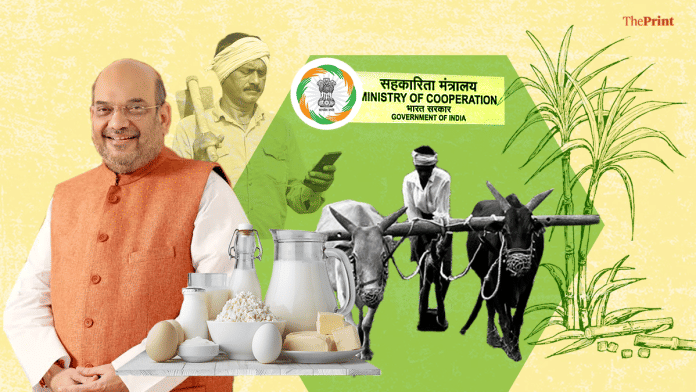

New Delhi: For decades, India’s cooperative movement occupied an unusual position in the country’s economic landscape, touching millions of lives through dairy, rural credit, fertiliser distribution and sugar production, yet rarely finding a place at the centre of policymaking.
The subject remained a department under the Ministry of Agriculture, competing for attention with agriculture, food security and farmers’ welfare.
However, the cooperatives sector today has moved beyond dairy and agriculture, expanding its footprints to newer areas like ride hailing taxis, insurance, renewable energy among others.
It was in July 2021, during the second term of Prime Minister Narendra Modi led NDA government, that a separate Ministry of Cooperation was created and Union Home Minister Amit Shah, one of the Bharatiya Janata Party’s (BJP) most influential leaders with long experience in Gujarat’s cooperative movement, was given its charge.
For many associated with the sector, that single decision marked the beginning of its biggest institutional shift in decades.
“I would not say cooperatives were neglected, but they certainly did not receive the attention they deserved,” says Prabhat Chaturvedi, Chief Executive Officer of the National Urban Cooperative Finance and Development Corporation (NUCFDC). “The creation of a separate ministry brought renewed focus. Because it is headed by one of the most influential ministers in the Cabinet, other ministries also started taking the cooperative sector much more seriously.”
Laxmi Dass, the President of the National Federation of Urban Cooperative Banks and Credit Societies (NAFCUB), echoes that view. Having spent over three decades in the cooperative sector, he says stakeholders had long sought a separate ministry.
“Whenever a full-fledged ministry is created, it naturally gives greater thrust to that subject. Earlier, cooperation kept shifting between ministries. Today, there is a dedicated ministry with a minister who himself understands the cooperative movement,” Dass told ThePrint.
Five years later, that political attention has translated into much more: a new cooperative policy after more than two decades, digitisation of thousands of Primary Agricultural Credit Societies (PACS), an attempted turnaround of urban cooperative banks, creation of a national cooperative institutions for exports, organic farming and quality seeds, and cooperatives pushed into sectors ranging from ride-hailing and insurance to renewable energy.
Supporters credit the ministry with giving the sector unprecedented political backing, while experts argue the next phase must focus on stronger governance, professional management and financially sustainable institutions.
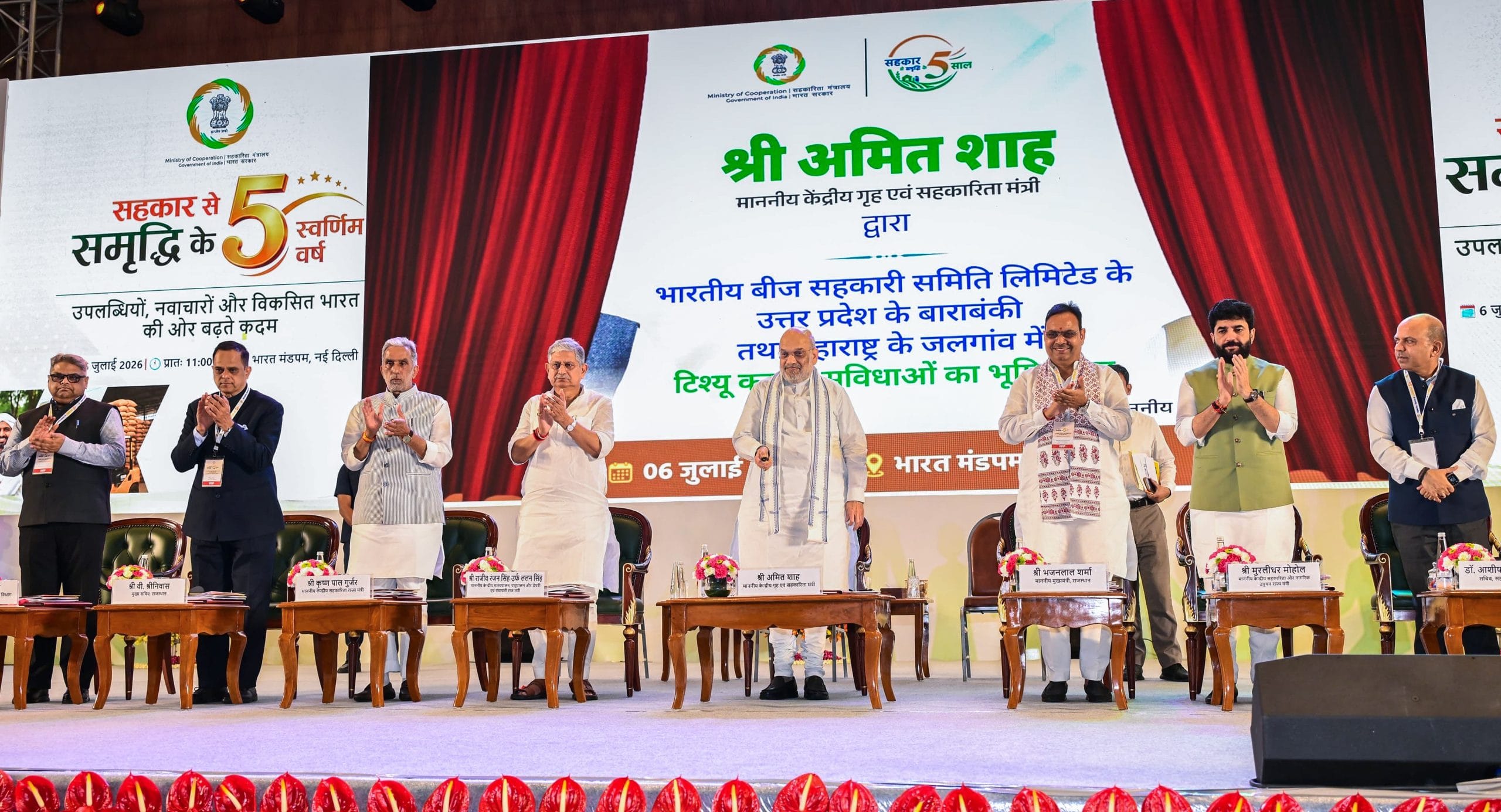
If there was any visual reminder of how much the sector’s standing has changed, it came earlier this month, on 6 July at New Delhi’s Bharat Mandapam. Nearly 14,000 representatives of cooperative societies – from dairy unions and credit societies to urban cooperative banks and farmers’ organisations – filled the convention centre as Shah addressed the Ministry of Cooperation’s fifth Foundation Day celebrations.
Calling the last five years “a golden period” for the cooperative movement, Shah said, “In these five years, we have identified problems, nurtured possibilities and also provided future-oriented policies to States.”
Also Read: Can a cooperative society buy a company in the middle of insolvency proceedings? SC clarifies
From a department to centre of policymaking
The significance of creating the Ministry of Cooperation becomes clearer when viewed against the sector’s institutional history. According to Shah, cooperation remained under the agriculture ministry for nearly six decades and was handled largely at the level of a joint secretary.
“Today, a fully independent Ministry of Cooperation is moving forward by taking all states and 8.30 lakh cooperative societies across the country along,” he said during the 5th Foundation Day celebrations.
Beyond symbolism, stakeholders say the ministry has fundamentally changed how the sector interacts with the government. Earlier, cooperative institutions often struggled to get policy attention because the department functioned alongside agriculture and farmers’ welfare.
Today, sector representatives say ministries ranging from MSME to food processing are engaging more actively with cooperatives, particularly in banking and credit delivery.
The numbers underline the scale of the sector. According to the Ministry of Cooperation, India today has more than 8.5 lakh registered cooperative societies, of which around 6.6 lakh are functional, operating across nearly 30 sectors and serving 32 crore members.
Three decades ago, the movement had around 22 crore members and remained concentrated largely in agriculture and rural credit.
New policy for a changing economy
Perhaps the ministry’s most significant long-term intervention has been the National Cooperative Policy 2025, the first comprehensive overhaul of India’s cooperative policy framework in more than two decades.
The previous policy, framed in 2002 by Atal Bihari Vajpayee’s National Democratic Alliance (NDA) government, has outlived its utility given India’s digital transformation, the rapid growth of e-commerce and the changing structure of the rural economy.
Recognising that the cooperative movement had to evolve, the Ministry of Cooperation in 2022 appointed a 48-member committee headed by former Union minister Suresh Prabhu to draft a new roadmap.
Following consultations through regional workshops, stakeholder meetings and hundreds of suggestions, the policy was unveiled in August 2025.
The new policy looks beyond strengthening existing cooperatives, seeking to redefine where the movement should grow over the next decade. The new policy encourages cooperatives to enter sectors where they have traditionally had little presence – renewable energy, waste management, healthcare, education, organic farming, ethanol and biogas production, besides aggregator platforms for taxi drivers and other service providers.
It also places strong emphasis on digital governance, transparency and professional management across cooperative institutions. The policy aims to expand the cooperative sector’s contribution to the economy, promote cooperative societies in every village and encourage greater participation of women and young professionals.
It also noted a need for closer coordination between the Centre and States to ensure more uniform implementation of cooperative reforms.
Beyond dairy and agriculture
The new cooperative policy has been accompanied by an equally ambitious effort to build institutions capable of taking cooperatives into new sectors. In January 2023, the government established three national cooperative institutions.
The National Cooperative Exports Limited (NCEL) now acts as the country’s export platform for products made by cooperative societies; it has exported more than 15.4 lakh metric tonnes of goods worth Rs 6,295 crore to 38 countries.
Meanwhile, the National Cooperative Organics Limited (NCOL) is building a nationwide ecosystem for certified organic products under the Bharat Organics brand, while the Bharatiya Beej Sahakari Samiti Limited (BBSSL) has been created to produce and distribute quality seeds under the Bharat Beej brand.
Through @coopbharattaxi, we have replaced the concept of a ‘driver’ with that of a ‘Sarathi’, where every Sarathi is not just a driver, but an owner of both the vehicle and the cooperative.
– Shri @AmitShah
Hon'ble Union Home and Cooperation Minister
Watch the complete event… pic.twitter.com/ZIW0t37fmH
— Ministry of Cooperation, Government of India (@MinOfCooperatn) July 20, 2026
Apart from creating new cooperative societies, the Parliament last year passed a bill to set up Tribhuvan Sahkari University (TSU), India’s first dedicated cooperative university to provide trained professionals for cooperative institutions.
Laxmi Dass believes that could prove to be one of the ministry’s most lasting reforms. “We need professionals. With the establishment of the Tribhuvan Sahkari University, cooperative institutions will increasingly have trained people, and that will improve the sector further,” he said.
Speaking at the 5th foundation day celebrations, Shah said TSU would help introduce professional management across the cooperative ecosystem by improving efficiency, increasing transparency in appointments and reducing corruption.
The first batch of the university is expected to graduate this year. ThePrint has previously done a detailed story on the Tribhuvan Sahkari University.
However, the ministry’s most visible initiative has been Bharat Taxi, a cooperative alternative to private ride-hailing platforms where drivers collectively own the enterprise instead of working for commission-based aggregators. The service is currently available across Delhi-NCR, Gujarat, Chandigarh, Lucknow and Mumbai.
During the foundation day event, Shah announced that Bharat Taxi would expand to more than 500 cities over the next two years and said the government would replicate the model through utility aggregator cooperatives while also launching a cooperative life insurance company.
Urban cooperative banks get fresh lease of life
Among the ministry’s most tangible interventions has been its push to revive urban cooperative banks (UCBs), a sector long weighed down by high bad loans, governance failures and outdated technology.
According to Reserve Bank of India data, the gross non-performing asset (GNPA) ratio of UCBs has fallen from 15.4 per cent in September 2021 to 5.2 per cent in March 2026, while net NPAs have declined from 8.7 per cent to just 1 per cent. Net profit after tax has also nearly doubled to Rs 5,345 crore in FY 2024-25, compared with FY 2020-21.
To build on that turnaround, the Ministry of Cooperation established the National Urban Cooperative Finance and Development Corporation (NUCFDC) in 2024 to modernise cooperative banks through digital banking, technology upgrades and stronger governance.
For Chaturvedi, however, the ministry’s biggest contribution has gone beyond technology. “The Ministry of Cooperation had written to other ministries asking them to include cooperative banks while implementing government schemes. This has helped bring them into the formal delivery system,” he told ThePrint. Earlier, many government schemes could only be routed through commercial banks, but financially sound cooperative banks are now increasingly being allowed to participate.
Shah last year also launched Sahakar DigiPay and Sahakar DigiLoan, two digital platforms aimed at narrowing the technology gap between cooperative and commercial banks by enabling paperless loans, Aadhaar-based e-signatures, Video KYC and faster digital transactions.
Dass points to another structural reform. The reduction in the priority sector lending (PSL) requirement for urban cooperative banks from 75 per cent to 60 per cent has helped many lenders meet regulatory norms while continuing to extend credit to priority sectors.
Collectively, these reforms have sought to position cooperative banks not as parallel institutions, but as a stronger part of India’s mainstream financial system. ThePrint earlier this year had done a detailed story on the turnaround of UCBs.
The next test
Five years after its creation, the Ministry of Cooperation has undeniably altered the conversation around India’s cooperative movement.
But institution-building alone may not determine the ministry’s long-term success.
Arya Roy Bardhan, Junior Fellow at the Observer Research Foundation (ORF), says the ministry has provided the cooperative movement with a clearer reform agenda. The more difficult task now is ensuring that those reforms improve outcomes on the ground. “Many cooperatives continue to face weak governance, politicisation, poor auditing, low managerial capacity and large differences in performance across states and sectors,” Bardhan told ThePrint.
According to him, the next phase should focus on strengthening the financial health of cooperatives, improving member incomes and building professional management. Without those changes, the expansion of institutions may not necessarily translate into stronger cooperative societies.
That is perhaps the biggest challenge facing Amit Shah’s cooperative agenda.
The first five years were largely about creating the architecture for change – a dedicated ministry, a new policy framework, national institutions and reforms to sectors such as urban cooperative banks.
The next five years will determine whether this architecture delivers what it ultimately promised: stronger cooperative institutions, better governance and higher incomes for the nearly 32 crore members connected with the movement.
(Edited by Nardeep Singh Dahiya)