





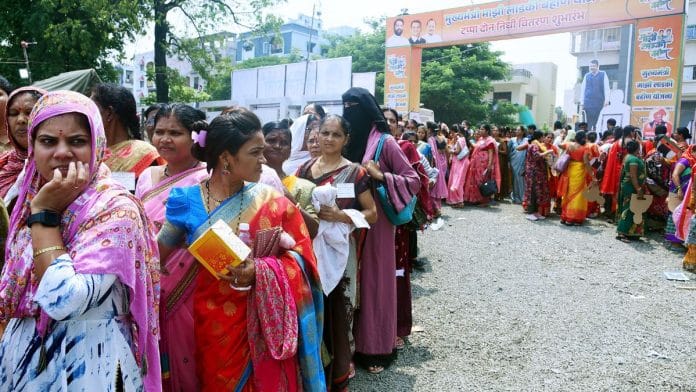


New Delhi: After women in Maharashtra began drawing Rs 1,500 a month under the Mukhyamantri Majhi Ladki Bahin Yojana, the men in their households cut their own spending by nearly half and let their bank balances build up, a working paper published this month by Economic Advisory Council to the Prime Minister has found.
The paper looks at month-by-month bank account data of scheme beneficiaries and the relatives linked to their accounts. It is authored by Soumya Kanti Ghosh, part-time EAC-PM member and Group Chief Economic Adviser at State Bank of India, along with SBI economist Shagishna K.
Among male relatives of Ladki Bahin beneficiaries, month-end balances rose 23 percent—from Rs 8,234 to Rs 10,144 on average—while monthly spending fell 49 percent, from Rs 3,124 to Rs 1,607. The authors term this a financial substitution effect. The transfer, they write, “reduces her reliance on male relatives for day-to-day consumption support”.
The fall in male spending, they add, “does not signify any deterioration in household welfare”. It is instead a shift of consumption responsibility from the man to the woman, whose own spending rose 46 percent over the same window.
Odisha shows a similar pattern. A 10 percent rise on an average in a Subhadra Yojana beneficiary’s account balance was associated with a 1.9 percent fall in her relatives’ spending. In the Odisha sample, the linked relatives were husbands (40 percent), fathers (21 percent) and sons (14 percent). In Maharashtra, spouses accounted for 68 percent.
A separate test in Odisha found no statistically significant link between a beneficiary’s spending and her male relative’s balance. The authors read this as evidence that women are now spending without reference to the men in the house—what the paper calls “emergent financial autonomy”.
Also Read: In Mahayuti’s poll-winning Ladki Bahin scheme, 14,000 of 26 lakh bogus beneficiaries found to be men
The two schemes
Ladki Bahin Yojana was announced by Maharashtra’s Women and Child Development Department in June 2024, months before the state went to polls. It pays Rs 1,500 a month to women aged 21 to 65, who are state residents with family income below Rs 2.5 lakh a year. Payments ran retrospectively from July 2024, with the first instalment of Rs 3,000 reaching accounts in August 2024.
Women already drawing Rs 1,500 or more from another government scheme are excluded, as are income-tax payers, MPs and MLAs, households with a government or PSU employee, and households owning a four-wheeler other than a tractor. Money goes by direct benefit transfer into an Aadhaar-linked, single-holder account in the woman’s name.
The stated objectives, the paper notes, run beyond welfare to “economic freedom for women” and a stronger role in household decisions. It cites Periodic Labour Force Survey 2023-24, under which the female worker population ratio for those aged 15 and above stood at 29.8 percent against 74.3 percent for men.
Subhadra Yojana was launched by the Odisha government on 17 September, 2024. It pays Rs 10,000 a year in two instalments of Rs 5,000, the first timed to Rakhi Purnima, and the second to International Women’s Day on 8 March, adding up to Rs 50,000 over five years to 2029. Eligibility runs from 21 to under 60, with the woman either covered under National Food Security Act or the state food security scheme, or from a household earning below Rs 2.5 lakh. The exclusions mirror Maharashtra’s.
Planned coverage exceeds one crore women across Odisha’s 30 districts. By March 2026, about 1.02 crore had received the fourth instalment, against an annual outlay of about Rs 10,145 crore. The state has since announced an expansion, Subhadra Plus, bundling in a call centre, savings, insurance and scholarship components.
At Rs 833 a month, Subhadra is the smallest transfer in the country. Delhi’s Mahila Samriddhi Yojana and Jharkhand’s CM Maiyan Samman Yojana pay Rs 2,500. West Bengal’s Annapurna Bhandar, which is replacing Lakshmir Bhandar, pays Rs 3,000.
Marginal propensity to consume
The study draws on account-level data for 44,547 women in Maharashtra across 36 months and 1.61 lakh women in Odisha, comparing those below the Rs 2.5 lakh income cut-off against women in households earning Rs 2.5-3 lakh.
In Maharashtra, month-end balances of beneficiaries rose by Rs 6,884, or 84 percent over the pre-scheme average of Rs 8,201. Monthly withdrawals rose Rs 1,349, or 46 percent. In Odisha, balances rose by Rs 6,887 and spending by Rs 1,920.
The marginal propensity to consume works out to about 0.9—of every Rs 1,500 transferred in Maharashtra, about Rs 1,349 was spent. The authors treat the number as a sign of binding liquidity constraints among recipients.
Age divided the response. Women aged 55 and above added Rs 10,835 to their month-end balances on average, but raised spending by only Rs 485. Women aged 21-29 added Rs 1,705 to balances and raised spending by Rs 869.
The religion factor
The Maharashtra results were also broken up religion-wise.
Hindu beneficiaries recorded the largest gain in monthly savings—Rs 7,641—and a spending increase of Rs 1,394. Muslim beneficiaries recorded a smaller savings gain of Rs 5,385, but the largest spending increase of any group at Rs 1,755.
Beneficiaries in the residual “Others” category—Sikh, Jain and no religion—added Rs 6,086 to balances and Rs 945 to spending.
Estimates for Buddhist and Christian beneficiaries are not reliable. On paper, Christian beneficiaries recorded the biggest savings gain in the table, Rs 35,264, and the only fall in spending, Rs 1,307. But the margin of error on the savings figure is close to Rs 22,000—wide enough that the real effect could be much smaller, or nothing at all. The authors say these numbers “should not be interpreted as evidence of programme impacts”. The paper does not report how many Buddhist or Christian women were in the sample.
Where the estimates hold, the paper reads the higher Muslim spending response as a sign of tighter liquidity constraints rather than of different preferences. No comparable religious breakdown was run for Odisha.
Lifestyle-led digital spending
Transaction data classified by Merchant Category Code shows where the money went.
On ATM withdrawals, education’s share rose from 18 percent to 24 percent, travel fell from 31 percent to 29 percent, and petrol pumps from 26 percent to 20 percent.
On UPI, the pattern reversed. Lifestyle was the largest category before the scheme and remained so after, rising from 37 percent to 42 percent. Medical spending moved from 8 percent to 10 percent. Education’s share of UPI spending halved, from 8 percent to 4 percent. The paper’s abstract highlights the rise in education spending at ATMs, not the fall on UPI.
Outlays
Further, the paper asks for a “cash-plus empowerment framework”, tighter beneficiary verification, and for transfers to be tied “to outcome-based transfers like improvement in children nutrition-based outcomes”.
Ladki Bahin and Subhadra schemes are both unconditional, as are those running in at least 13 other states. By FY26, more than 15 states had launched some version of the scheme, at an aggregate cost of roughly Rs 1.7 lakh crore, reaching close to 12 crore women. The number of states running such schemes rose more than five-fold between FY23 and FY26.
State finances carry the load unevenly. West Bengal commits 11.2 percent of its revenue expenditure and 12.5 percent of revenue receipts to such schemes, ahead of Jharkhand and Karnataka. Himachal Pradesh spends 0.3 percent on both counts. Jharkhand’s Maiyan Samman Yojana has the highest income ceiling, Rs 8 lakh a year, against Rs 2.5 lakh in most states.
Maharashtra’s own outlay has since come down from Rs 38,310 crore to Rs 26,500 crore, after an audit struck roughly 81 lakh names off the rolls.
(Edited by Mannat Chugh)