





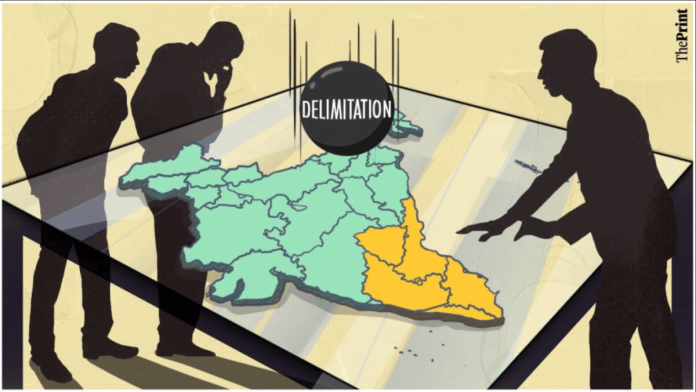


New Delhi: India should increase the number of Lok Sabha constituencies from 543 to 824 by splitting 170 large constituencies into smaller ones to raise the national voter turnout at the next general elections, a working paper by the Economic Advisory Council to the Prime Minister (EAC-PM) suggests.
The study, titled ‘Constituency Size, Composition and the Case for Delimitation in India’s Lok Sabha (2009–2024)’, also recommends that a delimitation exercise be paired with women-specific measures, such as women-only polling booths and evening polling hours.
The study was conducted by Dr Shamika Ravi, a member of the EAC-PM, and Mudit Kapoor of the Economics & Planning Unit at the Indian Statistical Institute (Delhi Centre).
The paper comes amid speculation that the Centre has begun building political consensus for a new delimitation bill before the 2029 Lok Sabha elections.
The Centre introduced three new Bills in a special sitting of Parliament in April to allow delimitation based on the “latest Census figures”, while increasing the total number of Lok Sabha seats from 543 to 850.
The amendments also sought to pave the way for women’s reservation in the Lok Sabha and State legislative assemblies.
However, the Bills were defeated in the Lok Sabha on 17 April, failing to secure the required two-thirds majority votes.
The latest study recommends splitting large constituencies based on a “targeted criterion, not a uniform one” as part of a plan to maximise voter turnout that splits the largest and most responsive constituencies into two or three parts.
The study says the delimitation exercise expected after the 2027 Census is the first opportunity in five decades to redraw the size and number of India’s parliamentary constituencies.
Based on the analysis, the report found that a targeted plan that splits 170 constituencies is predicted to raise national voter turnout at the next general elections. Of these 170, it recommended a two-way split for 59 constituencies and a three-way split for the remaining 111 constituencies.
The paper then makes a case for prioritising three categories for a three-way split.
The first category is the metropolitan constituencies of the southern states: Hyderabad and Secunderabad in Telangana, and Kolkata Dakshin in West Bengal.
The second is the larger metropolitan and secondary-urban constituencies of the Hindi belt and the western states: Bhavnagar and Rajkot in Gujarat, Visakhapatnam in Andhra Pradesh, and Kanniyakumari in Tamil Nadu.
The third consists of select tribal rural constituencies with high Scheduled Tribe population shares: Lohardaga in Jharkhand and Kandhamal in Odisha.
A two-way split is the “natural recommendation” for the constituencies of Kerala and Punjab, and for the secondary-urban constituencies of Karnataka, the report adds.
The report proposes increasing Kerala’s Lok Sabha seats from 20 to 30, Tamil Nadu’s seats from 39 to 59, Andhra Pradesh’s seats from 25 to 38, and Karnataka’s seats from 28 to 42.
The numbers are significant because of concerns raised by southern states about losing representation in a strictly population-based delimitation.
The numbers in the study largely correspond to the numbers suggested by Union Home Minister Amit Shah in Parliament in April.
As suggested by the report, the seats for Uttar Pradesh may increase from 80 to 120, from 40 to 60 for Bihar, and from 48 to 72 for Maharashtra.
In this manner, it largely maintains the proportional representation of at least the larger states in the Lok Sabha.
Ravi is also a part of the Centre’s “High-Level Committee on Demographic Change” headed by Justice (Retd) Prakash Prabhakar Naolekar. It also comprises the Census Commissioner, retired IAS officer Durga Shankar Mishra and retired IPS officer Balaji Srivastava.
Announcing the formation of the committee last month, Union Home Minister Amit Shah had said that “infiltration and other reasons causing unnatural demographic change pose a very significant challenge to the present and future of any nation”.
Also Read: Congress once called him ‘BJP man’: Who is SC ex-judge, Shah’s pick to head Demographic Change panel
Women-only booths, evening polling
The report also recommends that the Election Commission of India introduce “women-specific operational measures” alongside the delimitation process to address the gap in women’s turnout in urban areas.
These measures include women-only polling booths in the urban metropolitan constituencies, extending polling hours to the evening to accommodate the schedules of working women in urban areas, providing transport assistance from urban-fringe residential areas to the nearest polling stations, and conducting voter-roll-update drives targeted at women. These drives should involve Anganwadi centres, women’s self-help groups, and ASHA workers.
The report also recommends a fresh booth-rationalisation cycle along with the next delimitation.
“The empirical case for delimitation, women-specific operational measures, and booth rationalisation is the empirical case for all three together. None of them alone is likely to deliver the full predicted gain,” it says.
The fourth recommendation is for the Ministry of Statistics to release the 2027 Census tabulations on time, and for the Election Commission to continue to publish gender-disaggregated electoral statistics at both the constituency and polling-booth levels. This will help evaluate the impact of women-specific operational measures in real time.
The questions
The report says that the median Lok Sabha constituency in 2024 had 1.82 million registered electors, with the largest constituency having more than 3.2 million voters.
“By global standards, India’s parliamentary constituencies are very large. The policy question is the following: which constituencies should be split, into how many parts, and on what criterion. This brief addresses this question empirically using a panel of 2,171 constituency-elections across the four general elections of 2009, 2014, 2019 and 2024,” it says.
The authors also assert that the relationship between constituency size and turnout in India is driven by the urban share of the constituency, the Scheduled Caste and Scheduled Tribe shares, and the linguistic structure of the population.
Therefore, the data analysed by the authors also corresponded with the demographic and linguistic profile of that constituency in the 2011 Census.
However, the paper flags five caveats. This includes the fact that the demographic and linguistic measures that it uses are from the 2011 Census, and it warns that the report is not a finalised boundary-drawing plan.
(Edited by Sugita Katyal)