





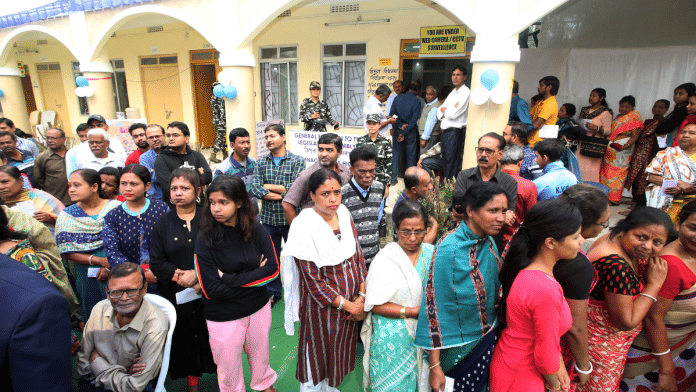


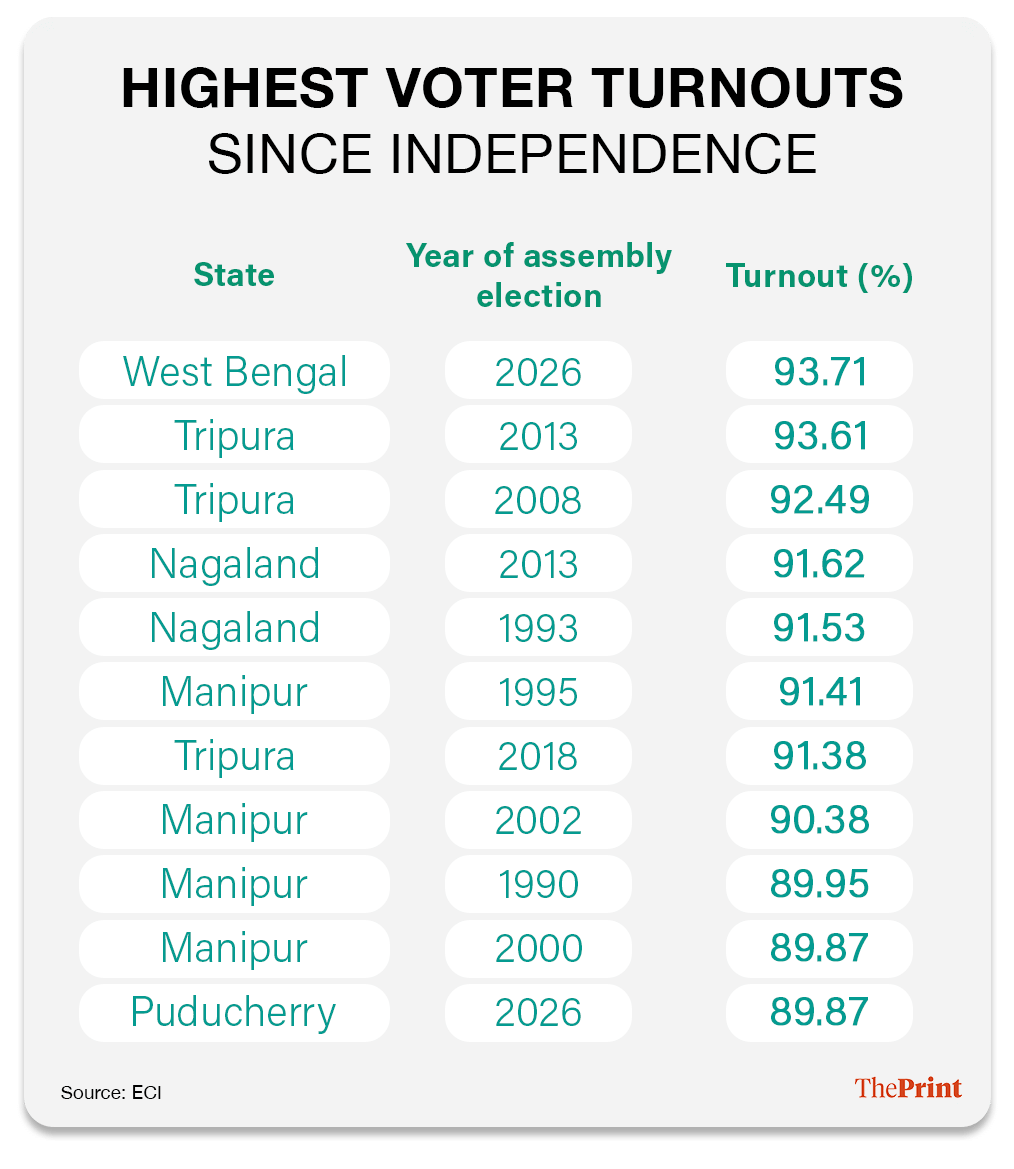
New Delhi: The people of the northeastern states of Tripura, Nagaland and Manipur remain the most enthusiastic about exercising their Constitutional right to vote, according to an Election Commission of India list of 11 states with the highest voter turnout since independence.
West Bengal and Puducherry—which went to polls recently bookend the list with 93.71 percent and 89.87 percent turnout, respectively.
The high voter turnout in West Bengal and Puducherry is attributed to the shrinking of their electorates due to the deletions in the Special Intensive Revision (SIR) of electoral roll. However, northeastern states display a consistent pattern of high voter turnout.
The figures also don’t indicate any direct correlation between voter turnout and the electoral fate of incumbent governments, contrary to common perception.
For instance, in Tripura (which occupies the second and the third spots in the list) the incumbent got a fresh mandate in 2013 and 2008, when the voter turnout was 93.61 percent and 92.49 percent, respectively.
This turnout was marginally lower in 2018, at 91.38%, when the state saw a change in government. Similarly, Puducherry, which witnessed a record 89.87 percent voter turnout in elections this year, retained the ruling NDA.
Nagaland assembly polls of 2013 and 1993 occupy the fourth and fifth spot on the list, with 91.62 percent and 91.53 percent turnout, respectively.
The 2002, 1990 and 2000 Manipur elections feature next in the list, with 90.38 percent, 89.95 percent and 89.87 percent turnout, respectively. The 10th place is tied between 2000 Manipur polls and 2026 Puducherry polls— at 89.87 percent turnout.
‘People (in northeast) have been more educated and politically conscious and they come out and vote. It’s a matter of pride,’ says former Chief Election Commissioner SY Quraishi.
Former Chief Election Commissioner SY Quraishi told ThePrint that eastern and northeastern states have traditionally had a higher voter turnout as compared to the rest of the country.
“We have always been proud of the fact that democracy has been very alive in the North-East. People have been more educated and politically conscious and they come out and vote. It’s a matter of pride,” he said.
Former Chief Election Commissioner OP Rawat attributed the higher turnout to the higher literacy rates and political awareness among the people of the northeastern states.
“Duplicate voters in North India, like in UP, Uttarakhand, Jharkhand, Bihar, MP, Chhatisgarh make for a large number of voters. They are mobile for their livelihoods. They go to other states for seasonal work, so when the voter list has a lot of duplicates, then 5-10 percent of the vote is non-existent,” he told ThePrint, asserting that the voting percentage therefore drops in such states.
This, he said, isn’t the case in states like West Bengal, Kerala and northeastern states “because literacy rates are very high and people are aware that they have to get their names deleted from the earlier rolls if they move”.
Rawat also credits the high political awareness in the northeastern states. “They always ensure that they participate in elections and in politics.”
‘NE states attained statehood after facing a lot of troublesome situations This is the reason they have genetically developed this habit that they have to vote… They believe their vote has value and that it is their sacred duty,’ Biswendu Bhattacharjee, ADR.
According to experts, the reason behind the high voter turnout in the northeastern states may also lie in the historical struggle in the manner in which they attained statehood.
“Northeastern states have attained statehood after facing a lot of troublesome situations. In Manipur, there was an armed struggle. In Tripura, there was an insurgency. They wanted to install a parallel government. Similar situations were faced in Assam and Mizoram,” Biswendu Bhattacharjee, the Tripura Coordinator for the Association of Democratic Reforms, told ThePrint.
“This is the reason why people (in the northeast) have genetically developed this habit that they have to vote… People believe that their vote has value and that it is their sacred duty,” Bhattacharjee added.
Also Read: Victory in Kerala, but Congress continues to grapple with internal strain & shrinking footprint
‘Interpersonal relationships’
Experts also explain that voters in smaller states may be forming more interpersonal relationships with their local leaders, in comparison to larger states.
Praveen Rai, Political Analyst at the Centre for the Study of Developing Societies, Delhi, credits the ECI for the increased voter turnout in the recent times, saying that it is due to ECI’s initiatives in creating a festivalised environment for balloting, revision of electoral rolls and recording of votes through EVMs.
As for the smaller states, particularly in the northeast, Rai asserts that the turnout has been the highest “due to minimisation of insurgency, creation of a safe and secure voting ecosystem, economic compulsions and renewed trust in the government”.
“Citizens rely on MLAs and MPs for securing government jobs and availing facilities like state-run hospitals and schools. As a quid pro, they vote in hordes with the expectation that people’s representatives will aid in receiving the benefits of government welfare policies and help in times of dire needs,” Rai told ThePrint.
He explains that the small size of the state in terms of the electorate ensures greater proximity of the people with their local MLAs and MPs in comparison with larger states.
“The higher interactions result in interpersonal relationships and voting more of a personal obligation in contrast to bigger states where voting behaviour is impersonal with lesser incentive to exercise their franchise,” Rai added.
He also opines that the marginalisation of small states in national media provides an impetus to its citizens to vote in high numbers, and “make a strong statement that they are more democratic than bigger states that continue to dominate the Indian political landscape”.
The anti-incumbency correlation
The elections that are part of the list do not display a correlation with anti-incumbency in the states.
In the 2008 Tripura assembly polls, which saw the second highest voter turnout in India’s history, the Communist Party of India (Marxist)-led alliance, the Left Front, retained control of the Assembly by winning a fourth consecutive term. The alliance won 49 seats and secured a more than a two-thirds majority.
The 2013 polls, which recorded the third-highest voter turnout, also saw the return of the Left Front for the fifth consecutive term. It was only in the 2018 polls— which feature at the seventh spot in the list— that the BJP and its ally, the Indigenous People’s Front of Tripura (IPFT), defeated the Left Front to form government in the state.
Similarly, in the 2013 Nagaland polls, which is at the fourth place in the list, saw the return of the Nagaland People’s Front to power. The 1993 polls, on the fifth place in the voter turnout top 10 list, also saw the Indian National Congress (INC) returning to power.
In Manipur, the ruling Congress won the most seats in the 1990 polls, but a Manipur Peoples Party-led coalition formed the government. A coalition led by the ruling Congress party formed the government following the 1995 elections.
The assembly that was formed following the 2000 elections did not last a full term and the elections were held again in 2002, when the Congress won the most seats but joined the Secular Progressive Front alliance, along with the Communist Party of India, the Nationalist Congress Party and the Manipur State Congress Party.
The SIR theory
Experts attribute the high voter turnout in West Bengal to the Special Intensive Revision (SIR) exercise, which led to the deletion of approximately 91 lakh names in the run up to the polls.
‘SIR exercise & related controversies before actual poll generated a lot of awareness at ground level, charging population towards elections and voting,’ ex-CEC OP Rawat.
This number included 58 lakh voters, who are either dead or had relocated outside the state; and another 27 lakhs, who were removed during adjudication.
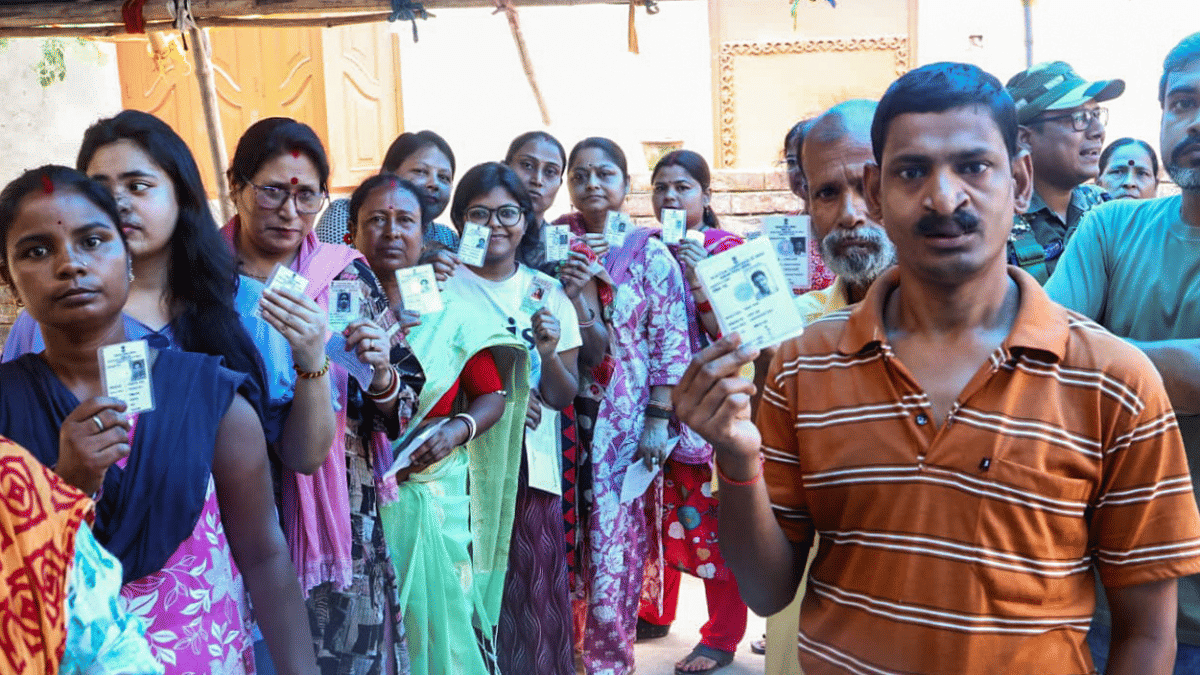
“It is wrong to gloat about the turnout figures in Bengal. The percentage has gone high because of the deletions during the SIR exercise,” Quraishi told ThePrint.
“Take a small example. 80 percent is 80 out of 100. But if you delete 10 voters, 80 out of 90 people may vote, leading to the percentage of voters shooting up,” he added.
Rawat also credits the electoral roll revision for the record turnout in West Bengal.
“The SIR exercise and related controversies for weeks before the actual poll generated a lot of awareness at ground level, charging the population towards elections and voting,” he told ThePrint.
“SIR also removed most of the dead, duplicates permanently shifted or not ordinarily residing as well as those who could not connect to 2003 list or could not explain and substantiate their claim to get out of logical discrepancy criteria.”
(Edited by Ajeet Tiwari)
Also Read: Did SIR help BJP? What data reveals about fiercely-contested West Bengal election
votor turbout in india is proportional to how unemployed youth is, sitamarhi vs mumbai turnout