





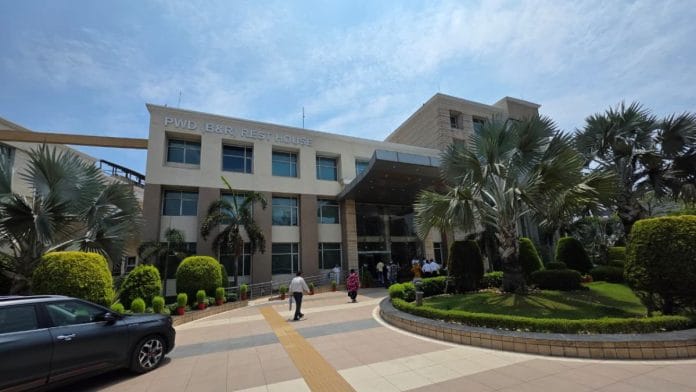


Gurugram: Days after ThePrint reported on Gurugram District Courts functioning out of a government guesthouse in the Civil Lines area, with bedrooms turned into makeshift courtrooms, the Punjab and Haryana High Court Thursday cleared the relocation of Gurugram District Courts to the long-delayed Tower of Justice complex. This, despite the complex still awaiting formal clearances from the Fire Department and Pollution Control Board, and its basement having flooded with sewage water just two days back.
A bench of Acting Chief Justice Ashwani Kumar Mishra and Justice Rohit Kapoor, hearing a suo motu public interest litigation on the project’s delay, permitted the state to go ahead with the relocation “forthwith”, while formal statutory approvals remain pending.
The bench adjourned the matter to 21 July, asking the state to file an affidavit confirming compliance. On Wednesday, it had also pulled up the Haryana government over delay in completing what was touted as northern India’s largest court complex.
The urgency, the bench said in its five-page order Thursday, stems from an unrelated crisis—a fire at the existing Gurugram District Courts that destroyed a large number of court records and left part of the complex structurally unfit for use. Since the fire, the district courts have been functioning out of a guest house, with only urgent matters being heard.
Also Read: Supreme Court proposes stipend for young lawyers, better court infra for women advocates
A nine-year wait, a building still not quite ready
The Punjab and Haryana High Court had taken suo motu cognisance of the construction delay on 29 April this year.
The Tower of Justice, envisioned as northern India’s largest district courts complex, was originally supposed to be ready by October 2020. Nearly six years on, the project has missed one deadline after another, the most recent being 19 June this year.
When the matter came up on 1 July, the Engineer-in-Chief of Haryana’s PWD (Buildings and Roads) told the High Court that the building was complete and ready for handover, with a formal inauguration proposed for 12 July.
The High Court asked the Gurugram District and Sessions Judge to inspect and report back.
That report, filed after inspections conducted on 1 and 2 July, told a different story: the exterior fascia needed repairs and finishing touches, interior work remained incomplete in several places, and furniture had not yet been installed.
More strikingly, the judge reported that the building’s basement was inundated by backflowing sewage water accumulated during rain on 7 July, less than a week before the scheduled inauguration. The District and Sessions Judge also flagged that NOC from the Fire Department and the environmental clearance certificate from the Pollution Control Board were both still awaited, along with operating permissions for lifts and escalators.
Court confronts Haryana govt, gets fresh assurance
When the High Court took up the matter again, it put the contents of the judge’s report directly to the Additional Advocate General, Haryana, Deepak Balyan, who sought a day to obtain instructions. On Thursday, the Engineer-in-Chief appeared in person before the bench and, through the state’s counsel, said the complex was now complete in all respects and any remaining shortcoming would be rectified without delay.
An affidavit was filed affirming that all statutory norms had been complied with, and that the application for the environmental clearance certificate had been submitted.
Administration Finalising Preparations for the Inauguration of the Tower of Justice
Chief Justice of India to Inaugurate Gurugram's State-of-the-Art Tower of Justice on 12 July
A coordination meeting was held under the chairmanship of District & Sessions Judge Shri Narender… pic.twitter.com/itNVL5mUdq
— DC Gurugram (@DC_Gurugram) July 9, 2026
On the fire clearance, the High Court was told officials had already inspected the premises and found no shortcomings, with certificates expected within a day or so. The pollution clearance, however, was still under what the state described as a “detailed process”.
Court weighs paperwork against non-functional courthouse
Faced with a choice, between waiting for all the clearances to come through and a district judgeship whose work had already been “severely curtailed” since the fire, the bench opted for the latter, holding that any further delay in relocating the court would be “prejudicial to the public at large”.
The High Court recorded the PWD engineer-in-chief’s assurance that any shortcoming still found in the building would be “rectified forthwith”, and on that basis allowed the relocation to proceed even as fire and pollution clearances remain in the pipeline. The bench directed that the formal inauguration of the Tower of Justice complex also go ahead as planned.
The Tower of Justice, spread over roughly seven acres, is set to house 55 district and sessions courtrooms, up from the 45 currently functioning in Gurugram, across two blocks of eight and seven floors respectively, along with underground parking. The complex is scheduled to be formally inaugurated on 12 July by Chief Justice of India Surya Kant, marking the culmination of a project running nearly nine years behind schedule.
On 6 July, ThePrint had reported that over a month after a fire broke out at the Gurugram District Courts complex, in May, around 21 courts continued to function from a government guesthouse in the Civil Lines area, with bedrooms turned into makeshift courtrooms, and lawyers and litigants adapting to cramped and unfamiliar spaces.
The cause of the fire, which reportedly originated in the record room, remains unknown.
The blaze rendered parts of the main court complex unusable, forcing the administration to shift several sessions and district courts to temporary premises.
While authorities have indicated that the newly constructed building near the complex could become operational from 12 July, lawyers say there is still little clarity on whether the timeline will ultimately be met. The temporary arrangement, according to them, has affected everyone—from judges and court staff to advocates and litigants—particularly the elderly who now have to navigate unfamiliar locations and cramped facilities.
(Edited by Amrtansh Arora)
Also Read: India is spending billions to modernise its courts. But a glaring fault line stands in way of justice