



New Delhi: India’s imports of Russian crude fell sharply in August as China stepped up purchases of Russian oil, intensifying competition for discounted barrels at a time when Russian supplies have also tightened.
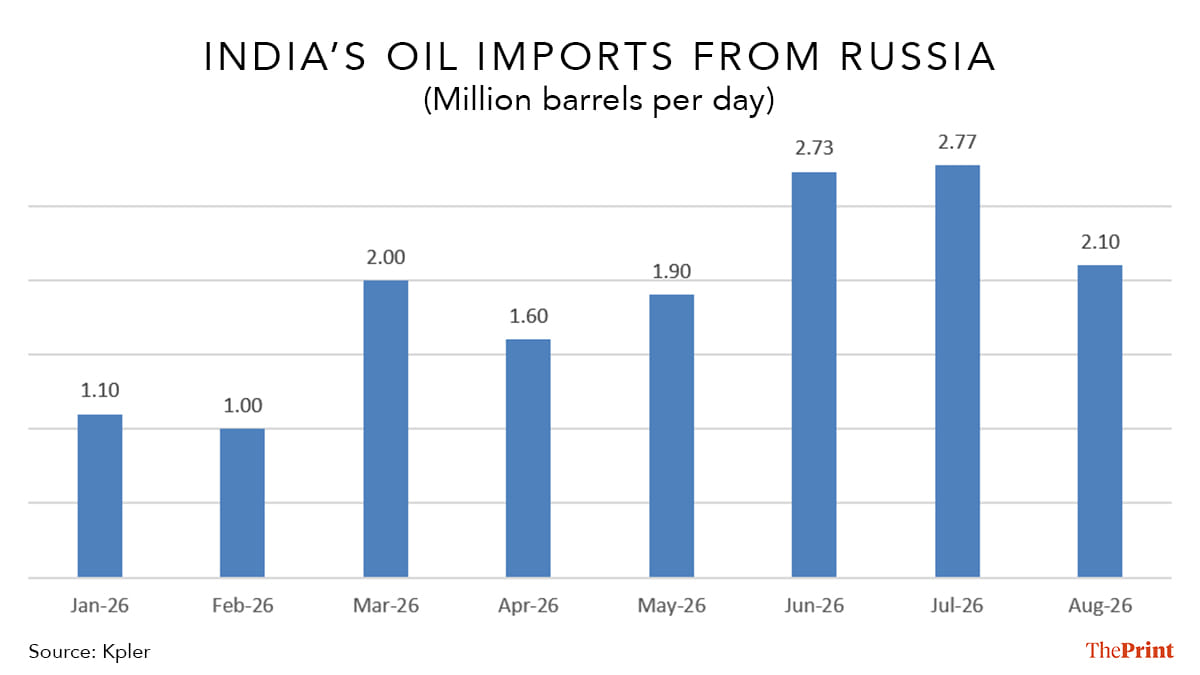
India imported around 2.1 million barrels per day (mbpd) of Russian crude in August, down from 2.7-2.8 mbpd in July, according to Natalia Katona, commodity analyst based in Abu Dhabi.
Trade data intelligence firm Kpler too estimates India’s Russian crude imports at around 2.0-2.1 mbpd for the month. This decline follows Russian imports reaching record levels of around 2.7-2.8 mbpd in June and July.
The August fall reflects a combination of refinery maintenance, normalisation after heavy buying in previous months, lower Russian export availability following infrastructure attacks by Ukraine and stronger competition from China for discounted Russian barrels, according to Sumit Ritolia, senior manager for oil markets at Kpler.
At Indian refineries, maintenance at plants like Mangalore Refinery and Petrochemicals Ltd (MRPL) and Panipat also contributed to the decline.
But the fall in Russian crude purchases is not simply a seasonal story, Katona said.
India’s overall crude imports also declined to 4.7 mbpd in August from around 5.1 mbpd in July, but the August figure was still the country’s highest for the month in the last five years and well above the five-year average of around 4.2 mbpd.
Normally, the monsoon period brings weaker diesel and gasoline demand that provides an opportunity for Indian refiners to undertake maintenance. This year, however, strong refined-product margins and a tight global supply situation have led many other refiners to postpone their maintenance, keeping their plants running.
China takes more Russian barrels
The bigger shift has been the growing competition for Russian barrels.
Overall, Russian crude supply fell to 5.5 mbpd in August from 5.6 mbpd in July and a June peak of 6.4 mbpd. At the same time, China increased its total crude imports to 7.05 mbpd in August from 6.9 mbpd in July and 5.9 mbpd in June.
Chinese imports of Russian crude grew to 1.7 mbpd in August from 1.3 mbpd in July. “We are already seeing more Urals (Russian crude) cargoes being directed toward China than India,” Katona said.
Also, Russia is keeping more crude for its own refineries because of fuel shortages. Some refineries hit by Ukrainian drone attacks are also restarting, increasing demand for crude within Russia.
China, meanwhile, has been using up Iranian crude stored on ships near China and Singapore. With US restrictions limiting Iranian oil shipments, these stocks may not be replenished soon. This is pushing Chinese refiners to buy more Russian crude, explains Katona.
The result is a tighter market for Indian buyers who had benefited significantly from discounted Russian crude over the past few years.
Going forward, Ritolia expects India’s Russian crude imports to stabilise at around 2.0-2.5 mbpd, depending on refinery maintenance schedules and the economics of alternative crude grades.
Gulf barrels offer only partial relief
India is likely to raise crude imports from the Middle East as regional supply and shipping conditions improve, with the UAE expected to be the biggest near-term beneficiary.
The UAE was India’s second-largest crude supplier in August, with shipments rising to around 5,20,000 barrels per day from 4,70,000 barrels per day in July. Saudi Arabia, however, saw its supplies to India fall from 4,15,000 barrels per day in July to 3,50,000 barrels per day in August.
The UAE stands to be the biggest gainer as India increases crude imports from the Middle East, Ritolia said.
However, a recovery in Gulf oil production does not automatically translate into higher exports. Saudi Arabia and the UAE are gradually restoring production after the sharp decline earlier this year, but restrictions on key shipping routes continue to limit the availability of crude for export.
Other Gulf countries like Iraq, Kuwait and Qatar remain particularly vulnerable to restrictions around the Strait of Hormuz, while Iranian exports continue to face severe constraints.
“The Gulf can produce more oil, but those barrels do not help the market until they can be moved out of ports and storage facilities,” Katona said.
This could limit the pace at which Indian refiners can replace Russian crude with Middle Eastern supplies.
While India has diversified its suppliers, crude from the United States offers only limited scope as a direct replacement, as much of the additional US supply is of lighter grades, while several Indian refineries are configured to process heavier crude, according to Ritolia.
Venezuelan crude supplies to India have also moderated as trade flows shift, with a larger share of available Venezuelan crude now being directed to the US, where it is better suited to the refinery configurations on the Gulf Coast.
(Edited by Viny Mishra)
Also read: Is India becoming too dependent on Russian oil? The answer isn’t straightforward