





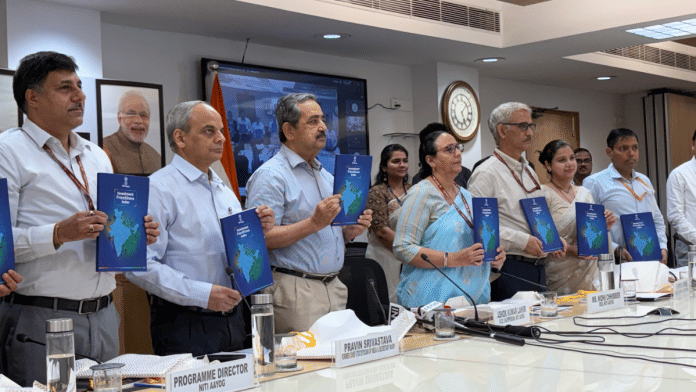

New Delhi: Gujarat has emerged as India’s most investment-friendly state in Niti Aayog’s first-ever Investment Friendliness Index (IFI) 2026, followed by Maharashtra and Tamil Nadu. Niti Aayog hopes that the index rankings will push states to compete for private investments while learning from each other’s best practices.
The report, ‘Investment Friendliness Index’, released Friday assesses all 28 states and eight Union Territories (UTs) on their ability to attract and sustain investments. Rather than being merely a ranking exercise, the index intends to help states identify policy gaps, undertake reforms and strengthen investment ecosystems.
More than 1,850 investors were surveyed and inputs from 165 stakeholders were incorporated while preparing the framework for the Investment Friendliness Index.
Among the large states, Gujarat was at the top position, followed by Maharashtra and Tamil Nadu.
In the hilly and North-Eastern category, Uttarakhand ranked first, followed by Assam and Himachal Pradesh. Among UTs and city states, Goa topped the rankings, followed by Delhi and Chandigarh.
According to the Investment Friendliness Index, Gujarat scored 56.6 out of 100, driven by efficient port operations, a competitive power sector and a favourable business climate.
Maharashtra scored 53.7, supported by strong private equity and venture capital investments, innovation infrastructure and robust economic indicators, while Tamil Nadu scored 53.3 on the back of its manufacturing ecosystem, export performance and infrastructure.
The report classifies states into four categories: Top performers, frontrunners, emerging performers and aspiring states. Five states have been identified as top performers, while 15 have been placed in the frontrunners category, including Delhi, Uttar Pradesh and Andhra Pradesh.
Eight states and UTs including Punjab, West Bengal, Bihar, J&K have been categorised as emerging performers, while another eight including Mizoram, Arunachal Pradesh and Manipur have been placed in the aspiring states category.
The Investment Friendliness Index evaluates states across eight pillars with different weightages that determine investment readiness—infrastructure (25 percent), business climate (20 percent), resources (15 percent), government policy (10 percent), regulatory ease (12 percent), financial health (7 percent), institutional environment (6 percent), and environmental resilience (5 percent).
Launching the Investment Friendliness Index, Niti Aayog Vice Chairman Ashok Kumar Lahiri stressed that the exercise should not be viewed as a competition among states.
“This is not a ranking exercise, this is not a horse race where we have put the states and said, let’s check who is doing the best,” Lahiri said. “It’s an exercise to tell the states that here are some indicators, look at where you are doing well, where you are not doing so well.”
He said the emphasis was on peer learning, arguing that every state has something others can adopt.
“There are things to be learned from Kerala, there are things to be learned from Madhya Pradesh, there are things to be learned from Odisha; so each state can learn from the other state,” he said, adding that the objective was to encourage states to improve on indicators where they lag, rather than celebrate rankings.
The report states the index is “intended to serve as a strategic reform instrument that enables governments to benchmark performance, identify policy gaps, learn from best practices and undertake continuous institutional improvement”.
Speaking at the launch, CRISIL chief economist D. K. Joshi said the index combines publicly available data with investor perception surveys, bringing together objective indicators and on-the-ground feedback.
He said the responses from businesses provide policymakers with actionable insights in areas requiring improvement, while encouraging states to learn from one another and strengthen collaboration with industry.
According to the report, state profiles are designed to help both governments and investors better understand each state’s strengths and weaknesses. Besides presenting macroeconomic indicators and sectoral strengths, Niti’s report identifies the factors driving a state’s score and compares its performance with the national average and the best-performing state across each pillar.
“These profiles will enable states to learn from one another and implement best practices to enhance their investment attractiveness,” the report said.
Ultimately, the report says the Investment Friendliness Index aims to encourage collaboration and informed policymaking.
“By acting on the insights from this index, states can foster a healthier business environment, thereby attracting more capital. This can enable stronger economic growth across states, percolate capital and, thereby, development across regions, strengthen investment attractiveness, and spur meaningful steps towards realising the Viksit Bharat vision,” it said.
(Edited by Viny Mishra)
Also read: The big squeeze: Why India’s richest states are spending more but building less