








New Delhi: Over the past decade, state government budgets across India have experienced dramatic expansion. However, a closer look at how the money is being spent reveals a concerning trend: investment spending is diminishing, even in the nation’s wealthiest states.
Consider Karnataka and Maharashtra, two of India’s most industrialised and fiscally robust states. Both have witnessed their total expenditures more than double since 2017-18. Specifically, Karnataka’s spending increased from Rs 1.86 lakh crore to Rs 4.48 lakh crore by 2026-27, while Maharashtra’s expenditure rose from Rs 2.84 lakh crore to nearly Rs 7.7 lakh crore over the same period.
Despite these expanding budgets, the proportion allocated to capital expenditure—which encompasses spending that constructs infrastructure, generates assets and supports long-term growth—has markedly declined.
Instead, an increasing portion of state finances is being consumed by revenue expenditure and debt servicing, thereby reducing the capacity for investment.
The quiet fall in public investment
The shift becomes evident when one looks at capital expenditure as a proportion of total expenditure.
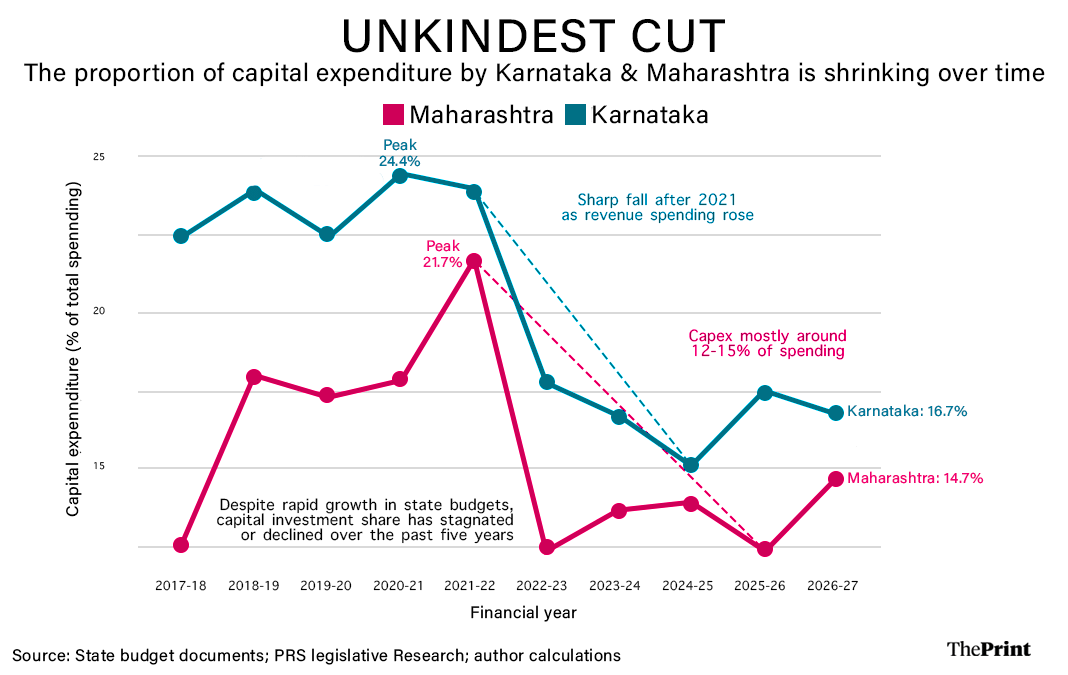
In Karnataka, capital expenditure constituted over 24 percent of total spending in 2020-21. However, this proportion has steadily declined since then.
By 2024-25, it had decreased to 15 percent, before experiencing a slight recovery to approximately 16.7 percent in 2026-27. Maharashtra exhibits a similar trend. Capital spending reached 21.7 percent of the budget in 2021-22, but subsequently declined sharply, stabilising between 12 percent and 15 percent in the years that followed.
In absolute terms, capital spending has increased modestly. Nevertheless, relative to the size of state budgets, investment spending has evidently diminished in priority. This is significant because capital expenditure possesses one of the highest fiscal multipliers among government spending categories.
Investments in roads, irrigation systems, urban transport networks and energy infrastructure enhance productive capacity and stimulate private investment. When the proportion of such spending declines, the long-term growth impact of government expenditure weakens.
The revenue spending trap
The observed reduction in investment spending signifies a more profound structural transformation within state budgets, wherein revenue expenditure is progressively crowding out capital spending.
Revenue expenditure encompasses salaries, pensions, subsidies, welfare schemes and administrative costs. While these expenditures are essential for government operations, they predominantly constitute recurring obligations that leave little lasting economic assets behind.
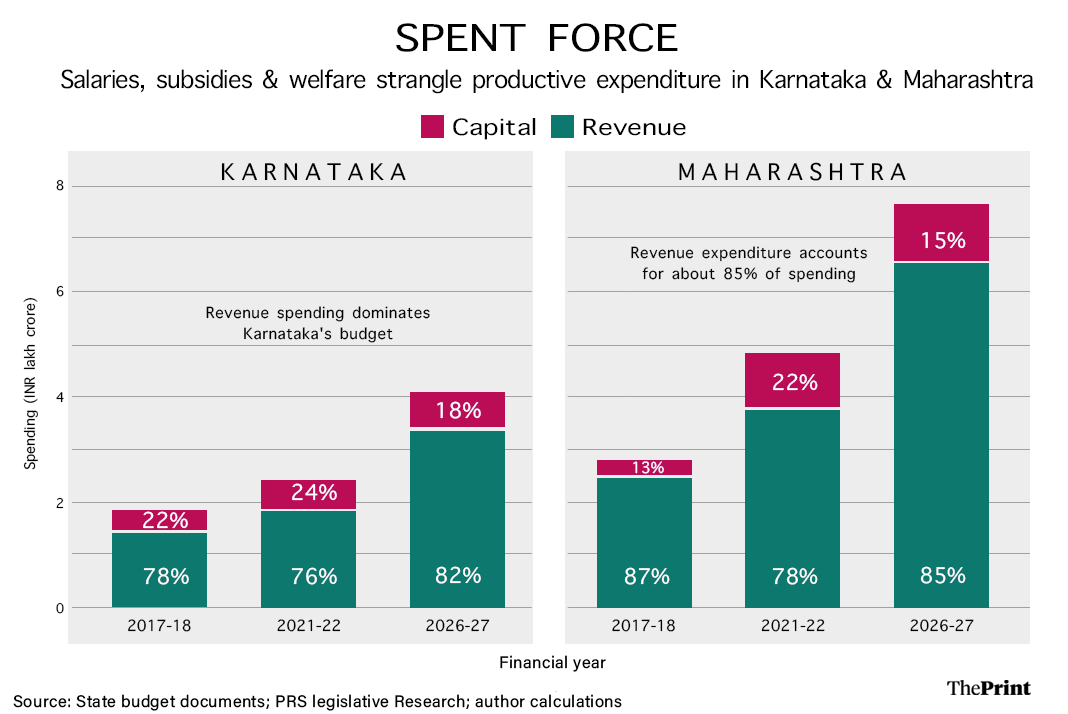
In Karnataka, revenue expenditure constituted 78 percent of total spending in 2017-18, with projections indicating an increase to approximately 82 percent by 2026-27.
In contrast, Maharashtra exhibits an even more pronounced pattern, with revenue expenditure comprising 87 percent of the budget in 2017-18, and currently maintaining a level of around 85 percent of total spending. This means that less than one-sixth of spending is now directed toward building long-term public assets.
This trend partially reflects the expanding welfare obligations of state governments. Additionally, competitive electoral politics have heightened the impetus to implement subsidies, cash transfers and social programmes. However, this has resulted in a gradual reduction in investment spending, even in states that are otherwise fiscally stronger than most.
When debt servicing crowds out development
A significant constraint on investment is the escalating burden of debt servicing.
Both Karnataka and Maharashtra have experienced a substantial widening of their fiscal deficits over the past decade. Karnataka’s fiscal deficit has increased from Rs 33,359 crore in 2017-18 to over ₹90,000 crore by 2026-27. Maharashtra’s deficit has expanded even more sharply, from Rs 38,789 crore to about Rs 1.5 lakh crore.
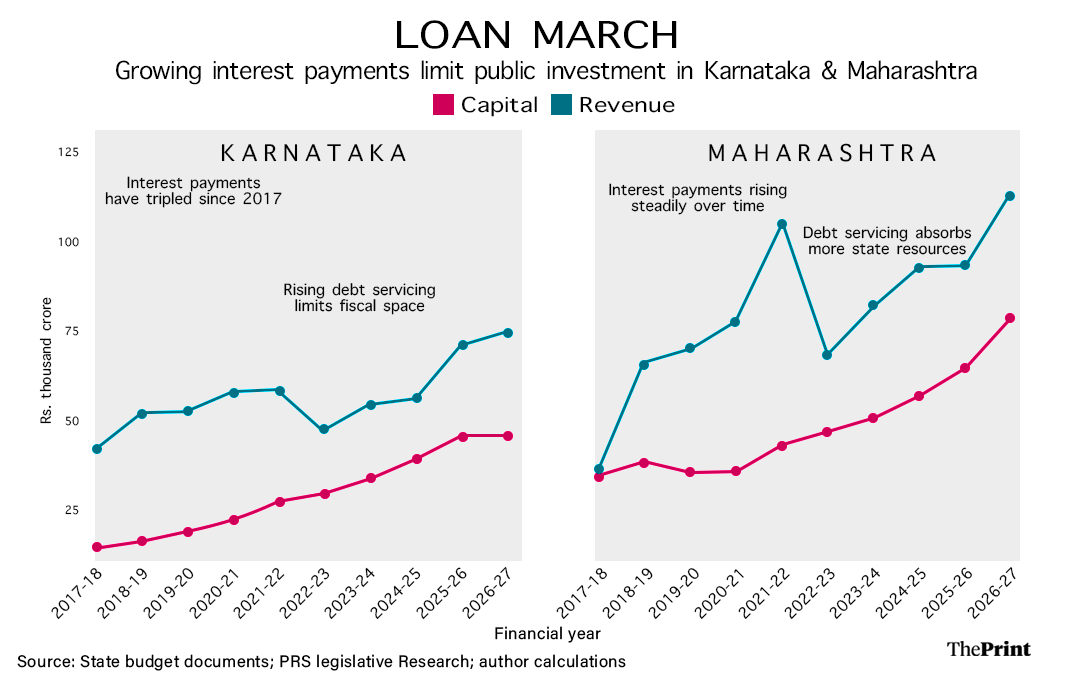
As borrowing increases, so do interest payments.
Karnataka’s interest burden has more than tripled, rising from Rs 14,159 crore to approximately Rs 45,600 crore over the same period. Maharashtra’s interest payments have escalated from Rs 34,127 crore to nearly Rs 79,000 crore.
What’s even more concerning is the rapid pace at which these payments are encroaching upon development spending. Interest payments now consume a growing share of state budgets, thereby narrowing the fiscal space available for new investment.
When governments are compelled to allocate a larger portion of their budgets in order to service past borrowing, fewer resources remain for infrastructure development or the expansion of productive capacity.
Also Read: India must reduce its dependence on fertiliser imports before it’s too late
How states can reverse the investment squeeze
Rebalancing state budgets toward investment will require more than mere incremental fiscal tightening. It requires a reassessment of the spending composition itself.
In Karnataka, the pressure on revenue expenditure has intensified following the introduction of the government’s flagship guarantee schemes, including Gruha Lakshmi, Shakti, Anna Bhagya, Gruha Jyothi and Yuva Nidhi. Collectively, these programmes are estimated to cost Rs 50,000-Rs 60,000 crore annually, rendering them one of the largest recurring fiscal commitments in the state budget.
These programmes have explicit social objectives. However, their scale highlights a broader fiscal trade-off: as recurring welfare commitments expand rapidly, they inevitably constrain the fiscal room available for infrastructure investment.
Karnataka faces a different yet equally significant set of fiscal pressures. Large power subsidies for agriculture, periodic farm loan waivers, and expanding social sector commitments have steadily increased the state’s revenue expenditure. Concurrently, Maharashtra holds one of the largest debt stocks among Indian states, which accounts for the steady rise in interest payments over the past decade. For both states, restoring the balance between consumption and investment will require a three-pronged approach.
First, better targeting of welfare spending is essential. Social protection programmes will remain a central responsibility of state governments, but improving beneficiary targeting and reducing inefficiencies can significantly alleviate fiscal pressure without weakening support for vulnerable households.
Second, states must strengthen their own revenue base. Expanding property taxation in rapidly growing urban centres, improving GST compliance, and rationalising user charges for public utilities can generate additional fiscal space without raising statutory tax rates.
Third, governments should adopt fiscal rules that explicitly protect capital expenditure. Several advanced economies have attempted to achieve this through institutional frameworks that prevent investment from being squeezed by routine spending pressures.
The United Kingdom’s ‘Golden Rule’, adopted in the late 1990s, allowed governments to borrow only to finance investment and not for day-to-day spending. Similarly, Germany’s constitutional ‘debt brake’ places strict limits on fiscal deficits while allowing carefully structured borrowing for long-term public investment.
The principle behind such frameworks is straightforward: governments may borrow to build assets that benefit future generations, but not to finance recurring consumption. Adapting a similar approach at the state level by ring-fencing infrastructure spending within fiscal frameworks could help ensure that capital expenditure does not become the easiest casualty of political spending cycles.
Karnataka and Maharashtra remain two of India’s most powerful economic engines. Yet, their budget trajectories illustrate a growing fiscal paradox: public spending is rising rapidly even as the share devoted to building the future is shrinking.
In the long run, economic growth depends less on how much governments spend and more on what they spend it on. When interest payments begin to rival infrastructure spending, the warning signs are already visible. For India’s wealthiest states and for the broader trajectory of state finances, the choice is becoming increasingly clear: spend more on consumption today, or invest more in productivity tomorrow.
(Edited by Nardeep Singh Dahiya)
Also Read: Interest rates are stubbornly high globally. And the West Asia conflict is not to blame