





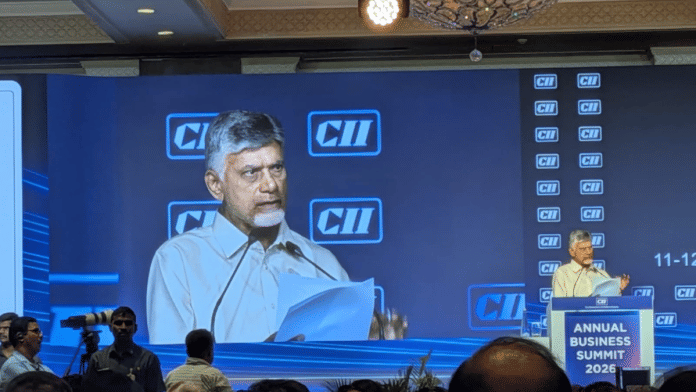

New Delhi: Andhra Pradesh Chief Minister Chandrababu Naidu on Monday praised Prime Minister Narendra Modi over the BJP’s victory in West Bengal elections, and backed his appeals to citizens to take measures to shield the country from the impact of the West Asia war.
Speaking at Confederation of Indian Industry (CII) Annual Business Summit in New Delhi, he said Bengal used to be the country’s thought leader, but it lost that position over the past four decades. He said the state will once again regain that under the BJP government.
He said the country is at a “historic inflection point”, unmatched since the reforms of the early 1990s, and leadership like PM Modi’s is sorely needed.
Naidu particularly lauded the PM’s appeal to people to take measures to minimise the impact of the West Asia war on India, and said it has given a “mission” to the country.
In his appeal, the PM encouraged work from home and called on Indians to stop buying gold for a year, cut down on foreign travel, conserve fuel and try amidst the fuel crisis brought on by the closure of the Straits of Hormuz.
Naidu supported the PM’s call, saying “everything is available at home”.
Naidu especially highlighted the need for energy self-reliance. Of 500 GW in renewable energy capacity planned by India, he said, “Andhra will contribute 160GW”. He said that deals have already been signed for projects totalling 90GW in the state.
He underlined the risk of India’s reliance on fertilizer imports too, proudly announcing that Andhra Pradesh has “20 lakh acres of land in natural farming”, and it is expanding.
For his own state, Naidu painted a rosy picture. Telling the audience about Google’s $15-billion investment in a data center outside Visakhapatnam, which began construction in late April, he said it is “the biggest FDI since liberalisation”.
He also revealed that many other firms have approached his government to discuss investments of similar magnitude. “There is huge demand now.”
Naidu credited Andhra’s investment success story to his focus on ease of doing business, including an initiative to deliver all state services entirely digitally. “Any citizen need not come to (government) office,” said Naidu, whose focus has moved from ease of doing business to “speed of delivering governance”.
Once a proponent of population control policies, he admitted that Andhra’s “ageing problem” now requires a focus on population management, such as his government’s policy of providing direct cash payments to mothers on the birth of their 3rd and 4th child.
He also raised a warning note over India’s skill gaps, encouraging cooperation between academia, industry, and government to produce talented graduates. “Employability must become India’s national mission.”
However, Naidu said he believes India is perfectly placed to accelerate its growth and become a leader in deep tech fields.
While the country “must aggressively scale” renewable energy, power storage, and computing, he said he is confident in the country’s ability to become the world’s second-largest economy by 2037.
Sahaj Sankaran, a TPSJ alumna, is currently interning with ThePrint