





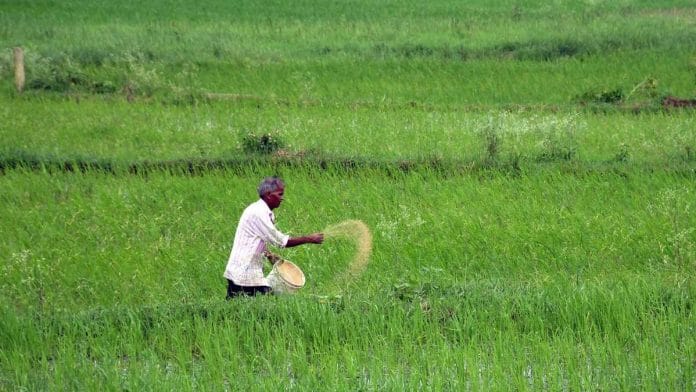


Gurugram: Days after Prime Minister Narendra Modi appealed to farmers to cut their use of chemical fertilisers by 25 to 50 percent, government data placed in Parliament suggests the message has not translated into lower consumption on the ground, with sales of all major fertilisers rising sharply this Kharif season compared to last year.
In a written reply to the Lok Sabha Friday, Union Minister for Chemicals and Fertilisers J.P. Nadda said the availability of urea, Diammonium Phosphate (DAP), Muriate of Potash (MOP), and complex Nitrogen-Phosphorus-Potassium-Sulfur (NPKS) fertilisers had “remained adequate” between April 1 and July 27.
But the numbers behind that reassurance tell a fuller story.
All India figures of requirement, availability and actual DBT sales tabled in Parliament as on 19 July showed the figures running well ahead of what was planned for the season.
Against a Kharif urea requirement of 109.40 LMT, availability stood at 163.78 LMT and DBT sales had already touched 94.78 LMT—meaning farmers had drawn down nearly 87 percent of the season’s entire urea requirement with more than two months of the Kharif season still to run.
The pattern repeats across the other three fertiliser categories: DAP sales of 22.82 LMT against a requirement of 31.57 LMT, MOP sales of 5.50 LMT against a requirement of 10.06 LMT, and NPKS sales of 39.36 LMT against a requirement of 48.48 LMT.
How the numbers are worked out
According to an official in the Haryana Agriculture Department, the “requirement” is the government’s own estimate of how much of each fertiliser a state will need for the season, worked out from the area sown, the cropping pattern, soil health card data and past consumption trends, in consultation with state agriculture departments.
“This is essentially a target, not a cap,” he explained.
“Availability” is the actual physical stock in the pipeline for that state or the country as a whole: Opening stock plus fresh receipts from domestic production and imports during the period.
The “DBT sales” refers to fertiliser actually sold to farmers, captured through Aadhaar-linked Point of Sale (PoS) machines at retail shops.
The Centre releases 100 percent of the subsidy to fertiliser companies only after a PoS-verified sale is recorded, making DBT sales figures a real-time, farmer-level record of what is being bought rather than what is available in godowns, he added.
Read together, the three figures make the point plainly:It is not supply that is constraining farmers, and it is not restraint that is limiting demand—sales are running ahead of the government’s own requirement estimates in state after state, even as the Prime Minister publicly appeals for cuts of up to half.
States buying more than they need
A state-wise breakup tabled in Parliament shows the gap between what the government estimated farmers would need and what they actually drew through the Direct Benefit Transfer system is starkest in a handful of states—Haryana among them.
Against a stated urea requirement of 5.93 LMT for the ongoing Kharif season, Haryana farmers had already purchased 7.17 LMT through DBT as on July 19—about 21 percent more than the government’s own requirement estimate, data presented in Parliament showed.
Haryana was not alone. Himachal Pradesh farmers bought 0.24 LMT of urea against a requirement of just 0.15 LMT, about 60 percent more than needed.
In Jammu & Kashmir, DBT sales of 0.75 LMT ran roughly 32 percent ahead of the 0.57 LMT requirement.
Assam recorded sales of 1.57 LMT against a requirement of 1.27 LMT, about 24 percent higher, while Kerala’s 0.38 LMT in sales exceeded its 0.31 LMT requirement by close to 23 percent.
The PM’s appeal
Modi’s appeal came in May this year when he urged farmers to pledge to cut chemical fertiliser use by a quarter to half, framing it as necessary to protect both soil health and the exchequer.
He reminded citizens that a bag of urea sells for around Rs 3,000 in other countries, while the government subsidises it to under Rs 300 a bag in India. “We need to take a pledge… we have to do it,” Modi said, warning that continued overuse would eventually leave the soil unable to produce, and nudging farmers instead towards natural farming.
Agriculture Minister Shivraj Singh Chouhan had struck a similar note, saying he was confident India could cut chemical fertiliser use by half without hurting crop productivity.
(Edited by Viny Mishra)
Also read: India must reduce its dependence on fertiliser imports before it’s too late