



New Delhi: Every month, statisticians in India compile the prices of a wide range of consumer goods and services, from rice and rent to school fees and silver anklets, to calculate the Consumer Price Index (CPI) inflation. In September, this figure rose to 5.54 percent from 4.83 percent in August, raising concerns as it approached the Reserve Bank of India’s (RBI) upper inflation tolerance limit of 6 percent.
Yet a single figure, while concise, can be both accurate and misleading. Consider an elevator with twelve occupants: if a few individuals with significantly higher weights enter, the average weight rises, even though most passengers remain unaffected. Similarly, the CPI comprises twelve categories of household expenditure. In September, onions, silver and the transportation of goods by lorry drove the increase, while other categories remained relatively stable.
A tale told in kitchens
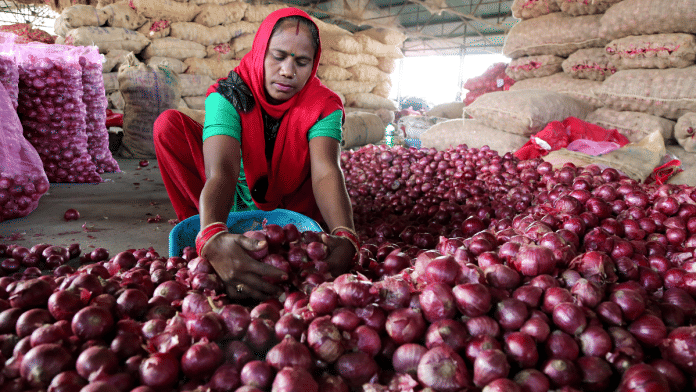
Onion inflation in the CPI basket reached 108 percent year-on-year, as per data from the Ministry of Statistics and Programme Implementation (MoSPI). Figures from the Department of Consumer Affairs show that the average all-India retail price of onion rose from Rs 27.4 per kilogram in September 2025 to Rs 52.8 in September this year. According to the RBI’s October monetary policy report, this increase reflects depleted and partially spoiled rabi stocks, alongside uncertainty over kharif arrivals due to uneven rainfall.
Economists have long recognised this pattern. In 1934, Nicholas Kaldor introduced the “cobweb theorem” to describe cyclical price and output fluctuations that occur when farmers base planting decisions on previous-season prices. Mordecai Ezekiel developed the theory further in 1938, explaining how such markets can oscillate between surplus and scarcity, tracing a spiderweb-like pattern on a supply-and-demand diagram. In India, onion prices remained low for two to three years, prompting farmers to reduce production. Thus, the inexpensive onions of 2025 gave way to the costly onions of 2026.
Manya Aggarwal/ThePrint
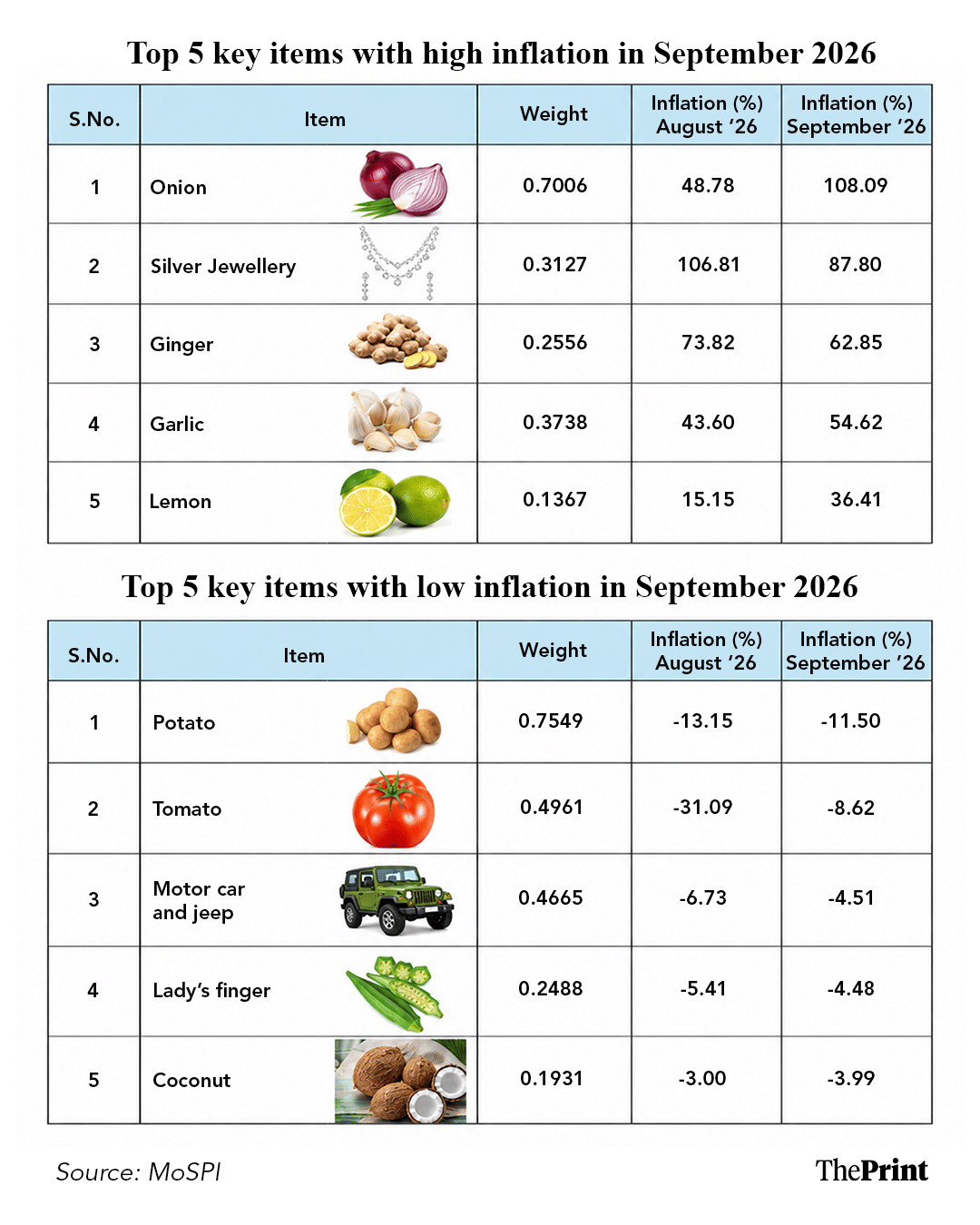
According to MoSPI data on items with the fastest- and slowest-rising prices, onion prices more than doubled, while potato and tomato prices—common household staples—fell by 11.5 percent and 8.62 percent, respectively.
Demand does not distinguish between vegetables in this way; supply dynamics do. These price increases are specific to crops with distinct storage challenges. Joining onions among items with high inflation were ginger at 62.85 percent, garlic at 54.62 percent and lemon at 36.41 percent. A rough estimate based on published weights suggests that onions alone contributed approximately half a percentage point to headline inflation.
Silver, sentiment and the open road
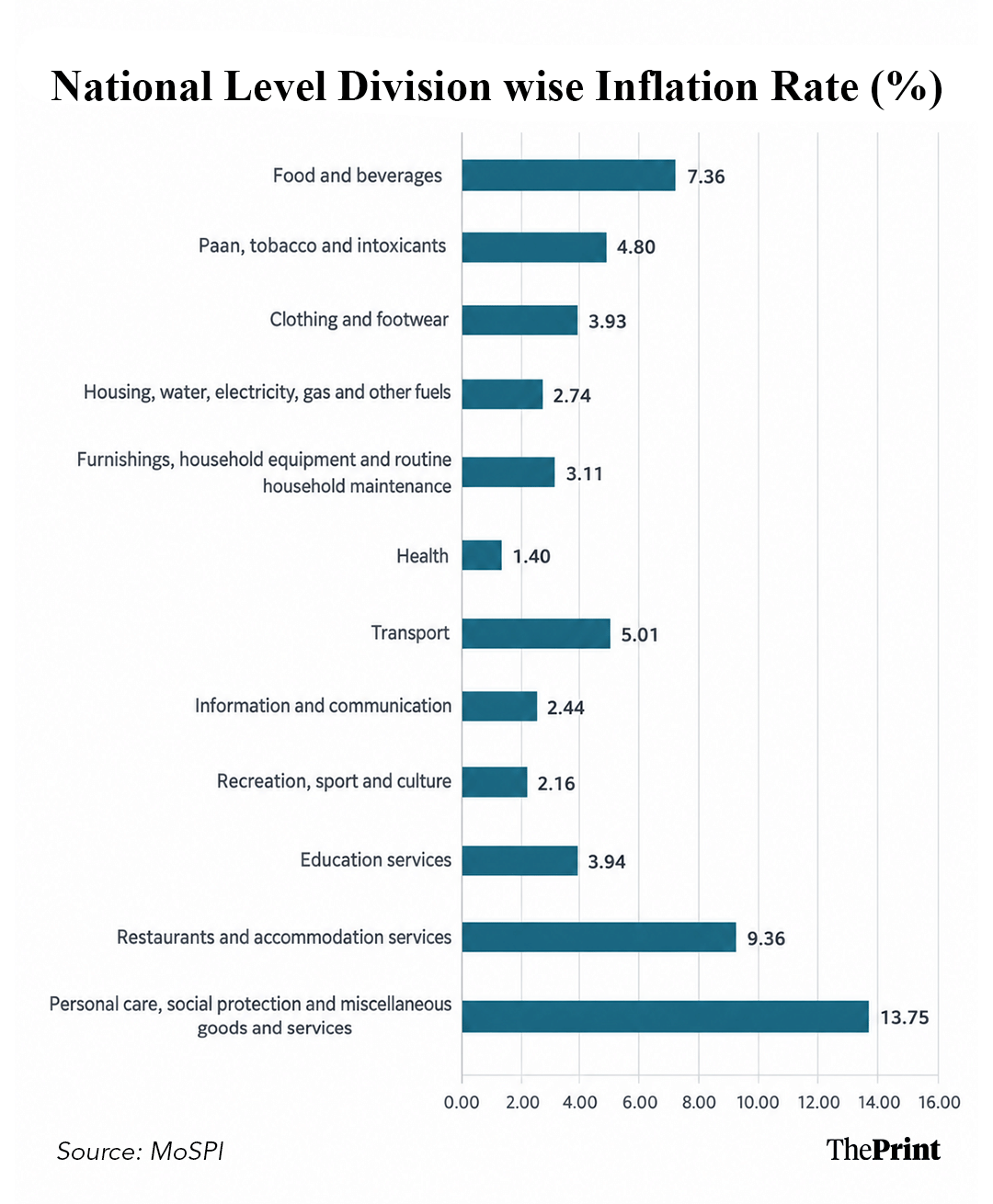
The second factor driving inflation is unrelated to Indian kitchens. Silver jewellery inflation stood at 87.8 percent, while the “other personal effects” category, which includes precious metals, rose 38.69 percent. This pushed inflation in the personal care and miscellaneous division to 13.75 percent, the highest among the divisions. Silver is priced in global markets, where it has experienced a prolonged rally. India imports these price pressures, reflecting global market conditions rather than domestic economic overheating.
Manya Aggarwal/ThePrint
To assess the economy’s performance, economists examine core inflation, a concept discussed by Otto Eckstein in his 1981 book Core Inflation. He described it in terms of the persistent underlying trend in overall price levels after excluding volatile items.
September’s data is reassuring in this context: health inflation stood at 1.40 percent, housing and utilities at 2.74 percent, information and communication at 2.44 percent, and recreation at 2.16 percent. Milton Friedman’s assertion that inflation is always a monetary phenomenon applies to situations in which excessive money chases limited goods across the economy, not necessarily to an index in which hospital bills and rents remain stable while onion and silver prices surge.
The government’s division-wise chart reinforces this point. In 1995, economists Laurence Ball and Gregory Mankiw showed that headline inflation can rise not because all prices increase uniformly, but because a few sharp price increases skew the distribution of price changes while others remain stable. This is the pattern observed in September: personal care (including silver) and restaurant meals stand out against a backdrop of shorter bars representing more moderate inflation.
One figure warrants particular attention: the cost of transporting goods, commonly referred to as freight bill, rose 14.73 percent, while restaurant meal prices rose 9.36 percent. Freight can transmit a localised shock across the economy because lorries carry goods to retail shelves. Central bankers call this a second-round effect, when an initial supply shock shifts from a temporary disturbance to a more permanent influence on the economy.
Why the math still matters
The 5.54 percent inflation rate cannot be ignored. The index for September 2025 remained unchanged from August 2025, suggesting that a favourable base effect did not contribute significantly to September 2026 inflation. Prices rose by 0.69 percent in a month, equivalent to an annualised rate of about 8.6 percent. Even if prices stabilise from this point forward, inflation would register 5.54 percent in October, 5.27 percent in November and 5.18 percent in December. The next three inflation readings are therefore, to a degree, predetermined.
Rural inflation of 6.08 percent, compared with 4.88 percent in urban India, sends a clear message. This pattern is consistent with Engel’s law, formulated by German statistician Ernst Engel in 1857: poorer households allocate a larger share of their budgets to food. Food inflation consequently acts like a regressive tax.
This rationale underpinned the Urjit Patel Committee’s 2014 decision to adopt headline CPI rather than a core measure as India’s inflation anchor. Indian households form expectations based on everyday purchases, such as vegetables, and once those expectations become unanchored, they are costly to restore.
A repo rate increase can temper demand, but it cannot increase onion production or improve storage. The government is distributing 1.21 lakh tonnes from its buffer stock at a subsidised rate of Rs 35 per kilogram in Delhi and more than 50 other cities. Yet by late September, retail prices in major cities ranged from Rs 53 to Rs 60 per kilogram.
This gap highlights the need for greater storage capacity, stronger cold chains to reduce spoilage, and procurement strategies that anticipate market fluctuations. With the kharif crop expected between September and November, some relief is anticipated.
India’s current inflation challenge is less about an overheated economy than about inefficiencies in onion storage. Addressing these storage issues would significantly ease the central bank’s task.
(Edited by Chingkheinganbi Mayengbam)