




New Delhi: Tamil Nadu Finance Minister N. Marie Wilson delivered a two-and-a-half-hour Budget speech Wednesday, which introduced numerous individually named schemes but provided few aggregate figures.
The speech elicited an immediate political response, with AIADMK’s Edappadi Palaniswami characterising it as a major disappointment due to the absence of significant announcements.
This assessment, however, conflates visibility with substance.
The most discussed elements of the Budget are its least significant. The core issue lies in a fiscal decision that the government is yet to fully address: whether to resolve its debt problem through economic growth or by increasing expenditure.
Also Read: At NITI Aayog, Vijay lays out TN development agenda—raises NEET, funds, youth skills & infra demands
The scheme that made news, and its actual size
The Annan Seer Thittam scheme, which provides a gold coin and saree for brides, received the most attention, with an allocation of Rs 812 crore. The Thaaimaaman Thanga Mothiram Thittam, offering a gold ring for each newborn delivered in a government hospital, was the second most highlighted, with Rs 560 crore.
Additionally, the enhanced fishing assistance, amounting to Rs 135 crore, contributes to a total of approximately Rs 1,500 crore for these symbolically significant welfare transfers. The increase in the Haj subsidy from Rs 25,000 to Rs 35,000 per pilgrim is also noteworthy, although its specific cost is not separately detailed in the Budget speech.
It is included within the Rs 1,700 crore allocated to the Backward Classes, Most Backward Classes, and Minorities Welfare Department, which also supports scholarships, women’s aid societies, and burial ground infrastructure.
Economists refer to the phenomenon where these schemes capture public attention despite their relatively modest cost as salience bias. This concept from behavioural public finance suggests that both voters and commentators tend to overemphasise spending that is vivid, novel, and personally identifiable, such as a gold ring or a named scheme, over more substantial but less conspicuous expenditures, such as a department’s wage bill.
For instance, while a gold ring is easily recognisable, a teacher’s salary is not, even though the latter incurs significantly higher costs. The School Education Department alone was allocated Rs 44,527 crore, nearly thirty times the combined cost of the prominent welfare-transfer schemes announced.
The primary concern of the white paper back in June was not the sarees or gold rings, but rather the foundational expenses: salaries, pensions, and interest, which quietly consume the majority of every department’s budget, irrespective of the announcements made publicly.
Where the big money actually goes, and what that reveals about the government’s priorities? Here is what today’s speech disclosed by department, ordered by size.
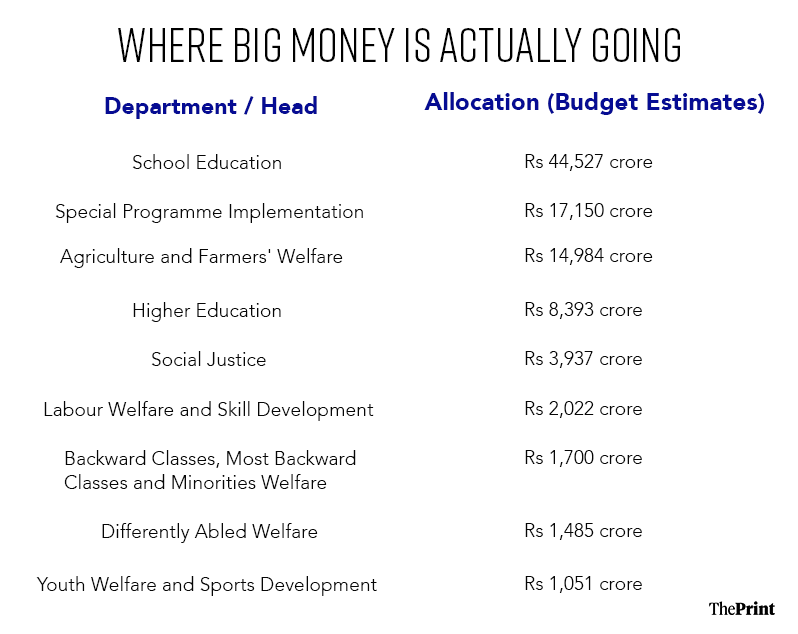
The nine disclosed departmental heads collectively account for approximately Rs 95,200 crore, with the composition being as significant as the total amount. Since Theodore Schultz’s seminal work on human capital in the 1960s, development economists have differentiated between expenditures that enhance a population’s future productive capacity, such as education, skill development, and health, and those that merely redistribute current income.
According to this criterion, the majority of the disclosed spending in this Budget, including allocations for School Education, Higher Education, and the skilling initiatives under Labour Welfare, aligns more closely with human capital investment than with consumption transfer, despite lacking the immediate appeal of a gold coin.
The Rs 44,527 crore allocated to School Education primarily covers salaries and pensions for a workforce serving over 4.3 million enrolled students, which falls under the committed expenditure category identified in the white paper as already consuming 64 percent of revenue receipts.
However, committed expenditure on teachers represents a long-term investment with an associated wage bill, distinct from a subsidy that could be withdrawn at any time. The latter is subject to what in public finance is referred to as the ratchet effect: a transfer that, once initiated, becomes politically challenging to reverse, thereby permanently increasing the state’s spending baseline irrespective of the revenue cycle.
In comparison, the new capital-oriented commitments appear relatively modest: Rs 2,000 crore for the Vetri Laptop Scheme and Rs 640 crore as the state’s 20 percent construction grant towards a Rs 3,200 crore student hostel infrastructure project, executed through a private-partner DBFOT structure.
This approach leverages private capital rather than fully funding the project with public resources. Such fiscal engineering, utilising PPP structures to sustain capital expenditure without a corresponding increase in public debt, is essential for a state with limited borrowing capacity.
The skilling initiative follows a similar rationale on a smaller scale: the Vetri Skill Training Scheme aims to benefit 1.2 million college students and 100,000 unemployed youth this year, supported by Rs 150 crore in stipend funding.
Additionally, five new ITIs (Industrial Training Institutes), with a total project cost of Rs 90 crore, receive Rs 7.5 crore this year to commence operations, with the remaining funds to be allocated as the institutes are developed.
The revenue side gets specific, and this is where the government is making its actual bet. The distinguishing feature of this Budget, compared to previous reports, is the inclusion of specific figures in the “efforts to increase revenue” section, which was previously vague.
The government has imposed an additional privilege fee on liquor manufacturers, anticipated to generate up to Rs 1,000 crore annually. Additionally, a series of IT-driven initiatives, such as faceless GST assessment, faceless property registration, and comprehensive computerised monitoring of mining activities, is expected to yield approximately Rs 15,000 crore in additional revenue.
Collectively, these measures aim for a revenue mobilisation target nearing Rs 16,000 crore, which, while slightly below, aligns with the white paper’s estimate of Rs 20,000 crore recoverable through leak-plugging alone.
This represents a significant economic decision, meriting explicit recognition. The government is prioritising the closure of its fiscal gap through administrative efficiency, enhanced enforcement, digitisation, and reduced leakage, rather than resorting to new taxation or expenditure reduction.
Economists would describe this as a focus on revenue effort rather than revenue capacity, aiming to extract more from the existing tax base instead of expanding the base or increasing rates.
This approach is the least politically contentious for a newly elected government committed to welfare promises, and aligns with the white paper’s assessment that Tamil Nadu’s issues are administrative rather than structural.
Furthermore, the government has initiated a more structural measure by establishing a new expert committee on Revenue Augmentation, chaired by Montek Singh Ahluwalia, the former Deputy Chairman of the Planning Commission.
This committee is tasked with providing recommendations for sustainable growth of the state’s tax and non-tax revenue. The involvement of an economist of Ahluwalia’s calibre indicates the government’s intention to frame this as a technocratic reform rather than mere tax administration.
What this Budget actually is
When considered collectively, this approach does not align with the reckless, debt-financed populism suggested by a sensational headline, nor does it meet the disciplined fiscal correction indicated by the white paper’s figures.
Instead, it reflects a familiar pattern in Indian state finance: an effort to fulfil welfare commitments through efficiency gains rather than austerity, with the expectation that economic growth and improved enforcement will address the remaining challenges.
While this strategy is defensible, it is also the most convenient for any state government facing a debt issue, as it requires minimal sacrifice.
The government’s own records indicate that its debt has doubled over five years to approximately Rs 10 lakh crore in direct terms, aligning with the broader Rs 13.18 lakh crore figure when public sector undertaking debt is included.
The critical evaluation, which only the Annual Financial Statement can resolve, is whether the Rs 16,000 crore in new revenue measures will be realised swiftly enough to support the Rs 95,200 crore in disclosed departmental spending without approaching the borrowing limit cautioned by the white paper.
Efficiency gains represent the most cost-effective form of fiscal consolidation, precisely because they are the easiest to overpromise.
(Edited by Ajeet Tiwari)
Also Read: TVK White Paper audits finances under DMK: Every newborn carries debt burden of Rs 1.28 lakh now