


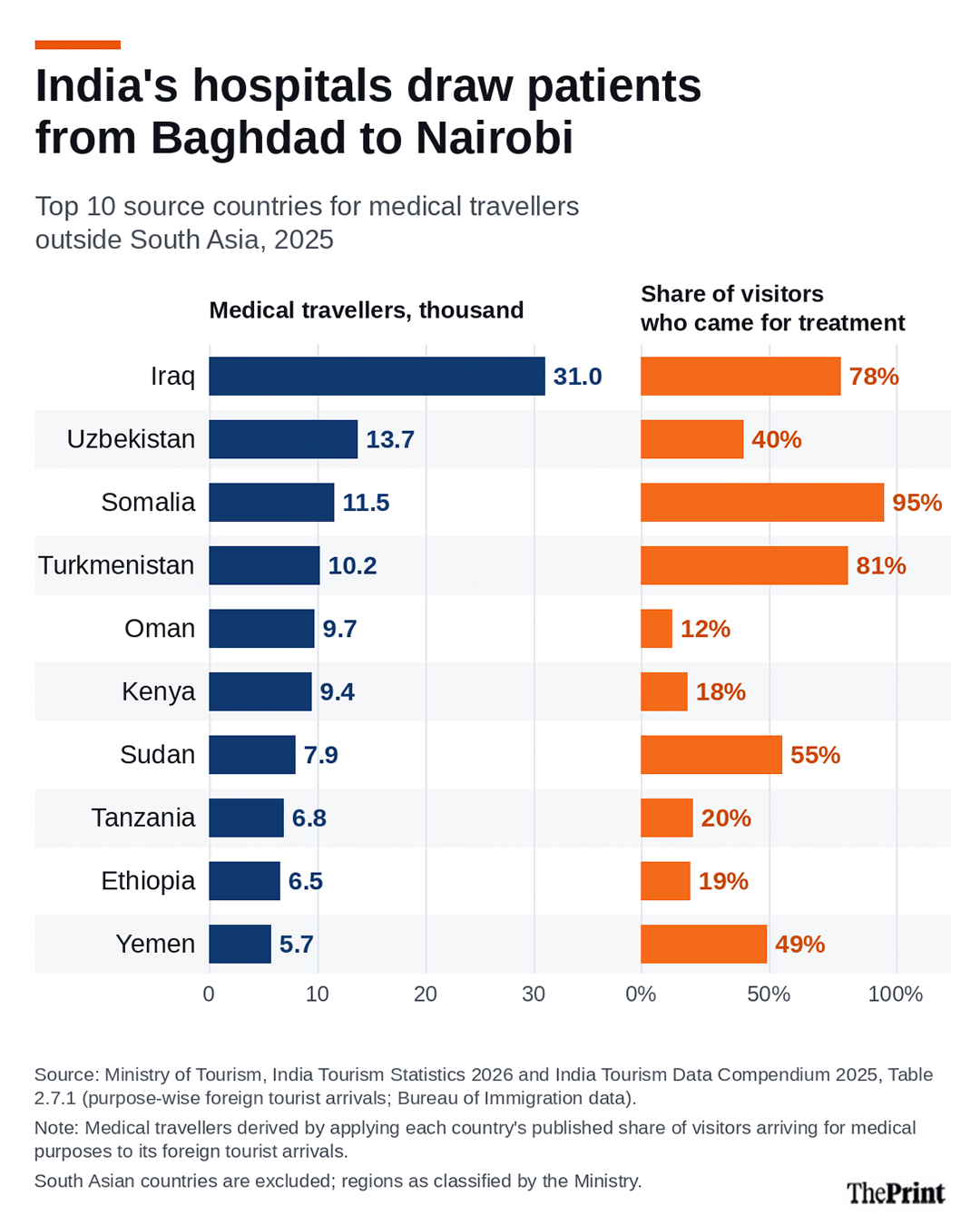
New Delhi: Of every 100 Somalis who travelled to India in 2025, 95 came for one reason: medical treatment, according to the Ministry of Tourism’s India Tourism Statistics 2026. For Turkmen visitors, the figure was 81, for Iraqis 78, and for Sudanese 55.
These individuals were not tourists who became unwell during their trip; they were patients who deliberately selected India as their destination, arranged their travel, and typically stayed here for over three weeks.
Embedded within India’s tourism data is a story less conspicuous than world-renowned attractions, such as the Taj Mahal or the beaches of Goa, yet potentially more significant. India is growing into a healthcare hub for a substantial section of emerging economies.
The country has been investing considerable effort in promoting itself to global tourists. Data indicates that it is increasingly attracting a different type of traveller, one arriving with medical documentation rather than travel guides, staying for extended periods, and departing with positive experiences of Indian healthcare. Capitalising on this trend could represent one of India’s most astute service exports.
Globally, India is among the major players in the medical tourism sector.
In 2025, South Korea reported approximately two million foreign patients, nearly double the previous year’s figure, with a substantial portion seeking cosmetic and skincare treatments, primarily from China and Japan. Malaysia recorded 1.84 million healthcare travellers in 2025, while Türkiye reported about 1.5 million health tourists in 2024.
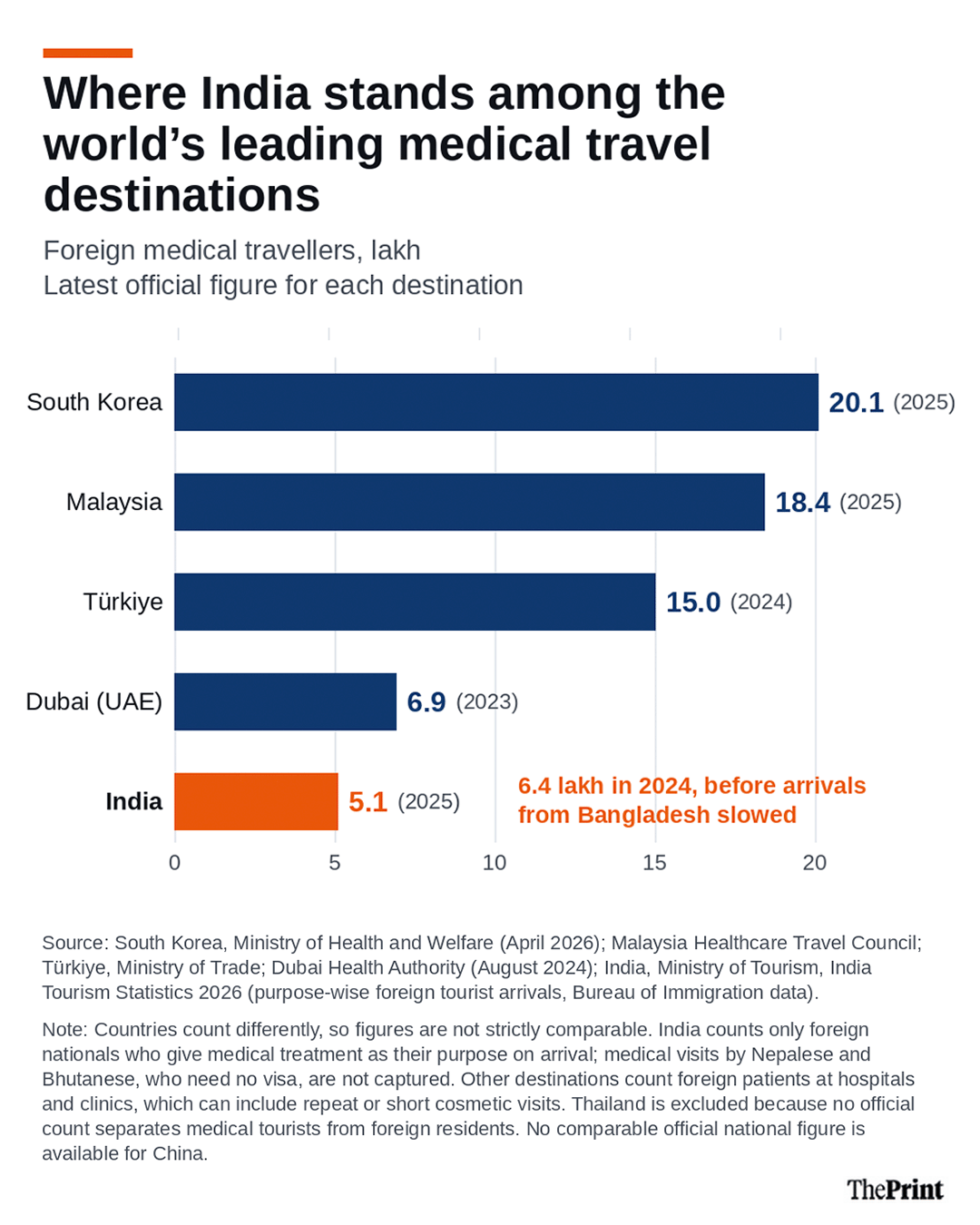
Although China has established a dedicated medical tourism zone in Boao, Hainan, it does not publish comparable national statistics on foreign patients.
India’s figure of 510,000 appears smaller versus others; however, this comparison is not directly equivalent.
India counts only foreign nationals who declare treatment as their purpose at immigration, whereas other countries include foreign patients at hospitals and clinics, including repeat and short cosmetic visits.
A commonality among the leading countries is that they treat healthcare travel as a national export, supported by dedicated agencies and specific revenue targets. Malaysia has a dedicated agency, the Malaysia Healthcare Travel Council, and its Health Ministry targeted RM 3 billion in medical tourism revenue for 2025. Turkiye set up a state company, USHAS, in 2019 and is aiming for $20 billion in health tourism revenue by 2028. South Korea set itself a target of 700,000 foreign patients by 2027, which it has since overtaken.
Industry estimates cited by the government put India’s medical tourism market at about $8.7 billion in 2025, and project it to reach about $16.2 billion by 2030.
Also Read: Indian diaspora brings more visitors than foreign tourism. The homecoming economy is undermeasured
An export made in a hospital room
When a patient from Nairobi undergoes a heart surgery in Chennai, India is exporting a service in a manner analogous to a Bengaluru-based software firm billing a client in New York.
The World Trade Organisation’s General Agreement on Trade in Services, effective since 1995, designates this as “consumption abroad”, or Mode 2 of services trade, wherein the customer—rather than the product—crosses international borders. Medical travel exemplifies this mode, generating foreign exchange without necessitating the physical export of goods.
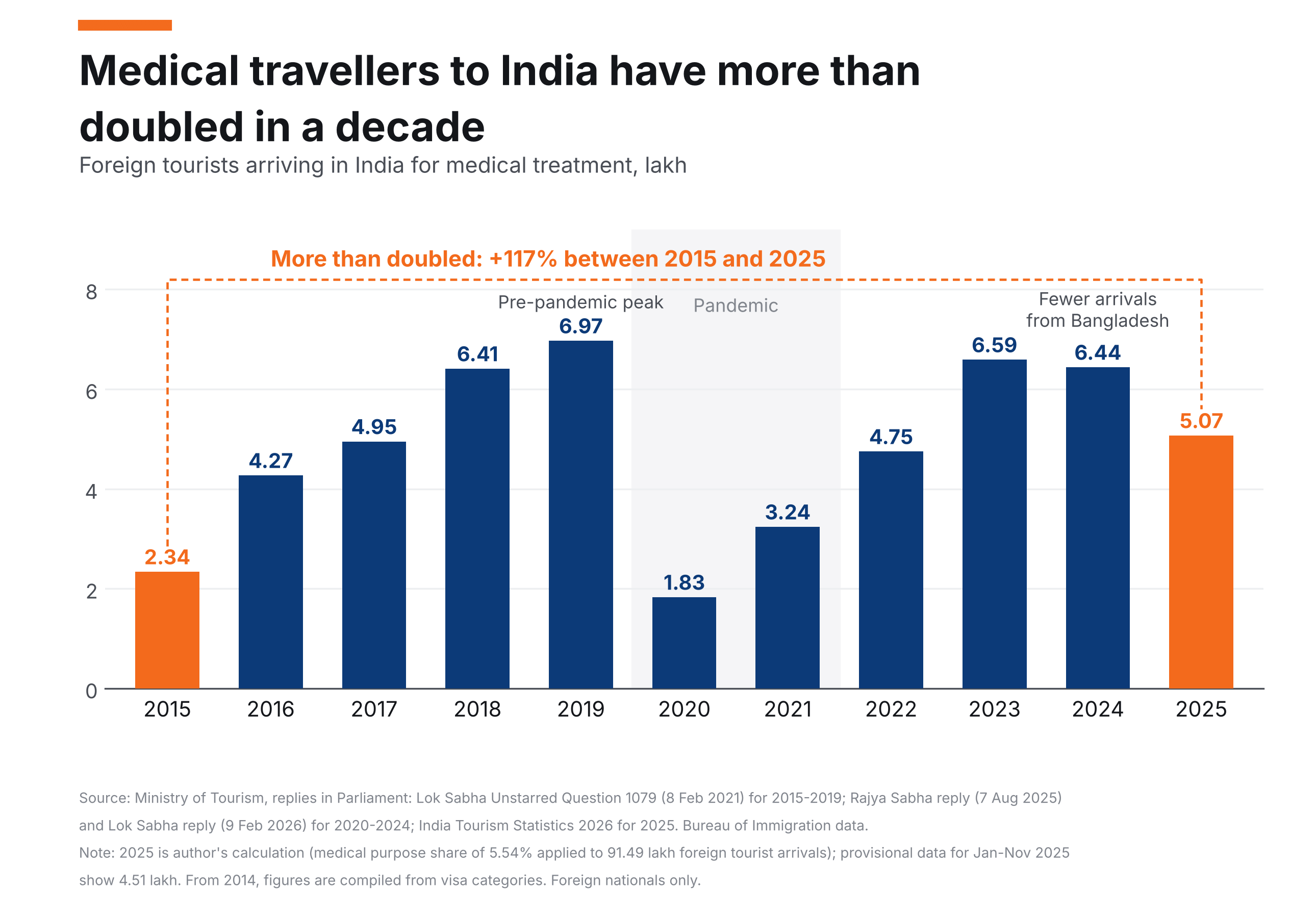
In 2025, approximately 5.07 lakh foreign tourists visited India for medical treatment, constituting roughly 5.5 percent of all foreign arrivals, according to government data. That is more than double the 2.34 lakh who came in 2015. The number is still below its pre-pandemic peak of 6.97 lakh in 2019, largely because fewer patients have travelled from Bangladesh, but arrivals from beyond South Asia are growing fast.
These 5.07 lakh tourists stayed in the country in 2025 for an average of 23.4 days, compared to about 15.5 days for holidaymakers, and 14.3 days for business travellers.
Therefore, medical patients, often accompanied by one or more family members, incur expenses for hospital fees, accommodation, food and local transportation over an extended period.
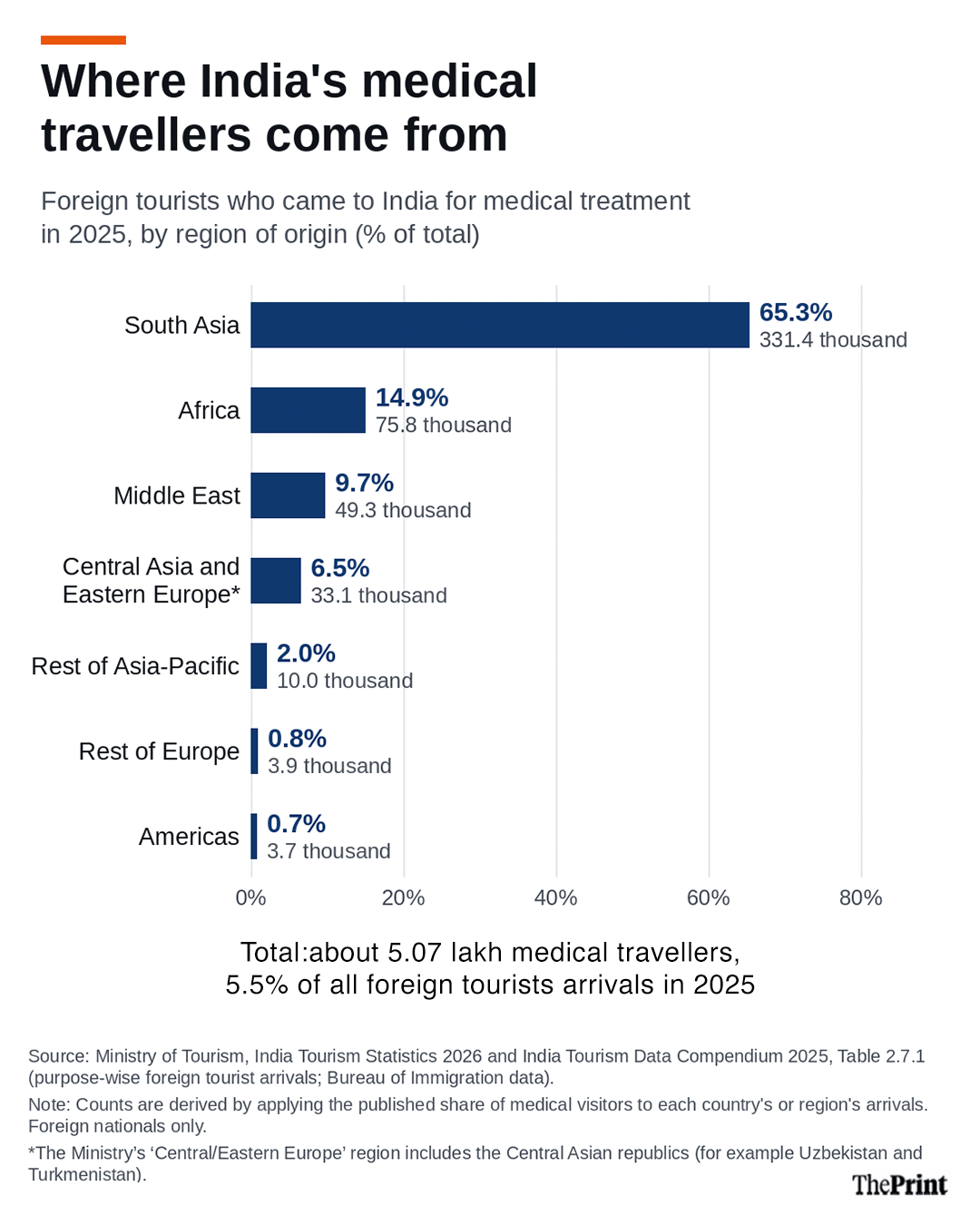
Approximately two-thirds of these travellers originate from South Asia, Bangladesh being the predominant source. This trend is attributed to trust in Indian hospitals built over several decades.
South Asia’s hospital
Within South Asia, India functions more as a primary destination than as a competitor in terms of medical tourism. Neighbouring countries predominantly send patients to India rather than receiving them.
For instance, Sri Lanka, which ranks as the second-most visited country in the region after India, reported that only 0.59 percent of its visitors in 2019—approximately 11,000 individuals—arrived for health and Ayurveda purposes. These visitors were primarily Europeans seeking wellness, rather than surgical procedures.
Nepal does not categorise medical travel separately, and other regional economies do not publish comparable statistics.
In contrast, India received approximately 3,30,000 medical travellers from South Asia in 2025. This figure likely under-represents the actual flow as citizens of Nepal and Bhutan do not require visas to enter India, and thus their hospital visits are not recorded as medical tourism.
For many in the region, a serious medical diagnosis has traditionally necessitated travel to cities such as Kolkata, Chennai, Delhi, or Vellore.
From beyond the neighbourhood
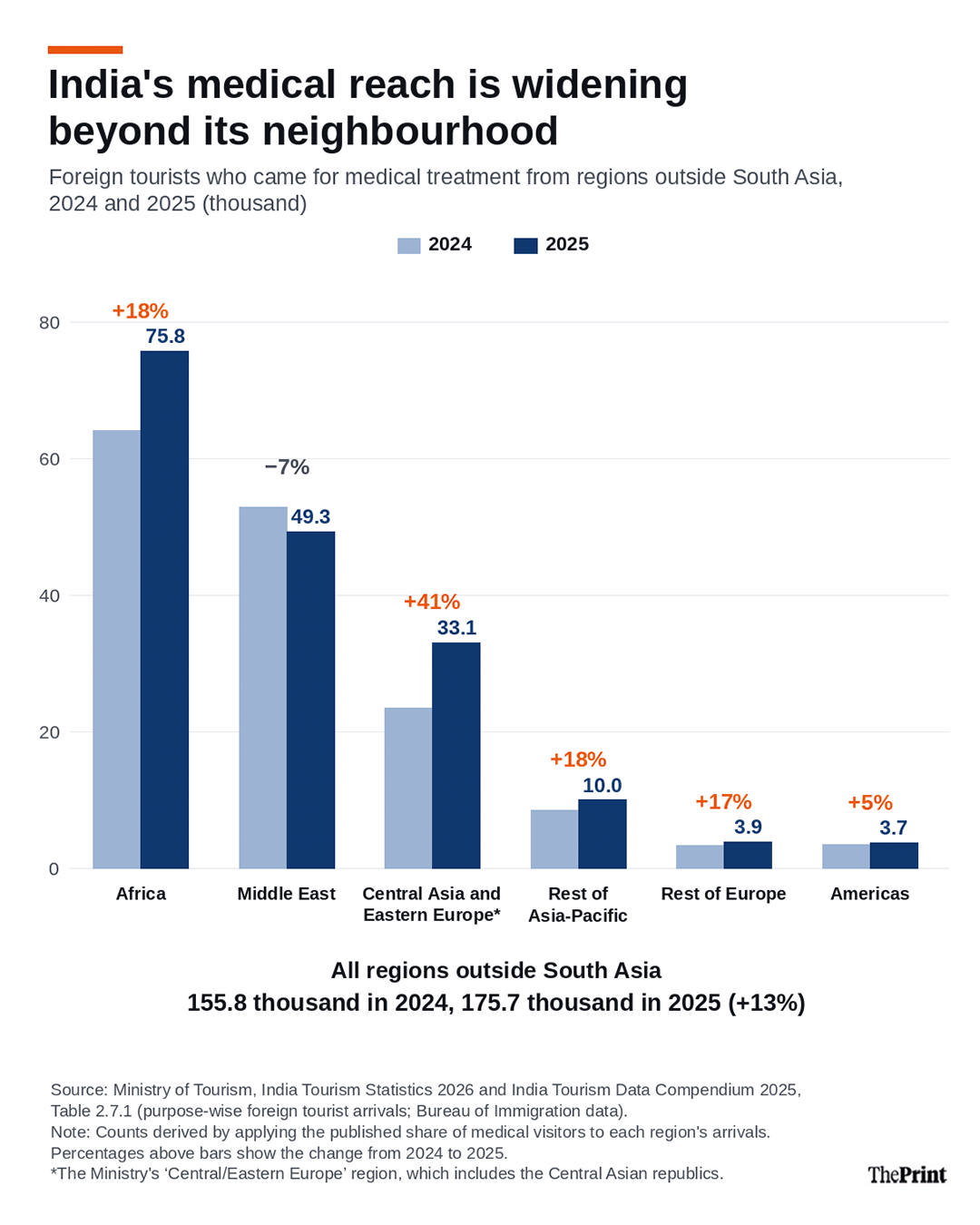
The most notable development in the context of medical tourism is the extent of India’s expanding influence. The number of medical travellers from regions outside South Asia increased from approximately 156,000 in 2024 to 176,000 in 2025, representing a 13 percent rise within a single year.
Africa emerged as a leading contributor, with patient arrivals increasing by 18 percent to nearly 76,000, making it the second-largest source region after South Asia.
The fastest growth was in Central Asia and Eastern Europe, where medical arrivals surged by 41 percent to approximately 33,000, driven primarily by Uzbekistan and Turkmenistan.
However, not all regions saw the same kind of growth in these numbers. Arrivals from the Middle East declined by about seven percent.
Nonetheless, the overall trend is evident.
An analysis of the countries contributing to India’s medical tourist figures reveals a significant pattern.
In 2025, Iraq dispatched approximately 31,000 patients, surpassing any nation outside of South Asia. Additionally, Uzbekistan, Somalia, and Turkmenistan each sent over 10,000 patients. The remaining countries in the top 10 list include Oman, Yemen, Kenya, Sudan, Tanzania and Ethiopia. For many of the visitors from these nations, travel to India is primarily for medical treatment.
Part of the draw is quality at a price. More than 1,299 Indian hospitals now hold accreditation from the National Accreditation Board for Hospitals and Healthcare Providers, and treatment costs a fraction of what it does elsewhere.
A heart bypass costs about $7,900 in India, against $123,000 in the United States and roughly $15,000 in Thailand, according to the Medical Tourism Association.
The state is adding capacity too: the Union Budget for 2026-27 raised the health ministry’s allocation by about 10 per cent to Rs 1.07 lakh crore, and proposed five Regional Medical Hubs with dedicated facilitation centres for foreign patients.
India has established foundational measures to boost its medical tourism sector. The e-Medical visa and e-Medical Attendant visa are available to citizens of 172 countries, and an Ayush visa for traditional Indian treatments was introduced in July 2023. The “Heal in India” initiative seeks to position the nation as a comprehensive healthcare destination.
However, while the visa infrastructure is in place, patients frequently encounter logistical challenges. Establishing direct flights to African and Central Asian capitals could reduce travel costs and fatigue for patients who are often in poor health.
Transparent pricing, along with straightforward payment and insurance processes, would enhance trust. Additionally, follow-up care via telemedicine after patients return home would sustain this trust post-discharge.
A reliable, accessible single-window system that enables families in Mogadishu or Tashkent to compare hospitals, book treatments and arrange visas would also alleviate much of the uncertainty currently faced by patients and their families.
(Edited by Mannat Chugh)
Also Read: India’s post-Covid tourism story: Rebound with fewer visitors, neighbours racing to record arrivals