


New Delhi: Every December, the arrival halls of airports in Delhi, Mumbai and Kochi fill with Indian nationals coming home from overseas. India receives more visitors from its own diaspora than from foreign tourists. Yet much of the money these homecomings bring into the country remains invisible in official tourism statistics.
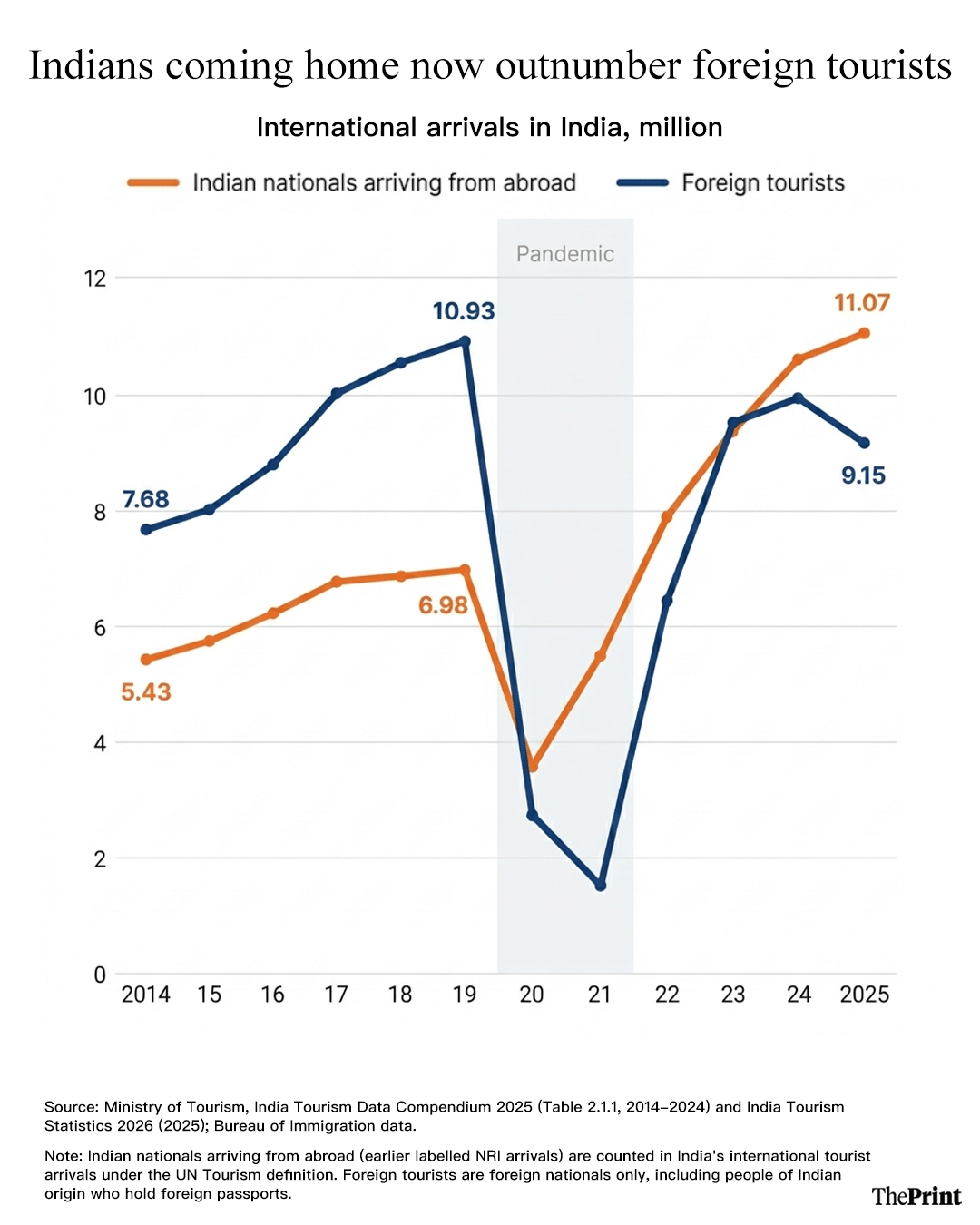
In 2025, 110.7 lakh Indian nationals, most of them living overseas, visited India, outnumbering the 91.5 lakh foreign tourists who came to the country. Arrivals of Indians living abroad have nearly doubled from 54.3 lakh in 2014, while foreign tourist arrivals have grown by only about 19 percent over the same period. Since 2024, returning Indians have consistently outnumbered foreign tourists.
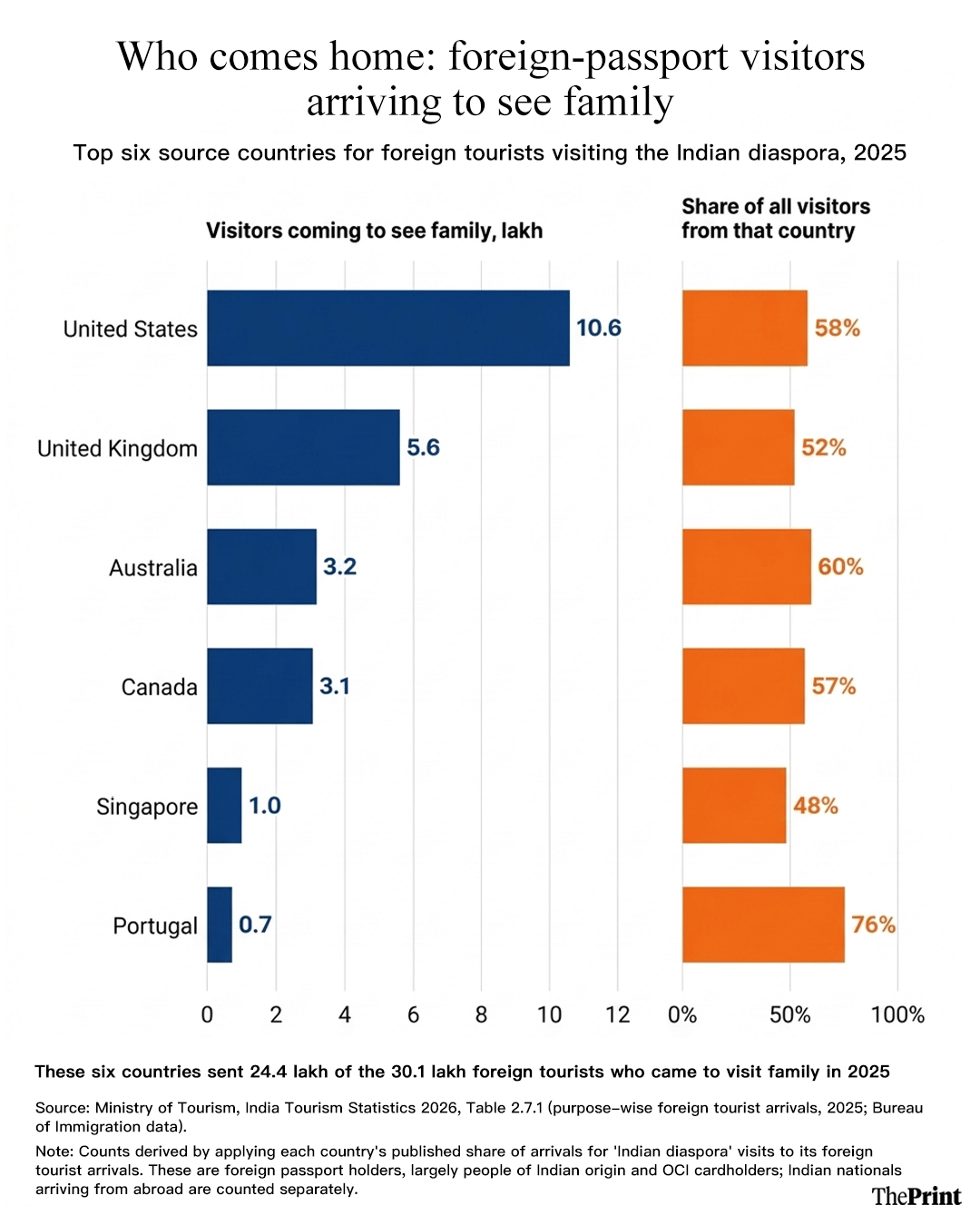
Even among foreign tourists, a significant proportion were people of Indian origin. Of the 91.5 lakh foreign tourists in 2025, approximately 30.1 lakh, or one-third, were people of Indian origin visiting family and friends.
These visitors came predominantly from a handful of countries. The US accounted for approximately 10.6 lakh such visitors, representing 58 percent of all US travellers to India. Britain, Australia and Canada followed, with more than half of their respective tourists to India constituting those who came to see family and friends. Together, six countries accounted for 24.4 lakh such visitors.
Visitors coming to see family and friends also tend to stay longer. In 2025, they spent an average of about 25 days in India, compared with 15.5 days for those visiting on holiday.
Also Read: India’s post-Covid tourism story: Rebound with fewer visitors, neighbours racing to record arrivals
Why the money is hard to see
The undercounting of travel to visit friends and relatives is not unique to India. In 1990, tourism researcher R.T. Jackson questioned whether this category of travel was being systematically underestimated and concluded that it was.
The reasons are straightforward. Visitors of Indian origin often stay with relatives rather than in hotels, leaving little trace in hotel records. They also tend to organise travel and spending through family networks rather than travel agents, making much of their expenditure harder to capture.
More than three decades later, Jackson’s observation remains relevant to India’s homecoming economy.
Under international balance of payments rules, spending by Indians visiting from places such as Dubai or Dallas is classified as tourism earnings because they are considered non-residents. However, India’s travel receipts have traditionally been estimated by multiplying tourist arrivals by an assumed expenditure per visitor. In 2011, an official of the Reserve Bank of India (RBI) told UN statisticians that there was no official documentation clarifying how expenditure by Indians visiting from abroad was incorporated into this calculation.
Some spending associated with homecomings also follow a different path altogether. For instance, when a wedding takes place at a family home, relatives in India may pay caterers and jewellers, sometimes using money sent from abroad. Such transfers are recorded as remittances rather than tourism expenditure.
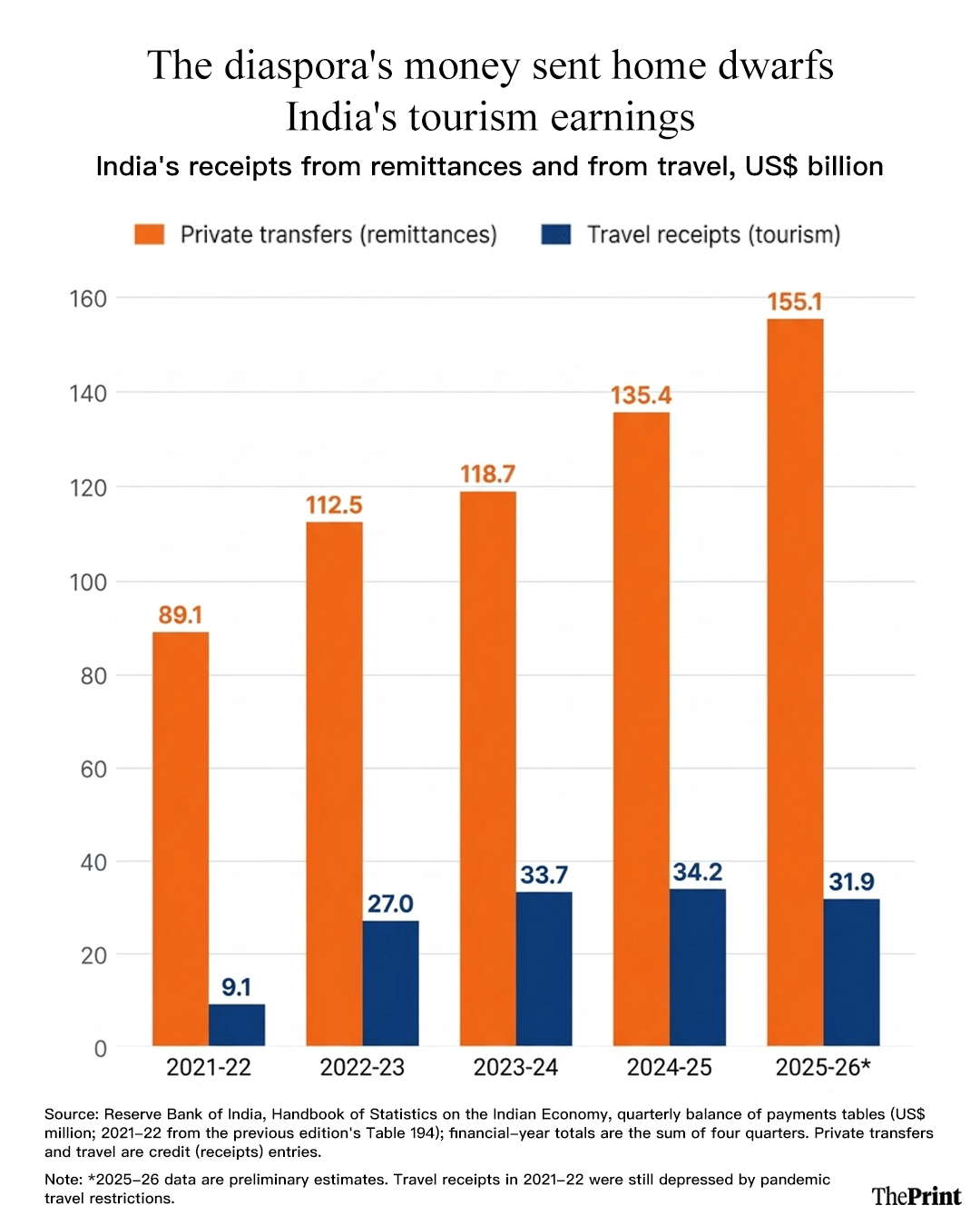
Most remittances, of course, constitute regular family support that would continue regardless of whether the sender visits India. But their scale illustrates the diaspora’s extensive economic ties with the country. India received $135.4 billion in remittances in 2024-25 and, according to preliminary RBI data, $155.1 billion in 2025-26—nearly five times its travel receipts of approximately $32 billion that year.
Tourism statistics, therefore, capture only part of the economic value of a homecoming. No single metric can fully account for this contribution, making a more systematic assessment of diaspora travel and expenditure necessary.
India has attempted such an exercise before. The Ministry of Tourism’s International Passenger Survey for 2015-16, conducted by the Indian Statistical Institute, covered more than 46,000 foreign visitors, including Non-Resident Indians (NRIs) and Overseas Citizens of India, and examined their travel and spending patterns.
An updated survey covering the expenditure of Indians living abroad, people of Indian origin and other foreign visitors could provide a clearer picture of the economic value of India’s homecoming economy and help inform tourism policy.
(Edited by Chingkheinganbi Mayengbam)