





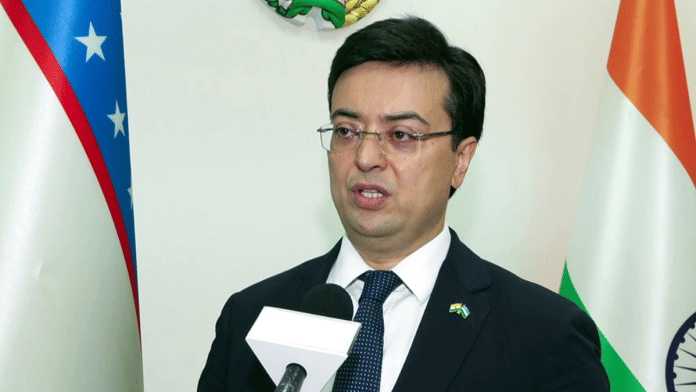

New Delhi: India and Uzbekistan have an increasingly close military relationship built on India’s experience with insurgents in difficult terrain, Uzbekistan’s ambassador to India, Sardor Mirzayusupovich Rustambaev said.
He was speaking at a roundtable Friday in New Delhi, jointly organised by the India Central Asia Foundation and the Uzbek Embassy.
“For us it is very important because they have particular attention to terrorism and cross-border infiltrations. So whatever the expertise India has, it is very interesting for us—how to mobilise troops, how to operate in a difficult mountainous environment,” Rustambaev told ThePrint.
A week after Prime Minister Narendra Modi’s state visit to Tashkent, the ambassador, who was present during the visit, laid out what he called three pillars of the defence relationship: Joint military exercises, regular strategic consultations—the most recent held in August, just before Modi’s visit—and military-technical cooperation, an area he suggested is shifting away from simple arms purchases toward joint development.
In the joint statement, India and Uzbekistan agreed to move from traditional arms procurement toward joint development and co-production under the Atmanirbhar Bharat initiative. They also agreed to strengthen joint military exercises and maintain a zero-tolerance approach toward terrorism and separatism.
“Due to our past geopolitical experience, we are a natural partner. Among the things discussed was how to modernise and be prepared for a new modern combat, which is very different nowadays,” the ambassador said.
India and Uzbekistan elevated their ties to a comprehensive strategic partnership during Modi’s trip, alongside a long-term uranium supply agreement and a slew of MoUs spanning trade, security and technology. Modi was also awarded Uzbekistan’s Order of the Highest Friendship by President Shavkat Mirziyoyev.
Rustambaev also recalled the atmosphere of the visit itself, adding that the President, breaking protocol, came to the airport to greet Modi, and repeatedly referred to each other as brothers which he labelled “a strong symbol for countries, for nations, and not only friendly nations, but brotherly nations”.
Digital highways—gateway to Uzbekistan
Beyond defence, Rustambaev also talked about Indian investment in Uzbekistan’s technology sector which he described as a deliberate, government-driven experiment that has paid off.
“Several years back, our President’s vision was to create a sort of a silicon valley in Central Asia,” he said. “Honestly speaking, lots of people were quite skeptical, because it takes a lot of time—it doesn’t happen overnight, the whole ecosystem is created. But it happened.”
He pointed to Indian firms already active in that build out, including a data centre in Tashkent built by L&T and construction of Uzbekistan’s airport involving India’s IT sector.
“By having a physical footprint in the region, India will have a huge access and be able to project their influence in neighbouring countries at a global scale,” he added.
“Uzbekistan can serve as a starting point for this IT expansion, for the digital revolution, with the technologies and the very cost-effective expertise that we have here. I think that Uzbekistan can serve as a slow, but strong, and very reliable partner,” he added.
He noted that a memorandum synchronising India’s UPI payments system with Uzbekistan’s national payment infrastructure was also one of the visit’s outcomes, alongside efforts to cut non-tariff barriers and harmonise regulatory standards.
On trade, Rustambaev said the two sides had set a target of raising bilateral turnover to $5 billion by 2030, up from roughly $3 billion currently discussed in the market, and that both countries had instructed officials to complete a joint feasibility study toward a Preferential Trade Agreement.
Rustambaev repeatedly framed the partnership against the backdrop of a broader transformation in Central Asia over the past decade, one he said had culminated in the current Central Asia-India dialogue mechanism.
“Ten years back, it was a completely different Central Asia,” he said, describing an earlier era of heavily guarded borders and “policies of mistrust” between the two states. “Now, of course, that shift of the paradigm is completely different. We look at each other not as partners, but as friends, as brothers… we almost don’t have borders now.”
Discussing the visit’s cultural and institutional dimensions, the conversation featured former ambassadors and scholars like Ambassador Gitesh Sarma, Ambassador Abdussamat Khaydarov, Dr Raj Kumar Sharma and Dr Ramakant Dwivedi of the India Central Asia Foundation.
They discussed the three sister-state agreements between Fergana and Haryana, Agra-Samarkand and also Gujarat and Samarkand as well as a memorandum linking Uzbekistan’s diplomatic academy with India’s Sushma Swaraj Institute of Foreign Service, calling it “a key link” for training a new generation of diplomats in both countries.
“These visits are something special, both the private and personal interactions, and the way the two referred to each other as brothers. I think it’s a strong symbol not only for friendly but brotherly nations”, the ambassador added referring to Modi’s visit.
(Edited by Viny Mishra)
Also read: PM Modi’s Central Asia visit is a quest for a new Eurasian highway. Detouring around rivals