



New Delhi: The Trump administration Thursday took aim at a number of Indian and American IT firms, accusing them of fraudulent hiring processes and suspending them from a programme that allows foreign workers to gain permanent residency in the country.
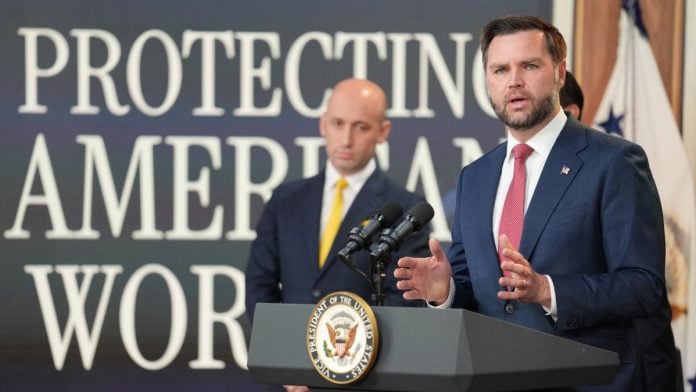
The action was announced by a number of senior US officials, including Vice President J.D. Vance. The companies affected by the suspension from the Permanent Labour Certification Programme include Infosys, Tata Consultancy Services, Wipro, HCL, Capgemini, and American firms Microsoft, Adobe and Cognizant.
Vance said, “The H-1B visa programme is meant to allow companies to bring the best of the best from outside the United States of America for positions that are completely impossible to fill with American workers. Unfortunately, the programme has become rife with fraud.”
He added, “There are two ways this system fundamentally works: the H-1B visa is how they get into the United States in the first place and the Perm [Permanent Labour Certification] programme is how those employees stay. So after a couple of cycles of H-1B reapplication, the companies will apply for a perm, which will allow the employee to stay, get a green card and potentially stay in the United States indefinitely.”
Keith Sonderling, the US Secretary of Labour, said that jobs were “stolen” from American workers, who are some of the “brightest and the best”, for foreign workers, adding that the current US administration is cutting off the “head of the snake” by going after the above-mentioned technology companies.
Now, the Department of Labour will not process any new or pending permanent labour certification applications for workers from these firms.
Sonderling explained that the above-mentioned companies have since 2009 received some 230,000 H-1B visas, and over 100,000 permanent labour certifications. “Thats hundreds of thousands of jobs that were taken from American workers. Our historic action is the first critical step to stop the fraud and the abuse, and to ensure that these programmes never come at the expense of American workers.”
Vance specifically took aim at Microsoft, declaring that “you’re a great American company, but you have got to hire great American workers”.
“There has been no company in the United States that has abused this system more than Microsoft…Microsoft laid off, last year, 6,000 American workers. At the same time the company benefitted from 6,300 H-1B visas and almost 3,000 green cards,” he said.
The Permanent Labour Certification programme is a key step for the pathway to an eventual green card for foreign skilled workers in the US. Under the current process, employers must apply for certification from Department of Labour, highlighting that there are no qualified US workers “able, willing, qualified and available” to accept the job opportunity in the area of “intended employment”, for a specific job—which is a PERM, according to information made available by the Department of Labour.
It is only after certification is acquired that most employment-based green cards can be issued by the US government, which allows permanent residency for a foreigner.
The current administration, led by US President Donald Trump, has been taking aim at the H-1B visa system for the better part of last year, in an attempt to reduce the number of high-skilled workers emigrating to the country. Indians have been among the largest beneficiaries of the visa structure, with up to 71 percent of all H-1B visas issued in 2024 to Indian nationals.
The Indian community in the US grew to 3.2 million in 2024, making it the second largest immigrant group in the country. Last year, the Trump administration imposed a $100,000 fee for H-1B visa applications, which has since been blocked by the courts, pending further legal review.
The Indian government has yet to comment on the latest action, but has in the past maintained that issuance of visas is a “sovereign right”, and has taken up the issue with the US government. External Affairs Minister S. Jaishankar last week pointed to the conversations surrounding foreign workers and the H-1B visa system as part of the larger challenges in India-US ties, while speaking at the Asia Society.
Also Read: India’s Russia-Ukraine ceasefire proposal ‘broadest’ among four on table, says Kyiv