


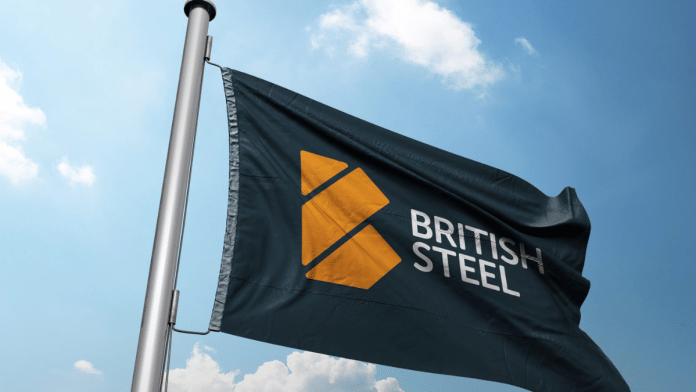
New Delhi: The British government formally brought British Steel into public ownership Thursday, ending Chinese conglomerate Jingye Group’s six-year ownership of the loss-making company, and prompting a trade retaliation warning from Beijing.
The ownership of British Steel was formally transferred from Jingye to the State after the Steel Industry (Nationalisation) Act received royal assent Wednesday. The House of Commons had approved amendments made by the House of Lords Tuesday, clearing the way for the transfer to take effect Thursday.
The nationalisation followed more than a year of government intervention at the Scunthorpe plant in Lincolnshire, which supports approximately 2,700 direct jobs and thousands more in associated businesses and local industries.
The Scunthorpe steelworks is Britain’s last facility capable of producing primary steel from raw materials, which makes its future a central concern for the government’s industrial and national-security policy.
“British Steel is part of the fabric of our nation and a cornerstone of Britain’s industrial strength,” outgoing UK Prime Minister Keir Starmer said in a statement Thursday. “Today’s decision secures the future of steelmaking in the UK, protects skilled jobs and safeguards a vital national capability.”
Starmer stated that the nationalisation demonstrated the government’s willingness to intervene in the national interest to defend strategic industries and strengthen the UK economy.
A new management team will be tasked with stabilising British Steel and transforming it into what the government described as a “commercially sustainable, low-carbon enterprise”.
An independent expert will assess the value of the company to determine whether Jingye should receive compensation and, if so, how much.
A historic day for British Steel, UK manufacturing and national security. Our Interim CEO Allan Bell thanked the UK Government for its decisive support and said he looks to the future with great optimism. https://t.co/QX10QZO8vy #BuildingStrongerFutures #BritishSteelForTheNation pic.twitter.com/PhIsjZ7RhC
— British Steel (@BritishSteelUK) July 16, 2026
The nationalisation is one of Starmer’s final major decisions as prime minister. Andy Burnham was formally declared Labour Party leader Friday and is due to be appointed prime minister Monday, succeeding Starmer.
Govt controlled plant since 2025
Although Thursday’s decision transferred formal ownership, the British government had effectively managed the company’s operations since April 2025. Jingye had announced that the Scunthorpe furnaces were no longer financially viable, claiming British Steel was losing about £700,000 each day.
Concerns escalated when the company cancelled orders for essential raw materials required to keep the blast furnaces operating.
Fearing that the furnaces could be permanently shut down, Starmer’s government recalled Parliament during its Easter recess and passed emergency legislation giving ministers control over the plant’s management, workforce, and supply arrangements.
While Jingye technically retained ownership, the government assumed operational control to maintain production. Thursday’s nationalisation completed that process by transferring the company itself into public hands.
Closing the furnaces would have left the UK as the only G7 country unable to produce primary steel from raw materials. Because cooled blast furnaces are difficult and expensive to restart, the loss of that capability could have been permanent.
The government has, therefore, treated domestic steelmaking as a national-security priority because of its importance to defence, infrastructure, and energy projects. It also tightened import protections from 1 July in cutting tariff-free steel quotas by 51 percent and raising duties on above-quota imports from 25 to 50 percent, to protect domestic producers from cheaper imports.
From Thatcher-era privatisation to Chinese ownership
British Steel has passed repeatedly between State and private ownership. The original British Steel Corporation was created through nationalisation in 1967. Margaret Thatcher’s Conservative government privatised it in 1988 as part of a wider programme that transferred major State-owned industries to private ownership.
British Steel later merged with Dutch steelmaker Hoogovens in 1999 to form Corus. India’s Tata Steel acquired the Anglo-Dutch company in 2007 for £5.8 billion, then the largest overseas acquisition by an Indian company.
The present British Steel was formed in 2016 after Greybull Capital acquired Tata Steel’s European long-products business. It collapsed in May 2019, putting around 5,000 jobs at risk, before Jingye bought it for approximately £70 million in 2020.
China condemns the nationalisation
China strongly criticised the United Kingdom Friday for nationalising British Steel, warning that the decision had violated the rights of its former Chinese owner and could discourage other Chinese companies from investing in the country.
China’s commerce ministry said Beijing “firmly opposes” the nationalisation and was “strongly dissatisfied” with the British government’s decision.
“Disregarding Jingye’s significant contribution to the UK economy and society, the British side forcibly took control of the company in the name of national security,” the ministry stated.
The ministry said the measures “seriously damaged” Jingye’s legitimate rights and interests, and “severely undermined” Chinese companies’ confidence in investing in the UK. Beijing has said it will monitor the compensation process and support Jingye in defending its interests.
Beijing also urged London to meet its obligations under the China-UK investment protection agreement. The legally binding bilateral investment treaty, signed in 1986, was designed to promote and protect investments made by companies from each country in the other’s territory.
The confrontation over British Steel has turned the future of the Scunthorpe steelworks into another source of friction in the already tense relationship between London and Beijing.
India secures steel access under trade agreement
While the nationalisation has heightened tensions with China, Britain has continued to expand steel trade with other major economies.
The India-UK Free Trade Agreement, which entered into force on Wednesday, secured duty-free access for more than 1.1 million tonnes of Indian steel exports to the UK, potentially worth around £750 million annually.
The arrangement highlights London’s effort to protect domestic steelmaking while maintaining commercial ties with its key trading partners.
Incoming prime minister Andy Burnham will, therefore, have to balance Britain’s national-security and industrial priorities against the economic benefits of stable relations with China, the world’s second-largest economy.
(Edited by Ajeet Tiwari)
Also Read: India to unveil green steel taxonomy, first country to take initiative in this direction