





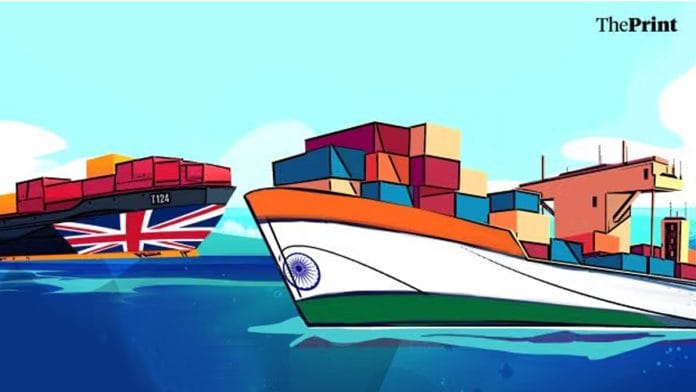


New Delhi: The India-United Kingdom Free Trade Agreement is the “floor” of trust between the two countries and will allow them to discuss more sensitive issues going forward, including extradition of wanted fugitives and other areas of security cooperation, a British official said Wednesday.
The Comprehensive Economic and Trade Agreement (CETA) signed last year between New Delhi and London came into effect on 15 July, 2026.
This is India’s first bilateral trade agreement with a G7 country to be operationalised.
A British official said that the trade agreement “helps underline the spirit and tone” of improving ties between India and the UK, allowing freer discussions on other issues. It indicates the “high level of trust with India,” especially as New Delhi’s economy continues to grow at a fast pace, the official added.
CETA negotiations began in 2022, and after 14 rounds, was finally inked last year, while Prime Minister Narendra Modi visited the UK. The agreement, consisting of 30 chapters, sees reduction or elimination of tariffs on 99 percent of Indian exports to the UK, while New Delhi will liberalise or eliminate roughly 90 percent of duties on British imports.
“This is a gold standard for trade agreements,” Commerce Secretary Rajesh Agrawal said Tuesday, while briefing the media on the trade deal. The deal is a significant marker of India’s evolving trade policy.
In 2019, New Delhi pulled out of the multilateral trade agreement—the Regional Comprehensive Economic Partnership—which includes 15 of the largest economies in the Asia-Pacific region, excluding India.
India’s withdrawal from the largest multilateral trade agreement marked a perceived retreat from such deals. However, following the COVID-19 pandemic, India launched negotiations with a number of countries for bilateral trade deals, including the CETA with the United Kingdom.
For the British, the deal is set to make a number of gains for its key exports including Scotch Whisky and premium automobiles. The deal includes chapters on services and government procurement, making it extremely comprehensive, Lindy Cameron, the British High Commissioner to India said at a press conference Wednesday.
“The trade deal brings sweeping benefits for a wide range of sectors, import duties on Scotch have been cut from 150 percent to 75 percent…Import duties on premium UK cars will fall from 110 percent to 10 percent. In the retail sector, the best of UK beauty products and cosmetics and sports goods will all be cheaper for Indian consumers to purchase,” added Cameron.
The British envoy underlined that in the renewable energy sector, UK-made turbines, generators and other components will also be cheaper for Indian companies to purchase. “The deal makes it easier for UK companies to bid into the Indian procurement market. The Indian procurement market is worth 38 billion pounds annually,” explained Cameron.
Even after the completion of the deal, the two countries continued negotiations on two major sensitive issues, the double contributions contravention agreement (DCC) and steel.
The original announcement of the finalisation of the deal in May 2025 highlighted that Indian employers and employees temporarily working in the UK would not have to pay social security contributions for up to 39 months. This has since been extended to 60 months, which is five years.
Indian employees temporarily working in the United Kingdom, would have no access to almost 25 percent of their salaries to the British social security services, especially if they were to return home post their assignment.
This is considered to be a “game changer” for the Indian services sector, according to Commerce Secretary Agrawal. However, the agreement does not have any protections on the British Carbon Border Adjustment Mechanism (CBAM) that will come into effect from 1 January 2027.
A British official defended the CBAM, highlighting that London does not view the mechanism as a “trade issue” but rather important for the UK to “economise” the costs of production in resource heavy industries.
Also Read: Why global law firms are betting on India desks instead of India offices ahead of India-UK FTA
Contours of the trade deal
The agreement is expected to let Indian farmers and seafood producers gain a competitive advantage for their exports to the UK. The British agricultural market is worth roughly $90 billion. Indian seafood producers gain a full tariff exemption for their exports to the UK from 15 July 2026.
The agreement protects India’s own agricultural sectors including dairy, cereals and pulses, while also protecting other sectors such as gold and jewellery and smartphones. The current level of bilateral trade between the two countries is worth roughly 48 billion pounds or $60 billion.
The trade agreement is set to boost bilateral trade by around $34 billion annually, according to British government estimates, while adding around $6.83 billion to India’s gross domestic product (GDP) every year.
Despite opening parts of its agricultural sector, the UK has not given any concessions in goods such as chicken, pork, eggs, rice and sugar. Other tariffs on Indian exports by the UK such as 70 percent on processed food products, up to 18 percent on engineering goods, up to 16 percent on leather and footwear products, and up to 12 percent on textiles and clothing have all been eliminated by London.
Tariffs on British automobiles will drop to roughly 10 percent from the current level of 110 percent, with the introduction of a new quota for the import of these goods. By 2036, roughly 85 percent of Indian tariffs on British goods will be reduced to zero.
On steel, Indian exporters gain a measure of protection against the UK’s measures introduced on 1 July. The protection is through a country specific quota, residual quotas and authorised use scheme (AUS), allowing roughly 85 per cent of Indian steel exports to be excluded from the new British measures. A British official defended the measures on steel, highlighting that it “contributes fully to” their own “national security and defence.”
The two countries were unable to find an agreement on the bilateral investment treaty. The CETA and the DCC were negotiated parallely. The investment treaty was also a part of the negotiations, but no deal has been inked yet.
(Edited by Amrtansh Arora)
Also Read: India-UK FTA to kick in on 15 July. What gets cheaper & how Indian exporters stand to benefit