





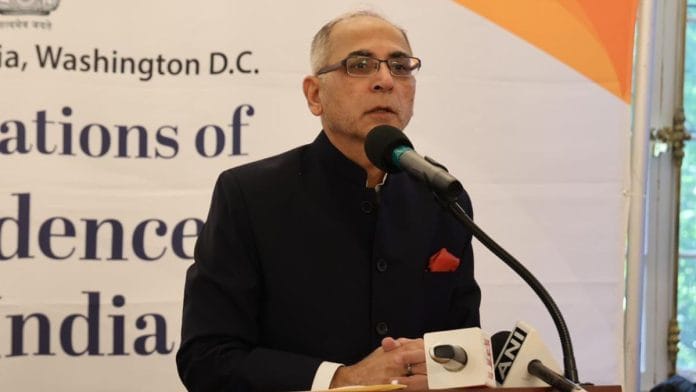

New Delhi: Indian envoy to the United States, Vinay Mohan Kwatra, Monday defended the Foreign Contribution (Regulation) Amendment Bill (FCRA), 2026, seeking to debunk the “myths” surrounding the proposed legislation. He said that regulation of foreign funds in public and political spheres is a “sovereign step driven by national security concerns”.
The remarks by the former foreign secretary came just two days after US Vice President J.D. Vance called Prime Minister Narendra Modi.
While there was no read-out from the American side, PM Modi posted on X that they discussed ways to further deepen India-US Comprehensive Global Strategic Partnership across key areas.
The PM also congratulated him and the Second Lady Usha Vance on the birth of their newborn son, and conveyed best wishes to the entire family.
Received a phone call from US Vice President JD Vance. We discussed ways to further deepen India-US Comprehensive Global Strategic Partnership across key areas.
Warmly congratulated him and the Second Lady on the birth of their son and conveyed best wishes to the entire family.…
— Narendra Modi (@narendramodi) August 8, 2026
The last time Vance had called Modi was during Operation Sindoor in 2025.
In a series of posts on X, Kwatra sought to address the “misunderstandings in the media and in civil society” about the proposed FCRA amendments.
There are many misunderstandings in the media and in civil society about the proposed Foreign Contribution (Regulation) Amendment Bill(FCRA), 2026.
Here is the Myth vs. Reality check.
— Amb Vinay Mohan Kwatra (@AmbVMKwatra) August 10, 2026
He wrote that the idea that India is framing a new law to cut off foreign aid to civil society is a myth.
“Truth: Regulation of foreign financial flows in public and political spaces is a sovereign step driven by national security concerns. It is an accepted feature of modern governance in many democracies around the world,” he posted.
The ambassador argued that the first FCRA in India came in 1976, and was replaced in 2010 with a more modern framework, and strengthened by amendments in 2016, 2018 and 2020.
“The 2026 Bill and Rules are the next step in the same direction: more transparency, better governance, clearer rules. The fact is that the law does not forbid Indians from receiving foreign donations or shut down law abiding civil society. Tens of thousands of associations are registered under FCRA and routinely receive foreign funds for health, education, disaster relief, research and humanitarian work,” he further wrote.
He added that another myth is that FCRA has adversely impacted the working of NGOs and charitable organisations, and that the new amendment would further restrict their ability to operate in India.
“In reality, foreign money inflows into India have been rising, not falling. Foreign contributions to registered organisations grew from roughly $1.2 billion in 2010-11 to $2.67 billion in 2024-25. India has over 3 million NGOs. A bare fraction of these, only 14,450, hold FCRA registration. Thus, the overwhelming majority of the civil society organizations are entirely outside the Act. FCRA does not stop anyone from accepting foreign charity, research grants or humanitarian aid. It asks three things — register, receive the money through laid down process, report what you did with I,” he wrote in another post.
Regarding the concern that the proposed amendment will lead to seizure of assets of NGOs, including religious charities, places of worship, hospitals, schools, and charitable organisations that rely on foreign donations, Kwatra posted that when a registration is cancelled or surrendered, “foreign contributions and the assets created from them already vest in a State Government authority”.
“This has been in force since 2010. It is not new,” he added.
“What the 2026 Bill adds is a designated authority to safeguard those assets—and a way back. If the organisation restores its registration, all assets and unused funds are returned in full. Places of worship carry their own protection. Where a cancelled association has created property connected to a place of worship, that property goes to another FCRA-registered association of the same faith to ensure continuity of worship.”
Also Read: Spain moves to replace its Ambassador to India after row over funds for cultural concerts