





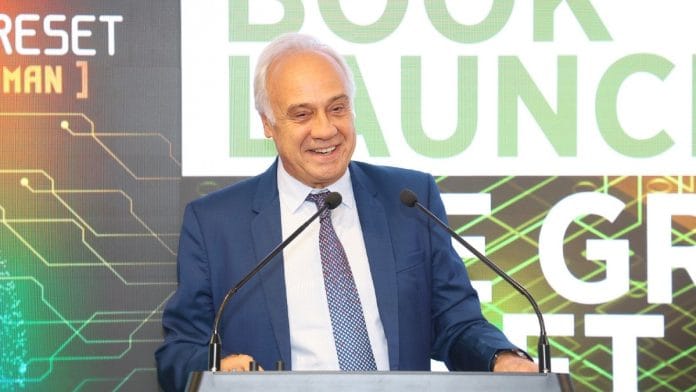


New Delhi: Spain has initiated the process to replace its Ambassador to India, Juan Antonio March Pujol, in the wake of reports pointing to potential violation of protocol, misuse of public funds and improper financial dealings. The move follows a report submitted by Spain’s Foreign Ministry to the country’s Anti-Corruption Prosecutor’s Office in May, as reported by the Spanish digital news outlet The Objective.
The reports in Spanish media do not, however, establish that the allegations against the ambassador have been proven.
According to The Objective, the ambassador allegedly sought support from various Spanish companies based in India as well as the government of Rajasthan to promote artists who were not Spanish. These sponsorships, it said, were sought without informing the Spanish foreign ministry, and the concerts were to be organised without leaving any record in the accounts of the Embassy in India.
The artists, the report said, were commissioned to perform at cultural concerts as part of the Spain-India Dual Year that coincided with the ambassador’s birthday. These concerts were ultimately vetoed by the Spanish Agency for International Development Cooperation (AECID). Those commissioned to perform included a local dance company, STEM Dance Kampani, Spanish tenor Joan Laínez and Chinese tenor Huiling Zhu.
It goes further to add that Huiling, the Chinese mezzo-soprano, “was rumored to have a romantic relationship with the ambassador”.
“This artist, who is not Spanish, received €18,000 from the cultural budget of this embassy,” according to the report. The ambassador justified seeking authorisation for use of public funds to commission her concerts in 2025 by arguing that her “musical repertoire consisted mostly of Spanish lyric songs”. But Huiling’s biography, according to The Objective, does not mention any Spanish music.
The ambassador is also alleged to have reached a personal agreement with BLS, an Indian company responsible for processing Spanish visa applications, under which the company would contribute 5,000 euros toward a cultural event in Rajasthan.
BLS handles outsourced visa-processing services for the Spanish Embassy in India, as well as for other Spanish missions around the world.
Alfredo Martínez Serrano, Spain’s ambassador to Canada, is expected to take charge in New Delhi. Once India grants its approval, the formal handover at the Spanish Embassy in New Delhi is expected to take place within the next few weeks.
March, according to The Objective, saw New Delhi as his last posting before his retirement in February 2028 when he would turn 70.
The report also said that after taking up his post in New Delhi, March inaugurated the Indo-Spanish Film and Cultural Forum at Marwah Film Studios, led by Sandeep Marwah, president of the International Chamber of Media and Entertainment Industries (ICMEI), in “partnership with the Spanish Embassy,” with March named its “patron”. The relationship later extended to March’s daughter, Milena March Franzi. Last July, Marwah hosted her for a workshop on “brand management” at the Asian Academy of Film and Television, an event promoted by ICMEI and featuring photographs of her with the ambassador.
According to The Objective, Milena holds a diplomatic passport issued by Spain’s foreign ministry, which has facilitated her professional activities in India alongside her father.
“They’ve established a company to introduce businesses to India. Milena attends private events in embassy cars and lives in the residence while doing business for her father. “She’s his front,” a former ambassador told the publication, terming the latest developments an “unprecedented scandal” .
Spain’s Council of Ministers had approved the appointment of Juan Antonio March Pujol as ambassador to India in early 2024. He assumed the role in September that year, after having been on leave from the Spanish foreign ministry for more than a decade. At the time, The Diplomat in Spain had described the delay as “an unusually long period” between two countries that maintained no known bilateral disagreement.
The Spanish government had sought India’s approval to appoint him as ambassador after the previous ambassador, José María Ridao, requested in December 2023 that Foreign Minister José Manuel Albares allow him to leave the post in New Delhi. Ridao was appointed Ambassador to India in July 2021.
March was considered close to former Spanish prime minister José Luis Rodríguez Zapatero and former foreign minister Miguel Ángel Moratinos. According to The Diplomat in Spain, Moratinos had apparently taken up the issue of the delay in the approval for March’s appointment with Indian authorities.
Also Read: Sanskrit to satellites, embassies in Delhi are using culture to show ties, get close to India
Barceló Dome controversy
Before India, Juan Antonio March Pujol’s last diplomatic posting was as Spain’s ambassador to Russia, where he served from 2007 until the end of 2011. March was also stationed in Geneva, where he served as Spain’s Permanent Representative to the United Nations and Ambassador to the World Trade Organization (WTO) between 2004 and 2007.
It was during his time at the United Nations that he became closely associated with one of Spain’s most ambitious cultural projects.
With the support of then-foreign minister Moratinos, March presented to the United Nations a proposal to renovate Room XX of the Palace of Nations in Geneva. The room was subsequently renamed the “Human Rights Chamber”.
Under the original proposal, Madrid would bear 30 percent of the cost, while the remainder would come from private contributions. The Spanish government subsequently budgeted €16.6 million for the construction of the Dome by Spanish painter Miquel Barceló. The final cost of the commission, however, exceeded €20 million.
The project became controversial, including over the allocation of €500,000 from the Development Assistance Fund, or FAD.
The Spanish government sought to justify that expenditure by arguing that the work was intended to promote human rights and multilateralism.
In 2017, Ramón Álvarez de Miranda, then president of Spain’s Court of Accounts, raised questions about the state’s contribution to the project before the Congress of Deputies.
The Barceló Dome was eventually inaugurated in 2008, almost a year later than originally scheduled. The ceremony was attended by King Juan Carlos and Queen Sofía, Prime Minister José Luis Rodríguez Zapatero, United Nations Secretary General Ban Ki-moon and Turkish President Recep Tayyip Erdogan, who was then prime minister. Zapatero’s government was at the time promoting the Alliance of Civilisations alongside Erdogan.
March attended the inauguration as vice president of the ONUART Foundation, a position he held alongside his post as Spain’s Ambassador to Russia.
The controversy surrounding March is not the first involving Spain’s envoy to India.
In 2016, Spain’s ambassador to India, Gustavo de Arístegui, resigned from his post over allegations that he had pocketed kickbacks from Spanish companies. The resignation was seen as a setback to then PM Mariano Rajoy and his Popular Party, or PP, which was seeking re-election. The episode was particularly damaging to Rajoy because Arístegui’s alleged business partner was Pedro Gómez de la Serna, a prominent MP and a Popular Party leader.
(Edited by Amrtansh Arora)
Also Read: And it’s official: India in talks with France to join 6th Gen fighter programme FCAS