



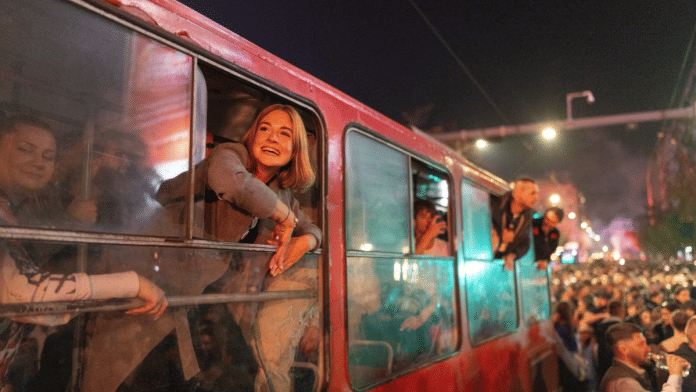
New Delhi: In an unprecedented electoral upset in the Balkans, a student-led coalition brought down the far-right’s decade-old hold on Serbia. But no one knows who the next Prime Minister will be. Far right leader Aleksandar Vučić lost to a student-led movement in snap elections Sunday in what is being called a new political era in Belgrade.
The electoral outcome followed an extraordinary period of protests against corruption and government negligence, culminating in a pivotal moment that resulted in a voter turnout reported to be the highest in 30 years.
Vučić, who was PM for three years from 2014 to 2017 and President for nine years since then, conceded defeat after more than a decade of political dominance as the student-led movement won a decisive majority in the country’s 250-seat parliament.
The election became, in effect, a referendum on Serbia’s political future: whether the country would continue under Vučić’s Serbian Progressive Party, known as the SNS, or a movement promising to restore democratic institutions, strengthen the rule of law and confront corruption. The youth-backed Students’ List, will take between 135 and 140 seats. The SNS got 105 seats.
Following Vučić’s resignation in September, Serbian Parliament Speaker Ana Brnabić assumed presidential duties. Vučić claimed he stepped down to contest the 25 October parliamentary election in a bid to become prime minister. Serbia must now hold presidential elections in the coming months to elect a successor and determine who will serve as the country’s next head of state.
The student movement, meanwhile, began in 2024 with students blockading streets after a concrete canopy collapsed outside the railway station in Novi Sad, Serbia’s second-largest city, killing 16 people.
Within less than two years, it grew into a nationwide campaign that brought together people from across Serbian society, including farmers, actors, judges, academics and other citizens disillusioned with the government.
The students had no obvious leaders and little conventional political experience. Yet their ‘Student List—Students Win’ movement attracted anti-government voters across the country. They fielded candidates for all 250 parliamentary seats, but no students appeared on the list. For now, they have not announced their PM candidate.
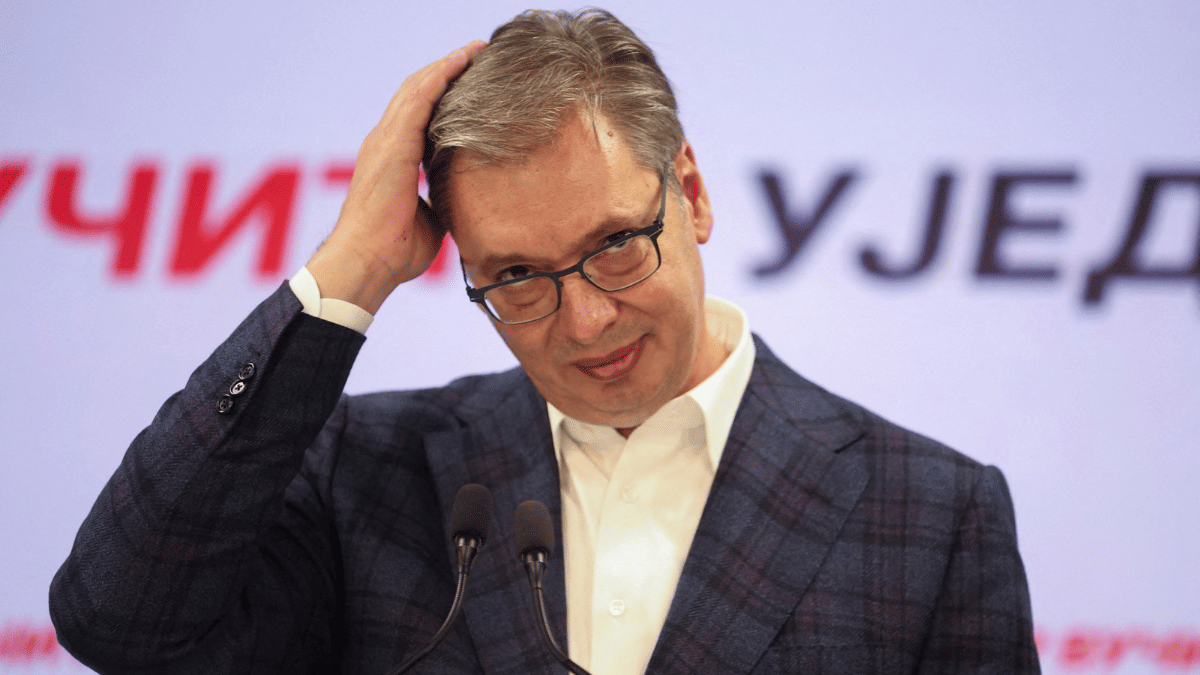
The victory marked a reversal for Vučić, an ultranationalist who cultivated an image as a pragmatic leader balancing ties with the European Union, Russia, China, and Israel. Born in Belgrade in 1970, Vučić entered politics in 1993 with Vojislav Šešelj’s far right Serbian Radical Party (SRS) and drew condemnation for his infamous 1995 parliamentary outburst to kill 100 Muslims for every Serb killed, nine days after the Srebrenica genocide.
In 2008, he left SRS over the party’s support for Serbia’s EU membership and co-founded SNS, a centre to far right party which later emerged as Serbia’s largest party in 2012. Vučić went on to consolidate a dominant-party system while pursuing EU accession, economic liberalisation and dialogue with Kosovo. The SNS ruled Serbia from 2012 to 2026.
Also Read: Brazil nips Latin America’s Trump tide with dramatic win for Lula: ‘Nobody’s backyard’
Will Serbia now be part of EU?
The student movement’s programme offers little clarity on its international priorities, while its statements suggest it could maintain the outgoing government’s positions on two contentious issues.
In a May 2026 memorandum, the movement described Kosovo as an “inalienable and integral part of Serbia” and a component of Serbian national identity, advocating a settlement within Serbia’s constitutional framework. In September, it opposed sanctions on Russia, which the outgoing government has also refused to support. Whether these positions would carry over into government remains unclear.
Public opinion among supporters of the student-backed list also suggests an appetite for closer European ties: 75 percent favour stronger relations with the EU, compared with just 10 percent who prefer closer relations with Russia.
Serbia applied for European Union membership in December 2009, received candidate status in March 2012 and formally began accession negotiations in January 2014. Accession progress has remained slow amid EU concerns over the rule of law, press freedom, Serbia’s limited alignment with the bloc’s foreign policy and sanctions against Russia, and the unresolved status of Kosovo.
The Kosovo-Serbia conflict is a political and territorial dispute rooted in ethnic tensions between Albanians and Serbs. The conflict escalated into the 1998–1999 Kosovo War and remains unresolved, with Serbia continuing to refuse recognition of Kosovo’s independence.
EU leaders Ursula von der Leyen and António Costa however welcomed the outcome, voicing hope for a reset in relations with Serbia, despite the student movement’s unclear position on European integration.
The election was also watched internationally as part of 10 pivotal days of voting around the world, in which right-wing forces face off against pro-democracy movements. The student-led victory in Serbia is expected to reverberate across Europe, adding momentum to youth and student protests that have shaken governments across the continent.
I have just spoken by phone with the leaders of the Students' List @studentblokade, who won the elections in Serbia, to congratulate them on their victory. I assured them of Hungary’s support. I was delighted to hear how much strength our victory in April had given them during…
— Magyar Péter (Ne féljetek) (@magyarpeterMP) October 25, 2026
Hungarian Prime Minister Péter Magyar was the first EU national leader to congratulate the victors, comparing their success with his own win over Viktor Orbán earlier this year. “I was delighted to hear how much strength our victory in April had given them during this difficult struggle,” he added on X.
A tragedy that became a national movement
In Serbia, what began as weekly student demonstrations after the 2024 tragedy grew into a movement demanding justice on university campuses and city streets and soon spread into communities. Farmers, actors, judges and other groups joined the protests, turning a student campaign into a broader challenge to the government.
In January 2025, Prime Minister Miloš Vučević resigned, saying the move was intended to “defuse tensions”. Two months later, Belgrade witnessed what was described as Serbia’s largest-ever anti-government protest.
As the movement grew, students organised themselves through assemblies, or plenums, rather than relying on a conventional leadership structure. The decentralised approach allowed the campaign to expand while maintaining its identity as a movement driven by students and ordinary citizens rather than established political figures.
By the time Vučić announced snap elections in September, the protesters had begun converting their public momentum into an organised electoral campaign. They staged rallies, visited rural areas that had long been Vučić strongholds and went door-to-door, presenting themselves as anti-establishment candidates. Their slogan was blunt: “Serbia or Mafia?”
Initially, Vučić sought to describe the protesters as “well-intentioned.” Ahead of the election, however, he accused them of trying to “bring down” Serbia. Even after conceding defeat Sunday night, the 56-year-old alleged that the movement had the backing of unnamed “European countries and the American deep state”.
Also Read:France to Italy, cost-of-living protests rock EU: Stores looted, 140-year-old landmark set on fire
What is Student List’s programme?
The elected members of parliament will be responsible for delivering what amounts to the movement’s manifesto. The students have said they were looking for people who could enter public institutions and “do their jobs responsibly and not forget why they are there”.
Under an 11-point programme, the student movement wants to eradicate corruption by establishing a police unit to arrest those responsible for it, purge the internal affairs ministry of officials who broke rules while cracking down on protesters or who have links to organised crime, reform Serbia’s media landscape and free the public broadcaster from political control, and end political patronage in public enterprises by stopping the recruitment of party loyalists.
Although the students themselves have not been elected, they are the ones who made promises to the Serbian people. They will, therefore, face pressure to ensure that the parliamentary representatives they selected follow through on the movement’s manifesto.
For his part, Vučić has shown little sign of accepting the movement’s victory as the end of his political struggle. In the speech to party supporters on Sunday evening, he said the students had destroyed two years of life in Serbia and would be defeated “faster by a campaign demanding accountability for a tragedy to a national political force challenging the government itself”.
Who will run Serbia now?
The students’ victory has created a new political challenge: identifying who will govern the country. According to reports, it will not be the students themselves, because they did not stand for election. The movement appears to have judged that voters might be reluctant to support a parliamentary list made up of candidates with little life experience.
Although Ilija Srdanović, a cardiology professor in Novi Sad, topped the Student List, he is not widely regarded as the most likely candidate for prime minister. At least 135 people on the list are thought to have won seats in parliament. They include former basketball star Dejan Bodiroga, who was 24th on the list; renowned actor Tihomir Stanić, who was eighth; opera singer Nikola Mikić, who was 46th; and Dejan Šoškić, the former governor of the National Bank of Serbia, who was 27th. The list also includes a substantial number of professors.
Šoškić’s name has been mentioned in connection with the top government post. He has spoken about economic reforms he would pursue and has faced extensive criticism in pro-government media.
The absence of a clearly established leadership could also complicate the transition from protest to government. A movement that drew strength from its decentralised structure will now have to make decisions, negotiate political differences and manage institutions.
The Russia pivot
Vučić’s political defeat also carries implications for Serbia’s foreign relationships. He campaigned aggressively through round-the-clock coverage on pro-government media, attacking his opponents as ‘foreign mercenaries’. He contrasted their campaign with his own plans to build prosperity through new roads and hospitals.
In the process, he moved away from the pro-EU positioning that had helped his populist party come to power in 2012, repeatedly boasting of the support of Russian President Vladimir Putin.
Speaking to the state broadcaster RTS during the campaign, Vučić claimed Putin understood that there would be no sanctions against Russia only if the populists won. “It is no coincidence that Vladimir Putin said he hopes that I will be the prime minister.”
His relationship with Moscow has been a prominent feature of his political positioning. In September, Vučić defied the EU by allowing what it describes as a hero’s funeral in Belgrade for Ratko Mladić, the former Bosnian Serb army commander convicted of genocide by a UN court.
Vučić has also enjoyed strong support from China’s President Xi Jinping. The two leaders have described their relationship as an “ironclad friendship.”
Xi has consistently backed Vučić politically, sending high-profile congratulations following his re-election victories and expressing support for Serbia’s national sovereignty. In May, during Vučić’s state visit to Beijing, Xi personally awarded him China’s Friendship Medal, the country’s highest state honour for foreign nationals.
(Edited by Tony Rai)