



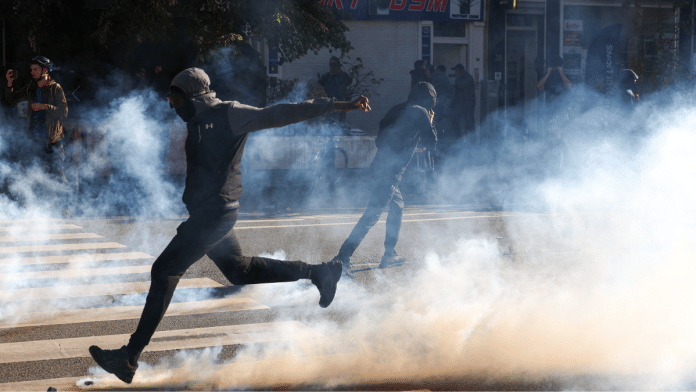
New Delhi: The streets of several European Union countries saw clashes between security forces and protesters Saturday as thousands took part in separate, uncoordinated demonstrations against the rising cost of living in France, Italy, Belgium and Portugal. In France, where 1,200 people were arrested, the unrest involved clashes, looting, fires and damage to public buildings and businesses. French Prime Minister Sébastien Lecornu condemned the “violence of extreme intensity”.
The demonstrations come at a politically consequential moment for Europe, amid an unprecedented super-cycle of national elections over the next 12 months, with polls scheduled in Spain, France, Italy and Poland.
France sees most turbulent protests in decades
France experienced one of its most turbulent days of protests in decades, with more than 550,000 people joining demonstrations, according to its Interior Ministry. Police confronted protesters across the country as some gatherings descended into clashes, looting and arson.
Prime Minister Lecornu said 1,200 people had been arrested and 150 police officers injured, according to French newspaper Le Monde. Dozens of shops, including those of the country’s famous fashion brands like Louis Vuitton and Hermès, were looted in Paris, Marseille, Nice, Nantes, Bordeaux, Limoges, Lille, Toulouse and Strasbourg, AFP reported. Paris Mayor Emmanuel Grégoire said entire streets in the capital “have been devastated”.
In Limoges, a fire set by masked protesters largely destroyed the town hall, a building more than 140 years old. City halls in Marseille and Lille were broken into and vandalised, while protesters in Lyon set fire to the city’s tourist office.
As the protests, which began last month, escalated into widespread violence, President Emmanuel Macron said those responsible for attacking public buildings and businesses and for looting would be “prosecuted and punished”.
Aucune place pour la violence dans notre République.
Ceux qui ont cassé, attaqué les préfectures comme les commerces, pillé jusqu’à nos mairies, seront poursuivis et punis.
Aux forces de l’ordre, garantes du droit à manifester, je dis le soutien de la Nation.
Nous ferons tous…
— Emmanuel Macron (@EmmanuelMacron) October 17, 2026
“No room for violence in our Republic. Those who have broken, attacked the prefectures as well as businesses, looted even our town halls, will be prosecuted and punished… We will all stand united against the sowers of chaos, who seek only to bring down our institutions and prevent those who peacefully express their demands from doing so,” he wrote on X.
Meloni asks Opposition to condemn violence
In Italy, rioters clashed with police, looted stores and set property on fire in central Milan Saturday. The march, organised around opposition to wars and rising living costs, began peacefully. However, masked protesters later threw stones, paving blocks and other objects at riot police and set fire to barricades made from bar tables, according to local reports.
Police deployed water cannons and tear gas to disperse the crowds. At least two police personnel were injured, and about 50 demonstrators, many of them minors, detained, according to Italian news agency LaPresse.
Responding to the protests, Italian Prime Minister Giorgia Meloni wrote on X, “Demonstrating is a right. Setting our cities ablaze is not.” While acknowledging the role of protests in a healthy democracy, she blamed “hooligans who exploit demonstrations to sow chaos, attack those responsible for ensuring security and hold entire cities hostage”.
Ho grande rispetto per le migliaia di persone che oggi hanno manifestato pacificamente, anche partecipando alla mobilitazione indetta dalla CGIL che ha visto anche la partecipazione dei leader della sinistra. Qualunque siano le idee per le quali si manifesta, la partecipazione è… pic.twitter.com/nZn0emcGrq
— Giorgia Meloni (@GiorgiaMeloni) October 17, 2026
Meloni also urged Opposition parties to unequivocally condemn the violence and call for peaceful demonstrations.
Milan’s centre-left mayor, Giuseppe Sala, acknowledged the grievances behind the protests while condemning the violence. “The reasons for the protests were understandable. The violence against law enforcement and serious damage to the city are not justifiable,” he said.
In Brussels, Belgium, police fired tear gas and deployed water cannons as hundreds took to the streets, and allegedly threw projectiles at officers and set fires. The demonstrations followed weeks of student protests over high university registration fees, adding education-related grievances to wider discontent over living costs.
In Lisbon, Portugal, thousands marched Saturday against the rising cost of living, low wages and the growing difficulty of securing housing in major cities. The march followed days of build-up.
Portugal’s Parliamentary Affairs Minister Carlos Abreu Amorim said the government would not give in to the demonstrations. “The government will not yield to shouts from the street,” he was quoted as saying on Friday.
How France became centre of protests
The protests in France began last month at high schools in the suburbs of Paris over teacher shortages and inadequate facilities. They spread to other parts of Paris and then nationwide, growing into a broader agitation over the high cost of living.
The protests have also attracted international attention. Earlier this month, US President Donald Trump blamed the unrest on Islam and migration. “What’s happening in France is nothing less than out-of-control mass migration,” Trump wrote on Truth Social, adding, “This isn’t about schools, this is about Islam wanting to take over a once great country!”
Saturday’s protests also echoed the 2018 “yellow vest” movement against the Macron government over rising fuel prices and the cost of living. AP reported that protesters across France responded to calls on social media to revive the movement, with many wearing the fluorescent yellow vests that became a symbol of the 2018 rallies.
(Edited by Chingkheinganbi Mayengbam)