





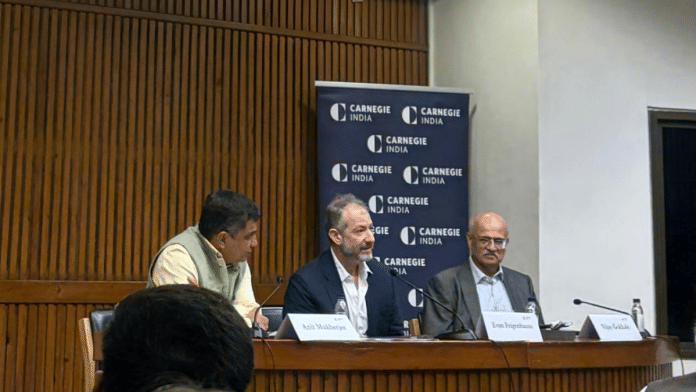

New Delhi: The Quad has gradually lost both its focus and its strategic relevance, former foreign secretary Vijay Gokhale has said.
He made the remarks during a conversation with former State Department official Evan Feigenbaum in New Delhi Wednesday on the geopolitical churn in Asia and whether the region is undergoing a paradigm shift in strategic relations.
“I think in the way the Quad has evolved, I think it has lost focus, and therefore it has lost meaning,” Gokhale said. “With President Trump, it has lost even more meaning because President Trump has narrowed the focus to the Western Pacific rather than the Indo-Pacific.”
The Quad, he said, was meant to become the nucleus of a rules-based order in the Indo-Pacific but had instead expanded into a range of non-security challenges and issues, diluting its original purpose.
“The four-nation grouping should either be reconsidered or supplemented by alternative arrangements and mechanisms,” Gokhale said.
He however added that the shift in the Quad’s purpose predates President Donald Trump but has become more pronounced under his administration.
Despite the changes in Washington, Gokhale said the United States remained India’s best bet in a changing world order because the United States and China were the two largest economies and were far ahead of other countries in the technology race.
But he argued that New Delhi’s approach to Washington needed to become more realistic and less “starry-eyed”.
“As Washington rebalances its priorities, the Indian Ocean region has gone way down in the list,” Gokhale said. “However, US and China are still the most consequential relationship for India because they are far ahead of everybody else in the technology race.”
He argued that technology would be central to India’s ambition of becoming the world’s third-largest economy and that China was unlikely to help India achieve that goal.
“If we are to become, as we claim, the third largest economy in the world, it’s going to happen because of technology,” he said. “And there are only two countries which are going to be able to help you. One (China) is certainly not going to help you. And it’s making it very, very evident. The United States still is our best bet.”
“Therefore, we have to have a more realistic relationship with them. Stop being starry-eyed about it. Understand that it is a give-and-take relationship. But we must also take and not just give,” he added.
Gokhale also said he did not believe Washington would deliberately hand China a sphere of influence in South Asia. But he warned that a reduced American presence could create space for Beijing to expand its influence.
He recalled that after India’s nuclear tests in 1998, the United States had invited China to play a greater role in South Asia on nuclear and missile issues.
“Outsourcing the region to Beijing,” he said, “has been done in the past.”
Gokhale also identified two developments that could reshape the regional balance. One was the possibility that a peace settlement around the Strait of Hormuz could lead the United States, Iran or Gulf allies to invite a Chinese naval presence to help keep strategic chokepoints such as Hormuz and the Bab-el-Mandeb open. Such a move, he said, could give China’s navy a foothold and greater legitimacy in the Indian Ocean.
The other, more distant possibility was that Washington could eventually seek to bring China into negotiations on nuclear arms.
Gokhale said Beijing was unlikely to entertain such talks until it had completed much of the planned expansion of its nuclear arsenal, potentially around 2030, and that any negotiations could come with pressure on India to limit its own programme.
Both speakers agreed that US-China relations in Asia had suffered a setback, but said neither side appeared willing to address the underlying problems.
“In India, trust in the US is probably down to what it was in 1998 and moving rapidly towards what it was in 1971,” Gokhale said.
Feigenbaum agreed, arguing that Washington had allowed its strategic competition with China to shape nearly every relationship and initiative in Asia.
“Instead of trying to get China right by getting Asia right, the United States is making every policy relationship and initiative in this part of the world derivative of its own obsession with security balancing and strategic competition with China,” Feigenbaum said. “It reduces countries in the region to being proxies in the American competition with China.”
Where Gokhale framed the crisis as one of mutual disengagement, Feigenbaum located the deeper problem in Washington’s strategic culture. The shift underway in Asia, he said, was real, but the American foreign policy establishment had failed to adjust to the region as it actually exists rather than to the region imagined by US planners.
For most countries in Asia, he said, “The mathematical operations that matter are addition and multiplication, not subtraction and division,” while Washington continued to tell them not to accept Chinese money or technology. Demanding that without offering an alternative, he said, amounted to “whining” not competing.
“The United States is long on attitude, short on strategy,” he added.
Feigenbaum also noted that the United States sits outside the region’s three major trade pacts—the CPTPP, RCEP and the Digital Economy Partnership Agreement. India is also outside all three, undercutting the idea that the two countries form the core of a functioning Indo-Pacific.
“So for all the American talk about an Indo-Pacific, the largest economy in Indo and the largest economy across the Pacific are both missing in action,” he said. “And if you ain’t got no Indo and you ain’t got no Pacific, basically you’re back to the centrality of Asia.”
Gokhale agreed, arguing that India’s decision to walk away from the Regional Comprehensive Economic Partnership after seven years at the negotiating table “is going to cost India heavily,” particularly because any future attempt to re-enter would mean negotiating on China’s terms.
Feigenbaum also rejected the idea that Asia’s future should be viewed solely through the prism of US-China competition.
“The challenge the United States is facing is that it’s in a region that is extremely dynamic, multidimensional, multifaceted, and to be blunt about it, increasingly multipolar,” he said. “But it acts like the United States is still the alpha and omega of everybody’s approach to the region.”
(Edited by Viny Mishra)
Also read: The Quad is fading. India must now confront the limits of strategic ambiguity