



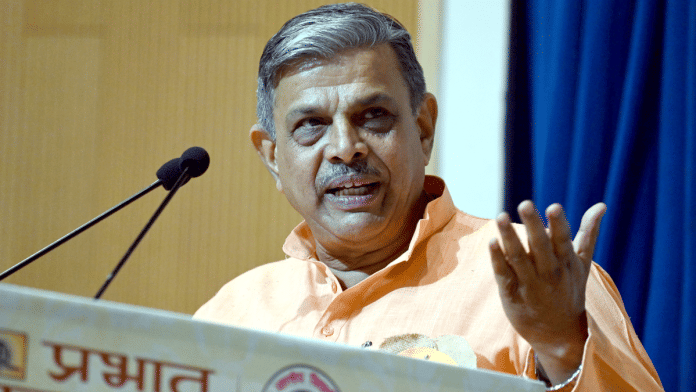

New Delhi: The Pakistan Foreign Office Thursday welcomed senior RSS functionary Dattatreya Hosabale’s remarks advocating dialogue with Islamabad, calling them “a positive development” and expressing hope that “sanity will prevail in India”.
In an interview with news agency PTI on 12 May, Rashtriya Swayamsevak Sangh General Secretary Hosabale said India should keep channels of communication open with Pakistan without compromising on “security and self-respect”.
Reacting to the statement, Pakistan Foreign Ministry spokesperson Tahir Andrabi told a press briefing in Islamabad Thursday that “the voices within India calling for dialogue are obviously a positive development”.
“We hope sanity will prevail in India. And the warmongering, the belligerence that emanates, that has been emanating for the past several months and even beyond, for the past year or more, will fade away and pave the way for more such voices to come up,” he said.
“We, of course, will do an official reaction to those voices, an official reaction within India. And about track two or back channel, well, I’m not aware of that. I do not wish to comment on those. And if I was to comment on it, there would be no back channel. The back channel or track two, I mean, the name is self-explanatory,” he added.
While official diplomatic engagement between India and Pakistan remains frozen since Operation Sindoor, retired generals, former diplomats and influential political voices in both countries have begun publicly advocating renewed dialogue.
An Indian Express report earlier revealed that in recent months, former Indian military and intelligence officials met their Pakistan counterparts in at least two unofficial gatherings, including one in Qatar and another in an undisclosed Asian capital.
The meetings were not formal negotiations, the participants said, but they represented the first known sustained contact between the two sides since Operation Sindoor.
The conversations come amid mounting concern within Indian security circles about the lack of crisis-management mechanisms between New Delhi and Islamabad. During the Pahalgam attack and the subsequent military confrontation, officials said, the only functioning channel between the two countries was the hotline connecting their Directors General of Military Operations, who now speak weekly.
India publicly maintains that “terror and talks cannot go together,” a longstanding position hardened after incidents such as the 2008 Mumbai terror attack and the 2019 Pulwama attack.
Yet, officials familiar with internal deliberations say, there is increasing acknowledgment that some form of back-channel communication may be necessary to prevent future escalations from spiraling uncontrollably.
The idea of renewed engagement has also begun surfacing in public statements from influential Indian figures, including voices closely associated with the ruling establishment, including Hosabale. His remarks were notable because the RSS has long been associated with a hard-line posturing toward Pakistan.
Former Indian Army chief Gen Manoj Naravane Thursday endorsed Hosabale’s comments, stressing on the importance of “people-to-people connections” and track-II diplomacy.
“Ordinary people live on both sides of the border, and common people everywhere have the same concerns,” Naravane said in a PTI interview. “When friendship develops between the people of two countries, it naturally helps improve relations between the countries themselves.”
At the same time, Naravane reiterated that India would continue to respond militarily if necessary, pointing to the dual-track thinking now emerging in parts of the Indian establishment: deterrence coupled with controlled engagement.
(Edited by Ajeet Tiwari)
Send terrorists then ask for sanity. Anyone who knows has basic knowledge of the geography should understand the only reason Pakistan exists is to keep India occupied with them. Anyone who is stupid enough to talk about peace with India will get slimed like Beinazir. Talks with them are pointless and will not go anywhere