






New Delhi: A year after India launched Operation Sindoor, Pakistan increased its defence budget by 18 percent, with military expenditure now accounting for 16 percent of the country’s total federal spending.
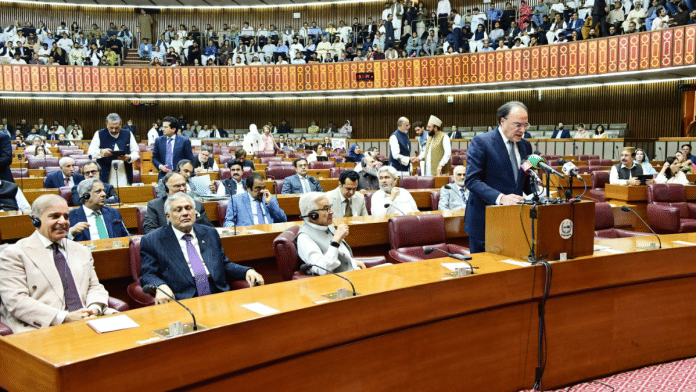
On Friday, the Shehbaz Sharif government unveiled a PKR 18.77 trillion (INR 6.46 trillion) budget for fiscal year 2026, with defence spending rising from last year’s PKR 2.55 trillion to PKR 3 trillion (INR 1.03 trillion).It is the first time that defence spending crossed the PKR 3 trillion-mark
Finance Minister Mohammad Aurangzab said the country’s defence sector had become a source of foreign exchange earnings.
“It is proof that strong defence is not just important for the country’s sovereignty but could also contribute to economic progress,” he told the National Assembly, presenting a budget delayed by almost a week.
The budget is usually tabled 5 June, while the fiscal year runs from 1 July to 30 June.
“This defence capability has reshaped our strategic partnerships not just in the region but in the world,” Aurangzeb added, referring to the defence pact signed between Pakistan and Saudi Arabia last year.
Pakistan had “complete support” from China in these efforts, he said. “Pak-China relations are an important part of our foreign policy. China is Pakistan’s most important trading partner.”
At the same time, the budget spotlighted Pakistan’s persistent fiscal strain. Debt servicing has crossed PKR 8 trillion (INR 2.75 trillion), meaning that for every PKR 100 (INR 34.4) collected by the Federal Board of Revenue, roughly PKR 70 (INR 24.09) goes to interest payments before spending reaches sectors such as health or education.
Pakistan’s current expenditure was estimated at PKR 17,495 bn (INR 6,020.94 crore)
As the country faces renewed inflationary pressure amid the West Asia war, the budget targets economic growth of 4.0 percent and inflation of 8.2 percent for the coming fiscal year, compared with 3.7 percent projected growth in fiscal year 2026 and 6.7 percent average inflation in the July–May period of the outgoing year.
Islamabad is also seeking to keep a $7 billion IMF programme on track after narrowly avoiding default in 2023. Pakistan has agreed to target a primary budget surplus of 2 percent of GDP, excluding debt-service payments, for the coming fiscal year. That requirement means the government must collect more than it spends before interest payments, leaving limited space for tax cuts or new welfare measures.
(Edited by Tony Rai)