





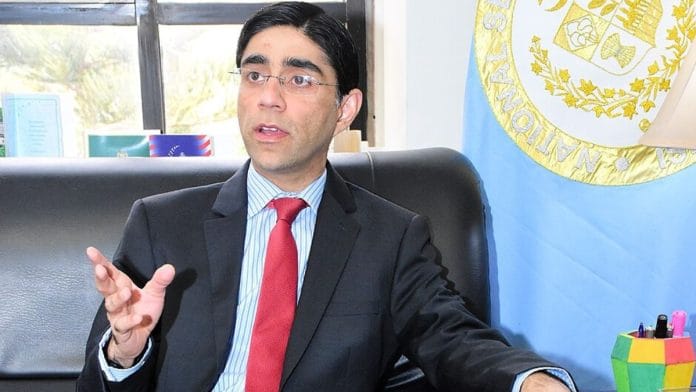


New Delhi: Pakistan should normalise ties with India in order to secure multi-alignment, regional connectivity and be a stronger middle power ally in Asia, Pakistan’s former National Security Adviser (NSA) Moeed Yusuf has said.
In a paper titled In the Eye of the Storm: Pakistan’s Balancing Act in the Evolving Geopolitical Order, Yusuf, who held office in 2022 and was Pakistan’s youngest NSA ever, argues that while Pakistan has “tremendous potential as a regional connector for trade, transit, and energy between South, Central, and West Asia, progress remains stalled due to a lack of regional integration”.
“The key to resolving Pakistan’s regional dilemma—and opening the most promising window for positive economic interdependence—lies in rectifying its most broken relationship: India,” he says.
Yusuf then adds: “A breakthrough would not only benefit the entire South Asian region but also align with broader US and Chinese strategic interests, potentially creating opportunities for collaboration between the two great powers.”
Also Read: Indus Waters Treaty in abeyance, India rejects latest arbitration award as ‘null & void’
Where Pakistan’s foreign policy goes wrong
For decades, Pakistan’s foreign policy has been defined by a singular strategic objective: managing its rivalry with India. Now, according to Yusuf, that objective is proving to be the country’s biggest hindrance towards economic revival, regional influence and geopolitical relevance.
In essence, Yusuf says Pakistan’s future depends less on Washington or Beijing and more on the possibility of a different relationship with New Delhi. The argument presents one of the most explicit cases made by a senior former Pakistani official on why normalisation with India is a strategic necessity for Pakistan.
The former NSA argues that Islamabad’s ambitions to become a regional trade, transit and energy hub cannot be realised without a fundamental improvement in ties with India, because while Pakistan has spent years cultivating strategic relationships with China, the US and key Gulf states, “the key to unlocking Pakistan’s true potential as a middle power is its relationship with its archrival, India”.
A case for regional integration
For Yusuf, geography offers Pakistan a historic opportunity. The country sits at the intersection of South, Central Asia and West Asia. But geography alone is not enough. Pakistan’s neighbours are either isolated or estranged: Iran faces sanctions, Afghanistan remains unstable, and relations with India have collapsed.
“To realise the connectivity vision, the region requires functional north-south (China-Pakistan) and east-west (India, Pakistan, Iran, Afghanistan, and Central Asia) axes to operate in tandem,” he points out.
The north-south corridor already exists in some form through the China-Pakistan Economic Corridor, or CPEC, Beijing’s flagship investment project linking western China to Pakistan’s Arabian Sea coast. The missing component, Yusuf argues, is the east-west axis that would connect India to Pakistan and onward to Afghanistan, Iran and Central Asia.
Without it, Pakistan’s ambitions remain constrained.
“A turnaround in this relationship (India-Pakistan) is necessary to optimise any connectivity corridor in South Asia; without an east-west axis, the Chinese-led north-south corridor remains limited in reach,” Yusuf writes.
The argument marks a departure from the traditional Pakistani security paradigm. The country’s 2022 National Security Policy, which Yusuf helped shape, too had earlier shifted away from defining national security primarily through military competition with India. Instead, it embraced what the document calls ‘Comprehensive National Security’, with economic security at its centre. Under that framework, geo-economics became the strategic principle of foreign policy.
The logic is simple: Pakistan’s economy remains deeply dependent on external support. The country relies on China for investment, the United States for exports and influence within international financial institutions, and Gulf states for remittances, loans and energy support. Yet despite these relationships, Pakistan remains trapped in recurring economic crises.
“Pakistan’s assistance-based approach suffers from a fundamental flaw,” Yusuf argues. Rather than using periods of geopolitical importance to build a sustainable economy, successive governments relied on external patronage. The result has been repeated boom-and-bust cycles and chronic dependence on foreign assistance.
Regional integration, he argues, offers a way out.
South Asia remains among the least integrated regions in the world. Intra-regional trade accounts for only about 5 per cent of total trade, compared with roughly 25 per cent within the Association of Southeast Asian Nations. Trade among South Asian countries remains far below its estimated potential.
“Pakistan’s dilemma within the evolving global order is clear. The country’s economy is too intertwined with and heavily dependent on both great power camps. With South Asia becoming increasingly entangled in great power contestation, the nature of Pakistan’s external relationships — combined with its internal vulnerabilities — makes a business-as-usual approach to the region’s evolving geopolitical dynamics untenable,” he adds.
Yusuf places much of the blame on the enduring hostility between India and Pakistan. “This stagnation is due to trade barriers, limited infrastructure, and, most importantly, perennial animosity between the two largest countries, India and Pakistan,” he claims.
The economic costs extend beyond trade. Pakistan’s vision centres on becoming a bridge between energy-rich Central Asia and energy-hungry South Asia. Proposed transportation links, rail corridors and energy projects would run through Pakistan, connecting Central Asia to global markets and South Asian consumers.
Yet he adds that the full potential of those projects remains unrealised because India and Pakistan remain estranged. “While India and Pakistan’s differences still prevent a truly synergetic amalgamation between CPEC and the east-west corridor — a union that could transform the South Asian region — this connectivity network remains viable even without India’s participation,” Yusuf writes.
India-Pak alignment can be a win-win
Still, he makes clear that India’s inclusion would dramatically expand the possibilities. “Including India could be a gamechanger, helping to mitigate some of the differences between India and Pakistan and unlocking other avenues for cooperation across South, Central, and West Asia,” he then adds.
Such cooperation could, he points out, even extend beyond commerce. Yusuf points to energy initiatives such as the long-stalled Iran-Pakistan pipeline, originally conceived as a tripartite project involving India. He also highlights broader opportunities for regional energy interdependence, noting that India’s rapidly growing economy will require vast new energy supplies in the years ahead.
“From a development perspective, these energy projects could create a win-win scenario for Pakistan and its neighbors by bolstering energy security, fostering economic interdependence, and providing mutual economic benefits,” he says.
Climate change presents another opening. “Smog presents a unique opportunity for collaboration between these two adversaries,” he writes, particularly between the Punjab provinces of Indian and Pakistan. Joint research, data-sharing and coordinated responses could address common environmental threats while building trust.
He also sees room for cooperation on climate justice, pointing out that India and Pakistan have earlier found common ground on issues surrounding the Loss and Damage Fund, adding that this proves that limited alignment remains possible even amid broader tensions.
Yet Yusuf acknowledges that the political environment is moving in the opposite direction. Recent military confrontations like Operation Sindoor have only hardened attitudes on both sides.
He calls the May 2025 skirmish, triggered by a terrorist attack in Kashmir, followed by Operation Sindoor a “watershed moment” because no dialogue is any longer possible.
The stakes extend beyond Pakistan itself. Yusuf argues that improved India-Pakistan relations would align with both American and Chinese interests. Washington would benefit from greater regional stability and economic integration. Beijing would gain from expanded connectivity linked to the CPEC. Pakistan, meanwhile, could avoid being forced to choose between the world’s two competing superpowers.
“For Pakistan, success lies in ensuring that the United States, China, and India all see the benefits of allowing north-south and east-west connectivity corridors to operate in tandem,” he writes.
The alternative, he warns, is a region that remains locked by rivalry. “Both lose out,” Yusuf concludes of India and Pakistan. “But for Pakistan, the regional and global consequences may become truly unsustainable.”
For now, he concedes, a breakthrough appears distant. “Arguably the most challenging aspect of Pakistan’s diplomacy remains its relationship with India,” he writes. “While a significant breakthrough seems unlikely for the foreseeable future, these two countries have created openings at equally improbable moments in the past.”
(Edited by Nardeep Singh Dahiya)
Also Read: Khawaja Asif urges people to ‘own’ their Hindu identity. Pakistanis are amused
You The Print stop advocating for Pakistan the dreaded Terrorists country. Let them have their own asking death
The Pakistani government should execute Imran Niazi now.
Return PoK. And then we can talk about normalizing relations.