



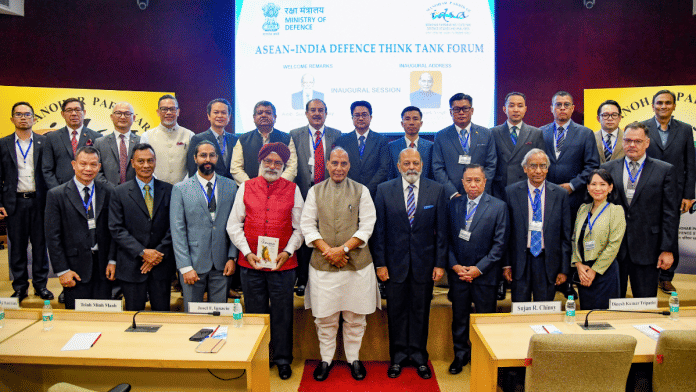
New Delhi: India Wednesday pitched for strong defence cooperation with ASEAN countries, underlining the need to build trust, respect each other’s sovereignty, follow international law and keep channels of dialogue open to tackle borderless challenges.
Defence Minister Rajnath Singh said that strengthening maritime domain awareness, interoperability and underwater cooperation is key to a stable, rule-based maritime order.
Speaking at the first meeting of the Association of Southeast Asian Nations (ASEAN)-India Defence Think Tank Forum at the Manohar Parrikar Institute for Defence Studies and Analyses (MP-IDSA), Singh said India is willling to cooperate with ASEAN partners in areas such as patrol vessels, radars, air-defence systems, helicopters, drones and other technologies, according to each country’s needs and priorities.
“India seeks an Indo-Pacific where all countries—large and small—make their own choices, protect their interests and pursue development in peace,” he said.
The Minister of Defence emphasised the need to discuss differences early and peacefully, before they become disputes, and pitched for a regional order where countries work together without being forced to choose sides.
“India believes that security is strengthened when countries build capacity together, respect international law and maintain trust through dialogue,” he said.
ASEAN is an intergovernmental forum of all 11 states in Southeast Asia. On 15 December 2008, member states met in Jakarta to launch the charter signed in November 2007, to move closer to “an EU-style community”. However, the aim has not been achieved yet due to multiple issues.
He said the bloc can turn shared interest into practical action. “We should improve the sharing of maritime information, strengthen cooperation among our navies and coast guards, and build the ability to respond together to emergencies. We should also work against piracy, trafficking, illegal fishing and other threats, in accordance with international law,” he said.
Singh called for joint research projects, shared testing opportunities, exchanges among young researchers and carefully designed innovation challenges, emphasising that such cooperation must also protect sensitive information, respect intellectual property and ensure that technology is shared responsibly.
“The aim should be to develop useful capabilities while strengthening trust between our countries,” he said.
He said the ‘Aatmanirbhar Bharat’ initiative focuses on building stronger domestic capabilities, but self-reliance does not mean working in isolation. It can create opportunities for trusted partners to design, build, maintain and improve equipment together, he said.
Underlining the importance of co-development, co-production, maintenance, repair and overhaul, training and long-term technical support, Singh said these arrangements can build local skills, support industry and make supply chains more reliable.
“Our researchers need to look closely at what makes such partnerships work: Clear requirements, reliable after-sales support, appropriate technology safeguards, fair sharing of responsibilities and benefits, and opportunities for local companies and skilled workers. Our goal should be lasting partnerships, not one-time transactions,” Rajnath Singh said.
(Edited by Viny Mishra)
Also read: India signs Rs 1,943-cr pact to lease two MQ-9B Sea Guardians, creating overlap with existing fleet