





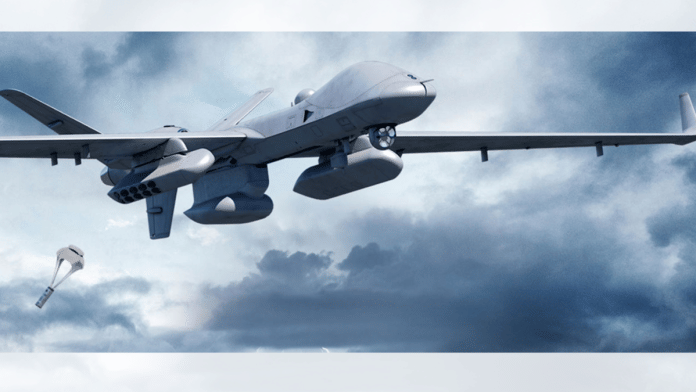

New Delhi: India signed a Rs 1,943-crore deal with General Atomics Aeronautical Systems Monday to lease two MQ-9B Sea Guardian High-Altitude Long-Endurance (HALE) Remotely Piloted Aircraft Systems (RPAS) for the Navy for a period of 30 months.
This new lease has been signed to ensure there is no gap in the Navy’s long-range surveillance capability. The two new drones will overlap for a few months with the two MQ-9A Sea Guardians currently being operated by the Navy under an earlier lease, sources in the defence and security establishment told ThePrint.
The lease of the existing two drones is due to end in early 2027. The new drones are expected to bridge the gap until deliveries begin of the 31 MQ-9B Sky Guardians and Sea Guardians that India contracted for in October 2024. The first of those 31 drones is expected to be delivered by the end of next year, according to the sources.
The new leased drones are essentially the same configuration as the MQ-9Bs India has ordered, although they will not be equipped with missiles, a source said. “The new ones that are being leased are the same as the ones being bought. Of course, the leased ones will not come with missiles but the ones we bought will.”
The MQ-9B Sea Guardian is a HALE unmanned system designed for over 40 hours of continuous watch and is equipped with advanced sensors and payloads. Its open architecture also allows the integration of systems such as a Sonobuoy Management and Control System (SMCS) and Sonobuoy Dispenser System (SDS), which can be used for anti-submarine warfare (ASW) and tracking submarines operating beneath the surface.
The defence ministry, in a statement, said the RPAs would provide “persistent Intelligence, Surveillance and Reconnaissance coverage over vast areas of the maritime domain”, strengthening India’s ability to monitor and respond to developments across the Indian Ocean Region. The decision to lease the two drones also comes against the backdrop of a long-standing requirement in the Navy for long-range unmanned surveillance platforms.
As China began expanding its naval presence and maritime activity in the Indian Ocean Region, Navy planners had, as early as 2015, identified the need for unmanned platforms that could maintain an almost 24×7 watch over vast stretches of the maritime domain.
The requirement was specifically for HALE-class platforms that could remain airborne for long periods and cover large distances.
At the time, the Defence Research and Development Organisation (DRDO) was working largely on Medium Altitude Long Endurance (MALE) unmanned systems. The Navy, however, wanted a HALE platform for its maritime surveillance requirements.
There were few options available internationally that could meet the requirement.
The US was the obvious choice because of its advanced unmanned systems, which had been extensively used in operations in Iraq, Afghanistan and Syria. But Washington was then reluctant to provide sophisticated unmanned systems to countries that were not treaty allies.
The MQ-9 family had also acquired a formidable reputation because of its use by the US for intelligence, surveillance and strike missions, including operations targeting high-value individuals. At the same time, China was rapidly emerging as the world’s biggest exporter of unmanned aerial vehicles, including armed variants.
But by then the India-US relations were changing. The US designated India a Major Defense Partner in 2016. A year later, under the Donald Trump administration, the US offered India the MQ-9B Sea Guardian for maritime surveillance.
(Edited by Harini T S)
Also read: Nepal confers honorary rank of General on Indian Army chief