





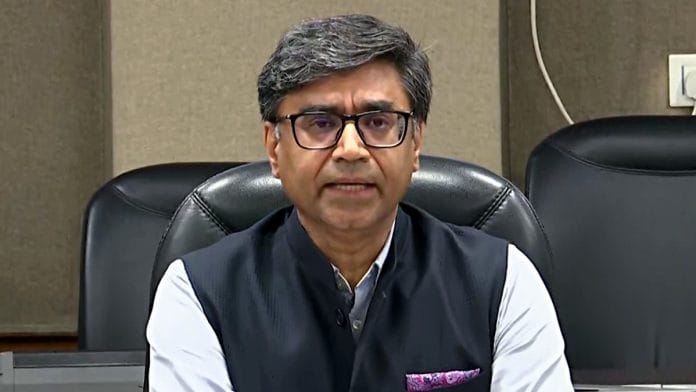


New Delhi: There are no official Track II dialogues between India and Pakistan, Foreign Secretary Vikram Misri said Monday, adding that while numerous such events take place, all those attending do so in their private capacity.
“What I would say is that firstly, look… dozens of these kinds of events take place in dozens of places around the world on a whole variety of subjects. So, there is nothing new, nothing special about these events. Secondly, as far as we are concerned, these are private events organised by private parties. There is nothing official about them as far as we are concerned,” Misri said in response to a reporter’s question in Seychelles.
He added: “I mean obviously, I cannot speak for the government of Pakistan, but as far as the Government of India is concerned, there is no official participation, no official support or involvement in these visits.”
His comments come amid reports that two Track II dialogues were held last week—in Bangkok by a Canada-based organisation, and in Colombo by London-based International Institute for Strategic Studies (IISS).
The Colombo event saw the participation of a number of senior retired officials, including General M.M. Naravane (Retd), former Chief of Army Staff (COAS).
Ram Madhav, senior Bharatiya Janata Party leader and president of the India Foundation, was also present. However, he dismissed the notion that the event was a Track II dialogue, asserting that it was the IISS’ “annual South Asia Dialogue”, which was attended by scholars from India, Sri Lanka, the US, the UK, Afghanistan and Pakistan.
“Even officials attended this annual dialogue in the past. No track 2 is held with so many countries. I did not attend the 2-day dialogue. I was invited to speak at one session which I did and left. Complete spin to a non-story,” Madhav wrote in a post on X Saturday.
Totally wrong portrayal. It was not any track 2 dialogue. It was IISS annual South Asia Dialogue which was attended by scholars from India, Sri Lanka, US, UK, Afghanistan n Pakistan. Even officials attended this annual dialogue in d past. No track 2 is held with so many… https://t.co/fPmrfRel5n
— Ram Madhav (@rammadhav_) June 27, 2026
On the Pakistani side, reports indicate that Sajjad Haider Khan, Director General of SAARC and South Asia in the foreign ministry participated in the talks. Other Pakistanis involved in the talks include Senator Sherry Rehman and Major General Isfandiyar Ali Khan Pataudi (Retd), who has served in the Inter-Services Intelligence (ISI).
Misri said Monday, “It should be obvious, therefore, that anybody from India who is participating in these events—whether it is retired diplomats, retired military officials, members of civil society, who are all distinguished individuals in their own right—that they, when they participate in such events, they speak for themselves and they represent their own point of view. They do not in any way…they cannot in any way represent the view of the Government of India.”
The Foreign Secretary added: “The other important thing to keep in mind… And thirdly, you know, we really take no cognisance of these events. They really don’t hold much value as far as we are concerned.”
These are not the first set of dialogues between India and Pakistan. At least three were held last year after Operation Sindoor, while these two have been scheduled for a while, as reported earlier by ThePrint.
Also Read: Not just a borderline difference: China’s readout on Doval-Wang meet differs from India’s
What is Track II diplomacy?
Track II diplomacy refers to an informal dialogue bringing together academics, religious leaders, retired civil servants and officials, civil society organisations, and sometimes even media personnel. The aim of such dialogues is to build understanding between the two sides, without the requirement of formal government-to-government negotiations—Track I diplomacy.
The term ‘Track II diplomacy’ was coined in the 1980s by Joseph Montville, a former American foreign service official, as he looked at the limitations of formal diplomacy between two countries, especially those that have numerous challenges with one another. Numerous formats of such dialogues have existed between India and Pakistan over the decades.
The process is among the major ways for India and Pakistan to gauge their respective positions in the absence of government-to-government dialogue mechanisms. India has maintained that no official talks can occur between the two countries until Islamabad stops its support for terror outfits.
The two countries were involved in an 87-hour armed conflict last year in May, after India launched Operation Sindoor targeting terrorist complexes across Pakistan. The Track-II dialogues began almost immediately after the conflict, with the first organised discussions held in July 2025. Further dialogue formats are expected to be held later this year.
The format has its importance in the ability to share the Pakistani thinking with government officials, even if said discussions have no government sanction. In the past, findings of certain Track II formats have been shared with Indian national security officials.
In recent years, from Islamabad’s point of view, the discussions have become more military focused, with the kind of representatives coming for its armed services. The dialogues have increasingly focused on conflict management, rather than dispute resolution, especially since Field Marshal Asim Munir assumed the leadership of the Pakistani military.
(Edited by Mannat Chugh)
Also Read: India, East Asia move beyond trade rivalry towards strategic alignment as US-China contest escalates